
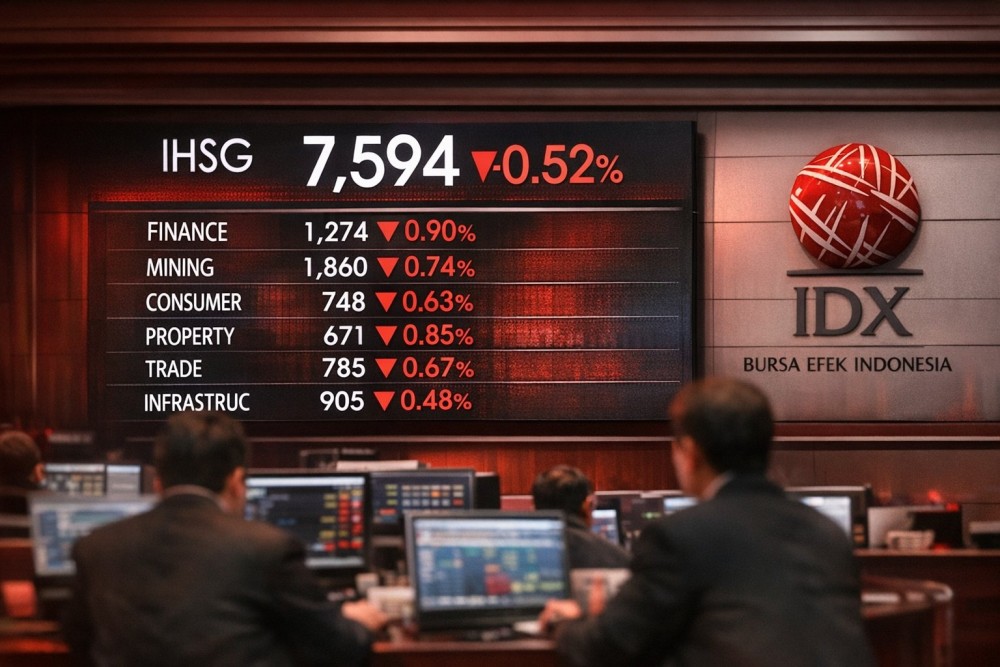
Gotrade News - Indonesia's benchmark Jakarta Composite Index (IHSG) closed 0.52% lower at 7,594 on Monday (Apr 20), shedding 39.89 points in broad-based selling. All trading sectors finished in negative territory without exception.
The decline came despite early-session strength that briefly pushed the index to a daily high of 7,692. The IHSG opened at 7,663 before reversing course in afternoon trading.
Key Takeaways:
- All sectors declined with property leading at -2.04%, followed by energy at -1.34% and technology at -1.29%
- Declining stocks (424) nearly doubled advancers (247) across the board
- Total transaction value reached Rp16.66 trillion with 40.61 billion shares traded
The property sector posted the steepest decline at 2.04%, according to Indonesia Stock Exchange data. PT Pantai Indah Kapuk Dua (PANI) fell 1.96% to Rp8,750 while PT Sentul City (BKSL) dropped 2.54%.
The energy sector lost 1.34% as mining and oil-gas stocks weakened across the board. PT Harum Energy (HRUM) declined 2.40% to Rp1,015 and PT Petrosea (PTRO) fell 2.02% to Rp6,075, according to Katadata.
Technology stocks slid 1.29%, adding to the overall bearish sentiment in the market. The LQ45 blue-chip index also fell 0.40% to 755.85, according to Bloomberg Technoz.
Large-cap LQ45 constituents served as the primary drag on index performance throughout the session. PT Alfamart (AMRT) posted the steepest loss among LQ45 stocks at 4.58%.
PT Surya Citra Media (SCMA) dropped 4.55% and PT Barito Pacific (BRPT) fell 4.04%, per Katadata. PT Unilever Indonesia (UNVR) declined 2.41% while PT Chandra Asri (TPIA) lost 2.02%.
Limited gains emerged in select banking heavyweights amid the broader weakness. PT Bank Central Asia (BBCA) rose 0.78% while PT Bank Rakyat Indonesia (BBRI) edged up 0.29%.
Total transactions reached 2.45 million with trading volume at 40.61 billion shares for the session. Market capitalization stood at Rp13,559 trillion at the close.
Persistent global uncertainty, including the unresolved US-Iran conflict, continued to weigh on domestic market sentiment. Investors remain focused on interest rate policy signals amid ongoing geopolitical tensions.