

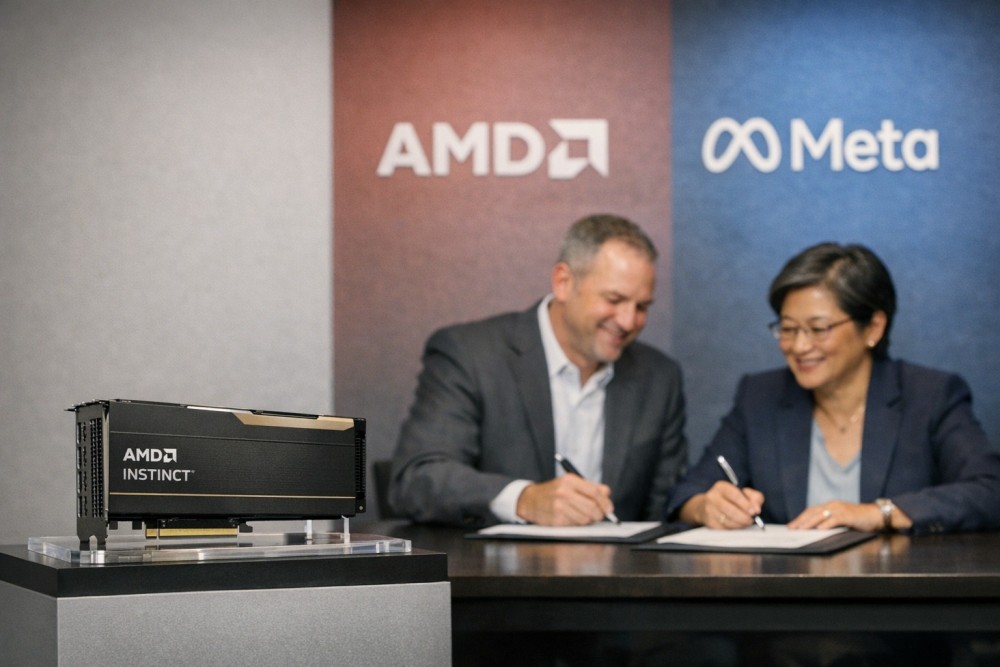
The AMD Meta partnership announced with Q1 FY2026 results is the clearest signal yet that the AI chip race has two credible suppliers. AMD and Meta unveiled up to 6 gigawatts of AMD Instinct GPUs, with the first 1 GW built on the new MI450. Add revenue of $10.3B (+38% YoY) and Data Center revenue of $5.8B (+57% YoY), and every Asia-based investor should rethink sizing across NVDA and AMD.
The stock jumped +15% on the print. The news is clearly bullish. The real question is what you do with your sleeve.
Quick Context: 6GW Instinct Deployment with MI450
According to AMD, the 6 GW agreement spans multiple Instinct generations, with shipments starting in the second half of 2026. The first gigawatt uses the MI450, paired with sixth-generation EPYC CPUs on AMD's Helios rack-scale architecture. Management framed revenue as significant double-digit billions of dollars per gigawatt.
AMD's Q1 Data Center business was $5.8B. A single gigawatt of MI450 can rival that annualized. Read this as a step-change in AMD's AI accelerator opportunity, not another logo win.
Why This Reshapes the AI Chip Race for Your Portfolio
Until now, AI accelerator exposure in most retail portfolios was a single-stock bet on NVDA. The META deal forces a rethink because it validates AMD as a second source at hyperscaler scale, not a niche alternative.
The duopoly thesis is now investable
Sell-side puts the AI accelerator TAM near $500B by 2028. If AMD takes 15-20% share, the math on Data Center changes from optionality to a base case. That justifies a permanent allocation, not just a trading position.
NVIDIA is not dethroned, but the moat looks narrower
NVDA still has the Blackwell ramp and the CUDA software moat as the key counterweight. Hyperscalers will not abandon CUDA. But they have openly told the market they want a second supplier, so future NVDA upside should be priced more carefully.
If your AI exposure is 100% one chip stock, the AMD Meta partnership is the market telling you to diversify before the next earnings cycle.
AMD Holders: Add, Hold, or Trim After the Catalyst
If you bought AMD before earnings, the +15% is the asymmetric payoff you were positioned for. The honest answer for retail investors is hold the core, trim the trade.
Trim the trading sleeve, keep the thesis sleeve
Take 20-30% off to lock in the catalyst gain, then ride the MI450 ramp into second-half 2026. This avoids round-tripping a winner because you refused to take any profit.
Adders: scale in, do not chase
If you do not own AMD yet, do not market-buy a +15% green candle. Build the position over three to four tranches with sizing rules anchored to a clear stop. Our guide on position sizing walks through the framework retail investors should default to.
NVDA Holders: Diversify or Stay Concentrated
If NVDA is more than 15% of your portfolio, trim. Not because the NVDA story is broken, but because single-stock concentration is the most fixable mistake we see in Asia-based retail accounts.
Pair, do not replace
Pair NVDA with a smaller AMD position so your AI sleeve has two legs. Our breakdown in NVIDIA vs TSMC vs Broadcom shows why owning the duopoly plus a foundry is more durable than owning one name.
Stay concentrated only with eyes open
If you stay 100% NVDA, accept that the AMD Meta partnership has shifted the marginal hyperscaler dollar. The thesis still works, but the upside path is no longer uncontested.
Action Plan: Position Sizing for Both AMD and NVDA
Run a portfolio review this week. Calculate AMD plus NVDA as a percentage of your equity exposure, then map it against our earnings super week positioning guide. A reasonable retail target sits in the 8-15% range combined.
Three rules to follow this month
First, no single AI chip name above 10% of your portfolio. Second, treat further AMD pops as a chance to harvest, not to chase. Third, journal every entry with the catalyst you are pricing in.
One rule to break only on purpose
Never average down on AMD or NVDA without a fresh thesis. A drawdown is not a buy signal. Wait for a real catalyst before adding to a losing AI position.
Conclusion
The AMD Meta partnership is the cleanest signal in two years that the AI accelerator market is a real duopoly. According to Yahoo Finance, AMD's guidance lifted with the print, showing management is backing the MI450 ramp publicly.
For your portfolio, the takeaway is not to pick a winner. It is to stop running an undiversified single-stock AI bet. AMD is now investable as a structural position. NVDA is still the leader, but it is no longer the only seat at the table.
Open your Gotrade app and review your AI chip sleeve. Trim, rebalance, or add a second leg before the next earnings cycle reprices it.
FAQ
What is the AMD Meta partnership?
It is a multi-year agreement to deploy up to 6 gigawatts of AMD Instinct GPUs for Meta, starting with a 1 GW MI450 build in second-half 2026.
Should I sell my NVDA after the AMD Meta deal?
No, but cap NVDA at a reasonable percentage of your portfolio and consider pairing it with a smaller AMD position rather than running a single-name AI bet.
How does the MI450 outlook compare to NVIDIA Blackwell?
The MI450 is AMD's first true hyperscaler-scale answer to Blackwell, but NVDA still leads on software via CUDA, so treat them as complementary.
How much of my portfolio should be in AI chip stocks?
For Asia-based retail investors, a combined AMD plus NVDA exposure of 8-15% is reasonable, with no single chip name above 10%.