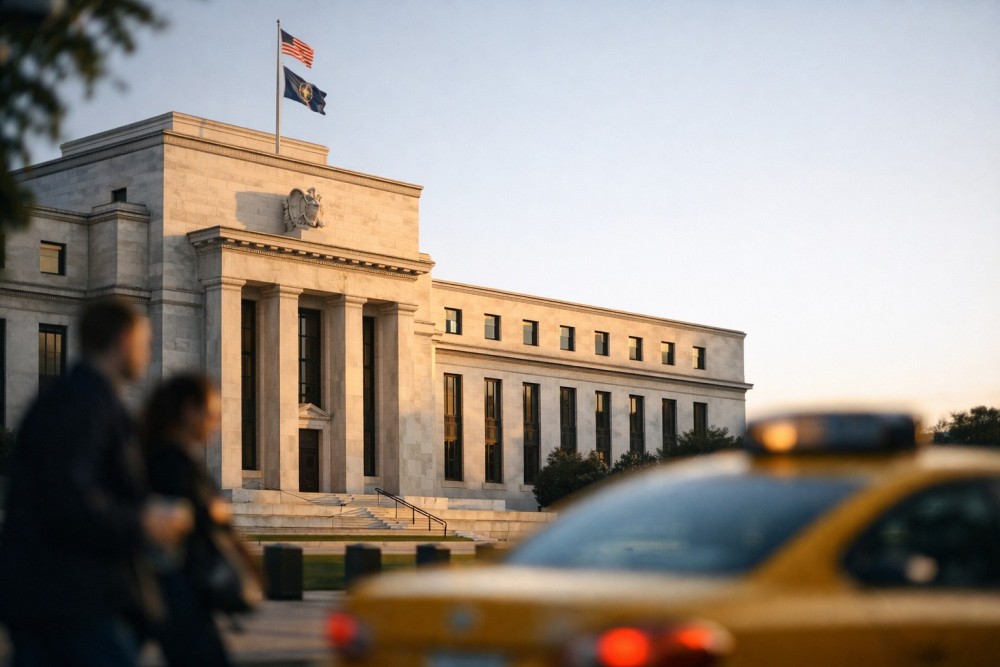
The Fed meeting is the biggest scheduled volatility event in any given quarter, and most retail investors react to it instead of trading it. The next FOMC decision lands June 17, 2026, and you have three repeatable setups to choose from depending on your time horizon and risk appetite.
This guide covers three setups for retail accounts: an iron condor for the volatility crush, a sector rotation trade, and a hold-through framework with disciplined sizing. For background on what the committee does, our Fed meeting primer is a good companion read.
What Moves Markets at FOMC: Statement, Dots, Press Conf
Three events move prices on FOMC day, and they hit in sequence. Knowing what each does to SPY and rate-sensitive sectors is the foundation for every setup below.
The 2 p.m. ET statement and rate decision
The policy statement drops at 2:00 p.m. ET. Index futures move within seconds on any change to the rate, the inflation language, or the balance of risks. In a hold-meeting like April 2026, the wording shift is what matters: "solid pace" versus "slowing" gets repriced immediately.
The dot plot and Summary of Economic Projections
March, June, September, and December meetings include the SEP and dot plot. The June 2026 dots are the first under Warsh, so the median 2026 and 2027 path will be scrutinized for drift. A single dot moving 25 basis points can shift two-year yields meaningfully.
The 2:30 p.m. ET press conference
The press conference runs 30 to 60 minutes and is where most intraday range gets made. Markets often reverse the initial statement reaction once the chair takes questions. This is when iron condor sellers want gamma to bleed.
Setup 1: Volatility Crush With Iron Condors
Implied volatility on S&P 500 options reliably builds into FOMC and collapses within hours of the press conference. An iron condor on SPY or VOO-tracked indices is the cleanest way to harvest that crush.
How the structure works
An iron condor sells an out-of-the-money call spread and put spread on the same expiry. You collect premium upfront and profit if the underlying stays between your short strikes. The trade is delta-neutral at entry and short vega, which is what you want into a known IV peak.
Practical execution around the meeting
Open the condor one to two days before the meeting using the weekly expiry two to three days after. Pick short strikes near the one-standard-deviation move implied by the chain, typically the 15 to 20 delta. Aim for credit around one third of the spread width, and close within 24 hours of the press conference once IV resets.
Setup 2: Sector Rotation Trade Pre and Post
The same Fed statement hits sectors differently. Banks like JPM and the broader XLF care about the yield curve, energy trades off growth, and consumer staples behave like duration when rates move.
Pre-meeting positioning
In the week before the decision, build a paired exposure. If your read is hawkish dots, lean defensive: overweight XLP, underweight XLY. If you expect dovish dots, reverse it and add XLK. Keep gross exposure modest, you are trading a binary tone read.
Trade the Fed with a real plan, not a hot take. Open a Gotrade account to run setups across SPY, sector ETFs, and single names in one place.
Post-meeting follow-through
The cleanest trades often appear 30 to 90 minutes after the press conference, once chop settles. If the curve steepens, XLF and JPM tend to follow. If energy holds while staples sell off, that is your growth-on signal and a window to add XLE. Cap each leg at a defined dollar risk and exit by the next session's close.
Setup 3: Hold-Through With Position Sizing
Most retail investors do not want to trade the meeting, they just hold through it. The mistake is doing nothing different. Hold-through is itself a setup, and it has rules.
Halve your size, define your stop
Cut any single-name position to half its normal size 24 hours before the meeting and write down the price at which you will sell if the move goes against you. The 2 p.m. release frequently produces a 1% to 2% move within minutes, and a stop set at 2:01 is a stop set in panic. Pre-committing the level is the edge.
Use index hedges if you cannot trim
If a position is part of a long-term thesis, hedge the systematic risk instead of trimming. A put spread on SPY sized to roughly 25% of your single-name notional absorbs most of the index move on a hawkish surprise. Close the hedge within a day or two.
Conclusion
The June 17, 2026 FOMC meeting is a known catalyst with three actionable setups: iron condor for premium sellers, sector rotation for thematic traders, hold-through with sizing for long-term holders. Pick one based on your edge.
FAQ
When is the next Fed meeting in 2026?
The next FOMC meeting is June 16 to 17, 2026, with the rate decision and Summary of Economic Projections released at 2 p.m. ET on June 17.
What is an iron condor in simple terms?
An iron condor sells an out-of-the-money call spread and put spread on the same underlying and expiry, profiting if the price stays between the short strikes.
Which sector ETFs react most to the Fed?
XLF moves with the yield curve, XLP and XLY swing on rate expectations through duration and consumer demand, and XLK is sensitive to long-end yields.
Should I just hold through the FOMC meeting?
Holding through is fine if you halve your position size and pre-commit a stop level before the 2 p.m. ET statement, rather than reacting in real time.