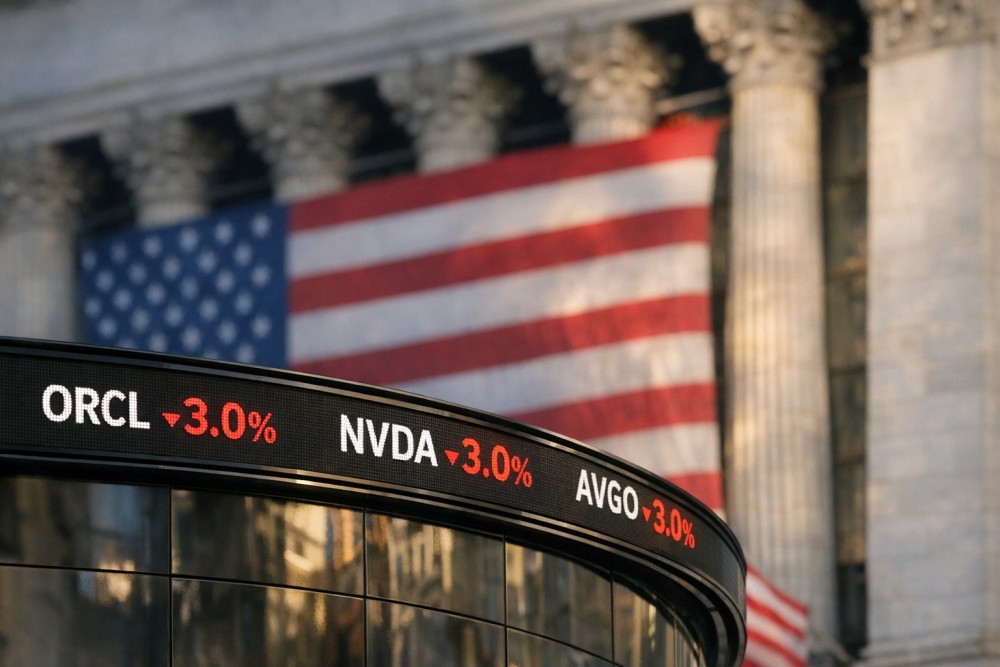
AI capex risk just moved from a slide in a strategist deck to a real selloff on the tape. A leaked report on OpenAI internal revenue numbers triggered an immediate drop in AI infrastructure stocks on April 28, 2026.
Oracle led the decline. Nvidia, Broadcom, and AMD followed.
This article is not a breaking news recap. It is a framework for how retail investors should think about AI capex risk before the next headline hits.
What the OpenAI Internal Growth Report Said
According to Fortune, OpenAI CFO Sarah Friar warned colleagues the company was spending too much on data centers relative to its revenue trajectory. Friar and CEO Sam Altman jointly called the report ridiculous.
The same article pegs 2026 AI data center capex from the four largest hyperscalers at up to $660 billion. Google is guiding to $185 billion, Meta to $135 billion, Amazon to $200 billion, and Microsoft to $140 billion.
According to Yahoo Finance, OpenAI also fell short on its internal target of one billion weekly active users by year-end. Anthropic gained ground in coding, while Google Gemini took consumer share.
The market read this as a single signal. The biggest single buyer of AI compute may be growing slower than the buildout assumes.
That gap between revenue growth and contracted compute spend is the core of AI capex risk. It is what makes the supply chain reflexive on any OpenAI headline.
Knock-On Effects on Oracle, Nvidia, and Suppliers
The pre-market reaction was sharp. Oracle (ORCL) dropped roughly 3 percent on a single headline.
That makes sense given the partnership math. Oracle has a multi-year cloud agreement to supply OpenAI, and any wobble in OpenAI revenue feeds straight into Oracle backlog risk.
The chip side moved too. Nvidia (NVDA) declined alongside Broadcom (AVGO) and AMD as investors repriced demand for AI accelerators and custom silicon.
What this tells us
AI infrastructure stocks are now trading like a single basket. When the end customer wobbles, the entire supply chain reprices in minutes.
Why concentration matters
OpenAI is not just one customer. It is the anchor tenant whose growth assumptions justify a meaningful slice of hyperscaler capex.
Reviewing your AI exposure today is cheaper than rebalancing in a panic. With Gotrade app you can buy fractional shares of US stocks from US$1, with zero commission, and rebalance in minutes.
Hyperscaler Capex Without OpenAI: Is It Sustainable
Strip OpenAI out of the demand stack and the question becomes whether organic enterprise AI workloads justify $660 billion in annual spending.
The bullish answer points to backlog. Google Cloud reported a backlog near $460 billion in its Alphabet Q1 2026 earnings reaction, almost double the prior year. That is contracted future revenue, not speculation.
Microsoft is in a similar position. Azure grew 40 percent in the latest quarter while capex hit $34.9 billion, per the Microsoft Q1 2026 earnings reaction.
The bear case
Backlog is not the same as recognized revenue. If a major customer like OpenAI renegotiates pricing, hyperscaler margins compress before backlog converts.
The base case
Capex grows, but the growth rate decelerates. Margins on AI workloads matter more than the headline buildout number.
Bubble Signal Checklist for AI Investors
You do not need a PhD to track AI capex risk. You need a short checklist you can run every quarter.
First, watch the customer concentration of your suppliers. The ANET earnings analysis notes Meta and Microsoft were roughly 48 percent of 2025 revenue.
Second, track backlog conversion, not just backlog growth. Rising backlog with falling conversion is a yellow flag.
Third, watch capex versus operating cash flow. When capex exceeds operating cash flow for multiple quarters, dilution or debt usually follows.
Fourth, monitor end-customer revenue growth. If OpenAI, Anthropic, and the major AI consumers slow, supplier multiples should compress before fundamentals do.
How to use the checklist
Run it on every AI name in your portfolio once per earnings cycle. If two or more flags trigger, trim the position and review.
What this is not
This is not a sell signal on AI infrastructure as a theme. It is a discipline for sizing positions when the cycle gets noisy.
Conclusion
The OpenAI revenue report did not break the AI thesis. It reminded the market that AI capex risk is real, concentrated, and reflexive across the supply chain.
The right response is not to exit AI exposure. It is to size it deliberately, diversify across the stack, and review every quarter against the four-flag checklist above.
If you want to act on this, open or review your Gotrade watchlist today. With fractional shares from US$1, you get easy and 24 hours/5 days access to US stocks like Oracle, Nvidia, and Broadcom without committing whole-share dollars to a single name.
FAQ
What is AI capex risk?
It is the risk that AI infrastructure spending outpaces the revenue growth of AI end customers, compressing supplier margins.
Why did Oracle stock drop on the OpenAI revenue report?
Oracle has a multi-year cloud supply agreement with OpenAI, so weaker OpenAI revenue raises questions about Oracle backlog conversion.
Are Nvidia and Broadcom still good long-term holdings?
Both remain core AI infrastructure plays, but position sizing should reflect customer concentration and capex-to-cash-flow trends.
How can I get exposure to AI stocks with a small budget?
Gotrade offers fractional shares of US stocks from US$1 with zero commission, so you can build diversified AI exposure without large capital.