AMD just took a hard hit in the 2026 semiconductor selloff. The stock dropped sharply even though nothing went wrong inside the company.
That gap between price and fundamentals is exactly where investors hunt for opportunity. It is also where value traps hide.
This is a balanced look at AMD after the drop: the bull case, the bear case, and how a retail investor should think about sizing it.
Why Chip Stocks Sold Off in 2026
The selloff was not about AMD at all. It started with Broadcom's earnings guidance in early June.
Broadcom guided Q3 AI chip sales to roughly $16 billion, below the $17.2 billion analysts wanted. It also declined to raise its full-year AI forecast.
According to Kavout (analysis of what triggered the selloff), that single guidance miss helped erase over $1.3 trillion in chip-sector value in days.
Contagion did the rest. Memory-chip oversupply and weak smartphone demand piled on, dragging the whole sector lower.
Macro jitters added pressure too. Renewed inflation worries and higher oil prices made investors quick to dump anything that had run up hard.
How far AMD fell
AMD (AMD) dropped 10.86% to close near $466 on June 5, 2026. That came off an early-June peak around $542.
Intel (INTC) and Nvidia (NVDA) slid alongside it, confirming this was a sector reset, not a company-specific crack.
That distinction matters. A stock falling on a rival's bad guidance behaves very differently from one falling on its own broken numbers.
For the wider mechanics of these moves, our guide on the 2026 semiconductor stocks selloff walks through the chain reaction.
The Bull Case: An AI Accelerator Underdog
AMD's business is growing fast underneath the noise. The selloff did not touch the numbers.
In Q1 2026, revenue rose 38% year over year to $10.3 billion. Data-center revenue jumped 57% to a record $5.8 billion, now more than half the company.
The MI-series roadmap
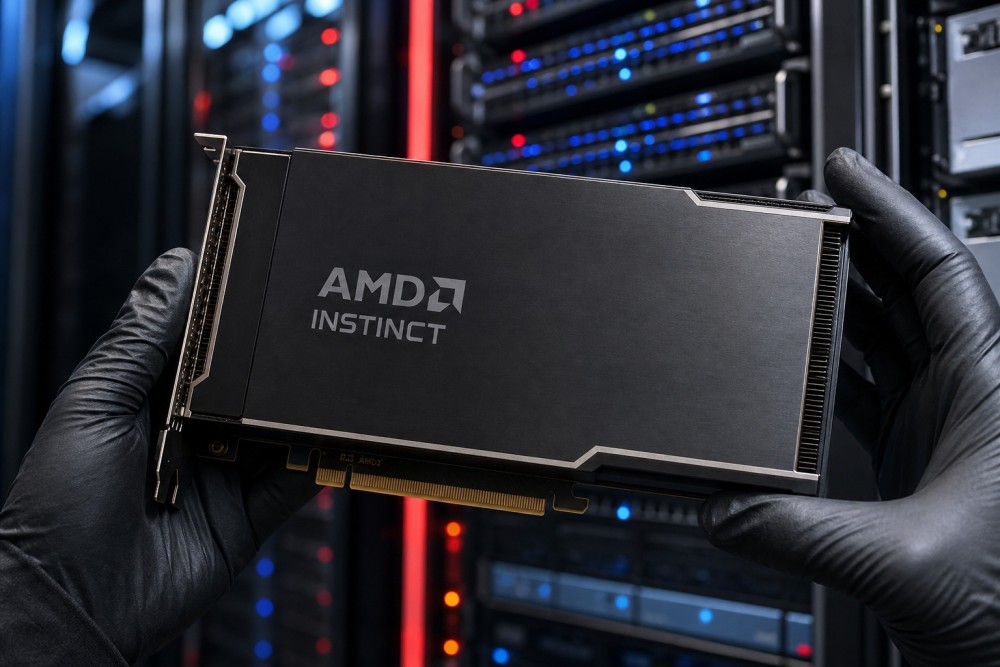
AMD's Instinct accelerators are the heart of the bull thesis. The MI350 series is shipping, and the MI400 family lands later in 2026.
The flagship MI455X promises 40 PFLOPS of FP4 compute and 432GB of HBM4 memory. AMD's Helios rack-scale system is built to deploy these GPUs at hyperscale.
If AMD can keep compounding data-center growth above 50% as MI400 ramps, it is taking real share in the fastest-growing market in tech.
The setup is classic underdog math. AMD only needs to capture a sliver of a market expanding into the hundreds of billions to grow meaningfully.
You do not need thousands of dollars to own this story. With Gotrade, you can buy fractional shares of US stocks from $1, so you can take a small starter position in AMD and add over time. Open a Gotrade account and start sizing on your own terms.
The Bear Case: A Possible Value Trap
The bear case is simple. AMD is still tiny next to Nvidia, and the valuation leaves little room to stumble.
Nvidia holds roughly 80% of the AI accelerator market by revenue. AMD's share sits closer to 5% to 7%, a fraction of the leader's scale.
The CUDA moat problem
Hardware is only half the battle. Nvidia's CUDA software ecosystem locks in developers in a way raw chip specs cannot easily undo.
AMD's ROCm software is improving, but switching costs are real. Customers do not move years of optimized AI code lightly.
Even after the drop, AMD traded around 58 times forward earnings, and far higher on trailing profits. According to a Motley Fool analysis (on whether AMD is a buy after the selloff), that premium leaves almost no margin for execution slips.
If MI400 deployments slip or hyperscaler spending cools, that rich multiple can compress fast. That is the value-trap risk.
How a Retail Investor Should Size It
AMD is a high-conviction, high-volatility name. The position size should respect that.
Treat it as a satellite holding, not a core anchor. A small slice of a diversified portfolio captures upside without betting the house.
A practical approach
Averaging in beats trying to call the exact bottom. Buying in small tranches smooths out the wild swings these chip names produce.
If you want a framework for the volatility, our guide on how to handle chip-stock volatility lays out the discipline.
Decide your maximum loss before you buy, not after. That single habit keeps a value-trap scenario from doing real damage.
Conclusion
AMD after the selloff is neither an obvious bargain nor an obvious trap. It is a genuine bet on whether the underdog can dent Nvidia's lead.
The fundamentals are strong, but the valuation and the CUDA moat are real risks. Size it small, average in, and let the MI400 cycle prove itself.
With Gotrade, you can buy fractional shares of US stocks from $1, so you can build a measured AMD position instead of an all-in gamble. Open a Gotrade account and start with a slice today.
FAQ
Why did AMD stock sell off in 2026?
It fell with the broader chip sector after Broadcom's weak AI guidance, not because of any AMD-specific problem.
How much did AMD drop?
AMD fell about 10.86% to roughly $466 on June 5, 2026, down from an early-June peak near $542.
Is AMD a value trap?
It could be if MI400 ramps slowly or its high valuation compresses, since Nvidia's CUDA moat is hard to break.
What are AMD's MI-series accelerators?
They are AMD's Instinct data-center AI GPUs, including the shipping MI350 and the upcoming MI400 family with the flagship MI455X.