You are looking at AMD trading at a clear discount to NVIDIA, and the question is no longer academic. It is a decision.
The MI355X is shipping. The MI400 Helios rack is on the books for H2 2026. AWS just signed on as a hyperscaler customer.
The catch is that NVDA is not slowing down either. Vera Rubin is coming the same half, and the discount you see in AMD reflects exactly that overhang.
The MI355 and MI400 Roadmap
AMD now has a real product cadence, not just a slide deck. The roadmap covers shipping silicon today and rack-scale systems within twelve months.
MI355X: shipping now
The MI350 family launched at Advancing AI 2025 in two flavors. The MI350X is a 1,000W air-cooled part, and the MI355X pushes to 1,400W with air plus liquid cooling.
The MI355 is the current shipping product, and it is broadly available through Dell, HPE, Supermicro, and the neo-cloud tier. That is wider distribution than AMD has ever had on an AI accelerator.
The performance pitch on MI355 is competitive FP8 throughput at a meaningfully better total cost of ownership. That is the message AMD is taking into every hyperscaler procurement call this year.
MI400 Helios: H2 2026 rack-scale
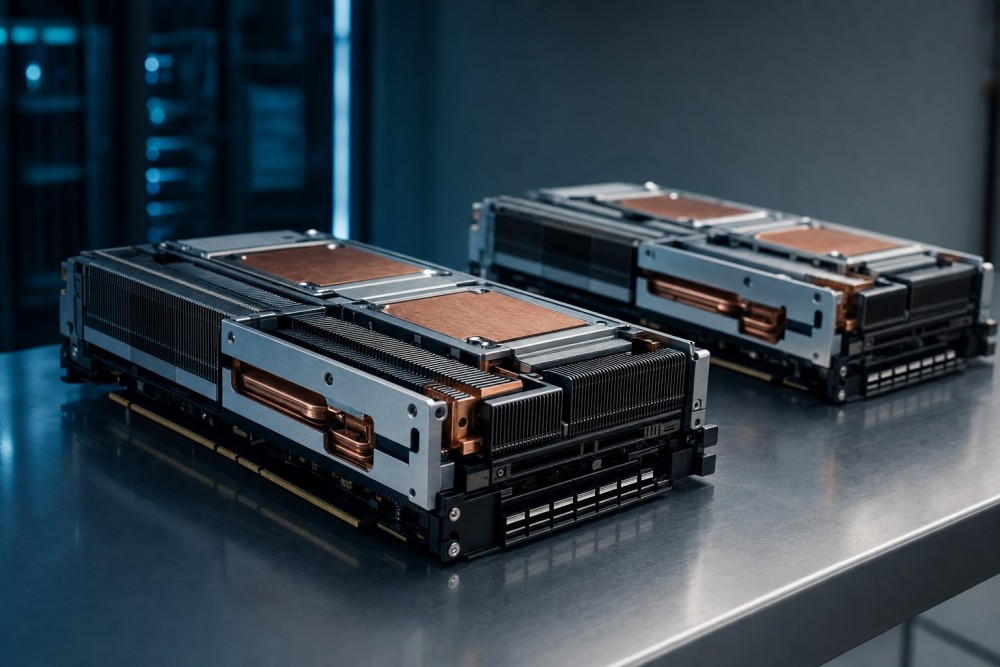
The MI400 series lands in H2 2026 as a full rack-scale solution called Helios. Each GPU brings 20 PFLOPS of FP8 compute, 432GB of HBM4, and 19.6 Tbps of memory bandwidth.
Scale-out runs at 300 Gbps per GPU, with UALink stitching up to 72 GPUs into a single rack. A follow-on MI500 series in 2027 is targeted at 256-GPU scale via UAL256.
AWS Just Signed Up. Why It Matters
The biggest signal of the cycle is not a spec. It is a customer.
AWS confirmed as a new MI350 series customer, the first true hyperscaler win that AMD has landed on this generation. Until now, the bull case relied on Microsoft, Meta, and Oracle conviction with AWS notably absent.
AWS does not pick a second source for fun. It picks one when supply is tight, when pricing leverage matters, or when an internal workload maps cleanly to the alternative architecture.
For AMD, this is the inflection point. Once one hyperscaler commits at scale, the others find it harder to stay all-NVDA on cost and supply grounds.
It also unlocks a software flywheel. AWS workloads ported to ROCm validate the stack for every smaller customer evaluating AMD next year.
How AMD Stacks vs NVDA on the H2 2026 Curve
The H2 2026 window is where the comparison gets sharp. Both companies are putting their next-generation rack on the table within the same quarters.
AMD: priced for the gap
AMD trades at a meaningful discount to NVDA on forward earnings. That gap exists because the market still treats AMD as the second source, not the share-taker.
If MI400 ships on time and AWS volumes ramp, that discount narrows. If MI400 slips or hyperscaler bookings stay thin, the discount is justified and may even widen.
NVDA: priced for the lead
NVDA is on the Blackwell B200 cycle today and ramping Vera Rubin VR200 NVL144 into H2 2026. The valuation already prices in continued share dominance and pricing power.
The bar for NVDA is execution, not surprise. For AMD, the bar is surprise to the upside, and a single missed quarter resets the thesis.
Buy, Wait, or Sell?
Here is a framework rather than a single answer. Match it to your existing book.
Buy a starter position if you have zero AMD and you believe MI400 ships on time. Size it at 2 to 3 percent of portfolio, paired with a larger NVDA core position.
Wait if you already hold NVDA and want proof first. The next two earnings reports and any incremental hyperscaler signing are the events to watch.
Sell into strength only if you are overweight AMD into the print and unwilling to hold through a roadmap slip. Trim, do not exit, because the AWS signal changes the floor.
Whatever bucket you fall into, write down the catalyst that would flip you. Pre-committing to triggers is what separates a thesis from a hope trade.
For sector context, watch Broadcom for custom silicon demand and TSMC for the foundry capacity that gates both AMD and NVDA shipments.
Conclusion
AMD has the cleanest setup it has had in years. Shipping product, a rack-scale answer for H2 2026, and a hyperscaler signature that the bulls had been waiting on.
The discount to NVDA is not a free lunch. It is the market paying you to accept execution risk on MI400 and ramp risk on AWS volumes.
The honest call for most retail books is complementary exposure, not a swap. Hold NVDA as the leader and use a measured AMD position to capture the catch-up trade if it lands.
Open the Gotrade Global app, check your AMD and NVDA allocation, and decide whether your sizing matches your conviction on H2 2026. Trade with fractional shares from $1 so a measured AMD position can sit alongside NVDA without forcing a full-share commitment.
FAQ
Is AMD really cheaper than NVDA right now?
Yes, AMD trades at a notable discount to NVDA on forward earnings, reflecting execution risk on MI400 and hyperscaler ramp.
What does the AWS deal actually change?
It moves AMD from a two-hyperscaler story to a three-hyperscaler story, which is the threshold investors use to validate a real second source.
When does MI400 ship?
AMD has guided H2 2026 for the MI400 Helios rack, directly into the NVDA Vera Rubin window.
Should I replace my NVDA with AMD?
Most retail investors are better off holding NVDA as the leader and adding AMD as a complementary position rather than a swap.