American Express (AXP) Stock 2026 sits in a unique place on Wall Street. It is one of Buffett's longest-held positions, and Berkshire Hathaway still owns roughly 21% of the company.
So why has the Oracle of Omaha refused to trim a stake bought 35 years ago, and does the thesis still hold today?
Why Buffett Has Held AXP Since 1991
Buffett first bought American Express through Berkshire Hathaway in 1991. He started with preferred shares while the company was rebuilding after the Optima Card crisis.
By 1994, Berkshire had converted into common stock and kept buying. The position has barely been touched since.
The original thesis
Buffett liked the brand, the high-spending cardholder base, and the recurring fee income. He saw a consumer franchise that was hard to copy.
That brand premium has compounded for decades. Annual dividends from AXP now send hundreds of millions of dollars back to Berkshire each year.
Why the position keeps growing
Berkshire has not added shares for years. Yet its ownership percentage keeps drifting higher because AXP buys back its own stock, giving Buffett a larger slice each year.
The Closed-Loop Network: Differentiation vs Visa and Mastercard
To understand AXP, you need to understand its network design. American Express is a closed-loop system, while Visa (V) and Mastercard (MA) run open-loop networks.
How the closed loop works
AXP issues most of its cards directly. It also processes the transaction on its own rails and holds the relationship with the merchant.
That means AXP collects merchant fees, card fees, and net interest income from the same customer. Visa and Mastercard mostly collect a small toll while banks issue the cards.
Why it matters for the long-term thesis
The closed loop gives AXP first-party data on cardholder spending. That data drives targeted offers, premium perks, and risk underwriting.
It is also why AXP can charge merchants higher fees. The cardholders spend more per swipe than a typical Visa or Mastercard customer, so merchants accept the cost.
Want to build exposure to the global payments rails? You can trade AXP, V, and MA together on Gotrade app. Browse the full US stocks list to start.
Premium Card Growth, Millennials, and Gen Z
The most important AXP story of the last five years is who is signing up for the Platinum and Gold cards. The answer is younger consumers.
The premium product engine
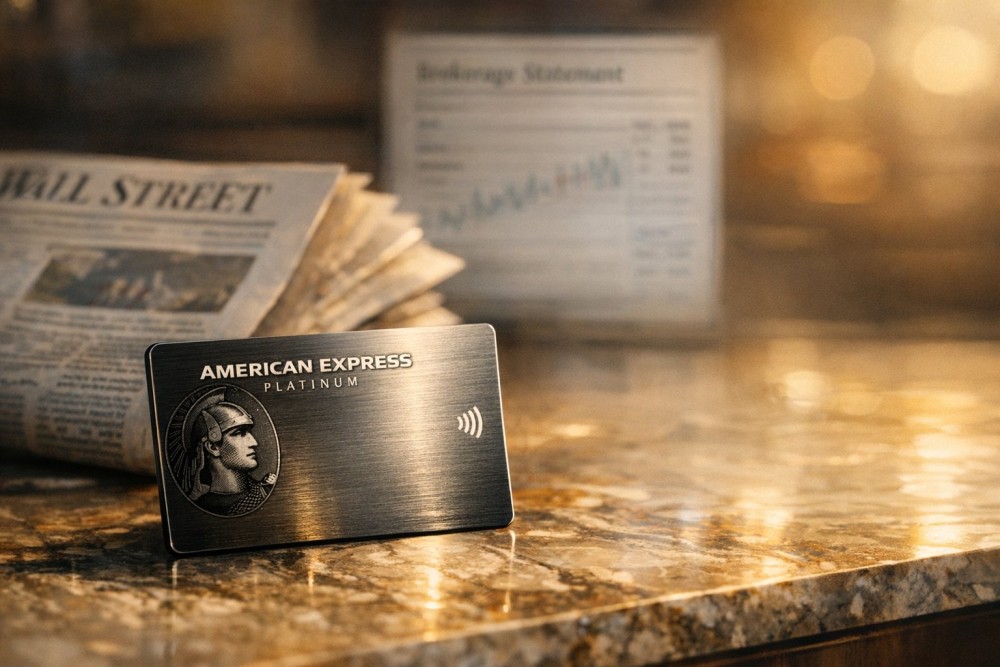
Platinum and Gold sit at the top of the card stack. They carry annual fees in the hundreds of dollars and unlock travel credits, lounge access, and dining perks.
According to AXP's Q1 2026 earnings call, Net Card Fees grew 16% on an FX-adjusted basis. Card Member spending rose 10%, the highest quarterly growth in three years.
Why younger users are joining
Management has flagged Millennials and Gen Z as the largest share of new Platinum and Gold sign-ups on multiple recent earnings calls.
The pitch is simple. If you spend on travel, dining, and subscriptions, the perks can outweigh the annual fee.
Valuation Snapshot: PE, ROE, and Buyback Yield
So how does the stock look on numbers as of Q1 2026?
Earnings power
Q1 2026 EPS came in at $4.28, up 18% year over year. Full-year guidance calls for $17.30 to $17.90 in EPS and 9% to 10% revenue growth.
Return on Equity hit 35% for the quarter. That is a level most banks and payment peers cannot match.
Capital return
AXP returned $2.3 billion to shareholders in Q1 2026 alone. That broke down to $0.7 billion in dividends and $1.7 billion in buybacks.
Buybacks are the engine that has quietly grown Buffett's ownership share. They also support EPS growth even when net income growth slows.
What to watch
Watch credit quality if the US consumer slows. AXP's premium customers are wealthier than average, but they are not immune.
Also watch FX. International billings grew double digits for the 20th straight quarter, as the Motley Fool noted in April 2026.
Conclusion
American Express in 2026 looks a lot like the AXP Buffett has owned for 35 years. A closed-loop network, a premium brand, and a buyback machine that compounds ownership for patient holders.
The risk is cyclical. A consumer pullback would hit billings and credit at once. The opportunity is structural, since Platinum and Gold are pulling in a new generation of high-spending cardholders.
If you want to follow Buffett's playbook on AXP or build your own payments basket alongside Visa and Mastercard, you can trade American Express (AXP) on Gotrade app with fractional shares from any amount.
FAQ
How much of American Express does Berkshire Hathaway own in 2026?
Berkshire owns roughly 21% of AXP, around 151 million shares as disclosed in its early 2026 13F filing.
When did Warren Buffett first buy AXP?
Buffett's Berkshire Hathaway started buying American Express in 1991 with preferred shares and converted to common stock by 1994.
What makes AXP different from Visa and Mastercard?
AXP runs a closed-loop network where it issues the card and processes the transaction, while Visa and Mastercard mainly run the rails for bank-issued cards.
Is AXP still growing in 2026?
Yes. Q1 2026 revenue grew 11%, EPS rose 18%, and management guided full-year revenue growth of 9% to 10%.
How can you buy American Express stock?
You can buy AXP and other US payment stocks like Visa and Mastercard through Gotrade with fractional shares from any amount.