

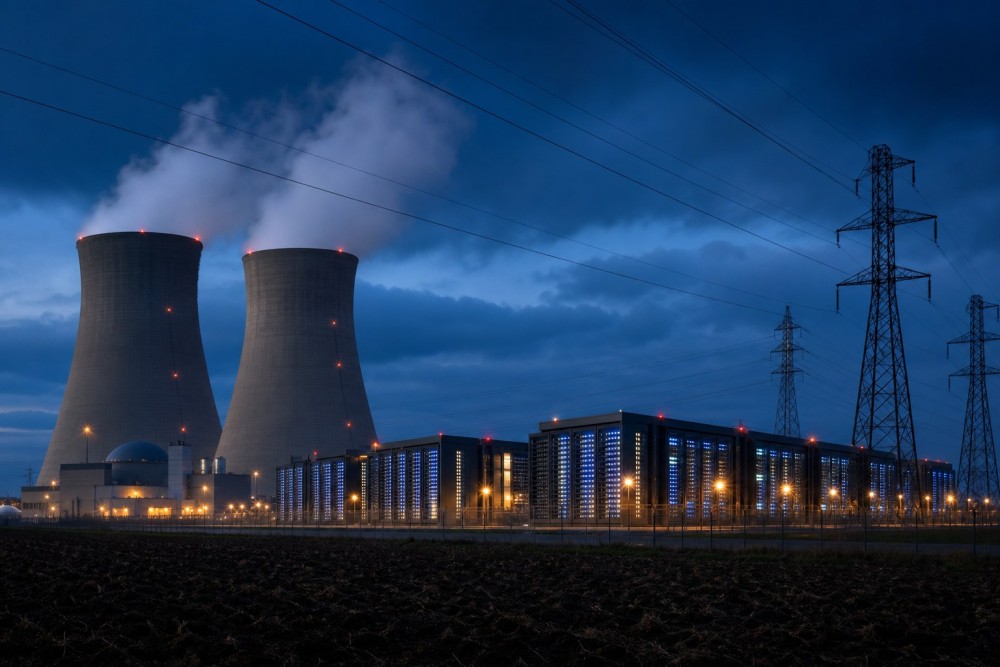
The CEG vs VST debate has become the cleanest way to play the AI power thesis on US markets. Both run nuclear fleets. Both supply hyperscalers. But they earn very different multiples.
Constellation Energy and Vistra are now the two most-watched names in the utility sector. Hyperscaler demand has pulled them out of their sleepy peer group.
Here is how the two stack up on contracts, valuation, and risk in 2026.
Business Profiles: CEG vs VST
Constellation Energy stock represents the largest nuclear fleet in the United States. Around 90% of CEG output is carbon-free.
The company spun out of Exelon in 2022 to focus purely on competitive power. Its scale and nuclear concentration are unmatched among listed US utilities.
Vistra is structurally different. Vistra Energy stock blends nuclear with a deep portfolio of natural gas plants, plus retail electricity in Texas.
Vistra picked up its nuclear fleet through the 2024 Energy Harbor acquisition. Its gas exposure makes it more sensitive to commodity prices than CEG.
Both names sit outside the regulated utility model. They sell power on competitive markets, so earnings move with power prices, not regulated rate base.
Hyperscaler Contract Exposure Comparison
This is where the two stories diverge most sharply.
CEG already locked in long-term agreements with Microsoft and Meta. According to The Motley Fool, Constellation has over 5,650 MW of clean energy contracts with hyperscalers. The Three Mile Island restart anchors its Microsoft deal.
A 20-year, 1.1 GW Meta deal signed in 2025 added another major leg. These are decade-plus contracts at premium pricing.
Vistra closed its own headline deal in January 2026. It signed 20-year PPAs with Meta for roughly 2,600 MW of nuclear power across three PJM-region plants.
Per TIKR, those Meta tonnages are not yet baked into Vistra full-year 2026 EBITDA guidance. That leaves upside if execution lands.
Net read: CEG has more announced hyperscaler MW today. VST has more potential upside if its Meta deal flows through earnings later in 2026.
Valuation: P/E, EV/EBITDA, Dividends
The market is paying very different prices for these two stories.
CEG trades at a forward P/E around 26x and a forward EV/EBITDA near 13x. That is utility-rare territory.
VST trades meaningfully cheaper. Its forward P/E is closer to 18x, with EV/EBITDA around 10x.
The premium for CEG reflects the cleaner nuclear story, lower leverage, and visibility from signed hyperscaler PPAs. CEG net debt sits near $5.9 billion.
VST carries about $19.6 billion in net debt, partly from the Energy Harbor deal and the pending Cogentrix gas acquisition. That weighs on the multiple even though free cash flow yield is higher.
Neither stock is a dividend play. CEG yields under 1%, and VST is similar. You buy these names for growth and contracted cash flows, not income.
Risk Profile: Nuclear vs Gas Mix
The fuel mix shapes the risk profile in a direct way.
CEG is overwhelmingly nuclear. That is a tailwind on the hyperscaler bid for clean, baseload, 24/7 power.
The downside is operational concentration. A single nuclear outage or regulatory issue moves the stock meaningfully.
VST runs a more diversified fleet of nuclear, gas, coal, and solar. Gas plants give it commercial flexibility but also natural gas price exposure.
The pending $4.7 billion Cogentrix acquisition adds 10 modern gas plants. Gas is the bridge fuel hyperscalers actually plug into today, while nuclear restarts take years.
Regulatory risk applies to both. Nuclear license extensions, grid interconnection queues, and state-level scrutiny of behind-the-meter deals are live issues for the sector.
VST also has meaningful Texas retail exposure. That adds weather risk, as the 2021 winter storm episode showed.
Portfolio Allocation Recommendations
The right mix depends on your tilt and time horizon.
If you want pure nuclear AI-power exposure with cleaner balance-sheet optics, lean CEG. The premium multiple is the cost of admission.
If you want cheaper entry with more upside from the next leg of hyperscaler contracts, lean VST. You take on more leverage and more gas exposure in exchange.
A barbell approach works well for many portfolios. Pair a CEG core position with a smaller VST position to capture both quality and value.
Investors who want diversification beyond pure-play independent power producers can also look at regulated utility names like NextEra Energy stock or Duke Energy stock. Both have data-center pipelines without the merchant-power volatility.
For a broader framework, our AI power trade utility playbook compares the wider set of names.
Conclusion
CEG and VST are the two cleanest expressions of the AI power thesis on US markets. CEG is the quality compounder, VST is the value plus leverage trade.
The bull case for both rests on the same demand curve: hyperscaler power needs are real, structural, and underwritten by 20-year contracts.
Open the Gotrade Global app, review your utility allocation, and position by growth tilt (CEG) or balanced value tilt (VST). Fractional shares start from $1, so pairing both names fits any portfolio size.
FAQ
Is CEG or VST a better AI utility stock?
CEG offers more hyperscaler capacity and a cleaner balance sheet, while VST trades cheaper with more 2026 Meta-deal upside, making CEG the growth pick and VST the value pick.
How exposed is Vistra to natural gas prices?
VST runs a large gas fleet alongside its nuclear plants plus the pending Cogentrix acquisition, giving it commercial flexibility but also direct gas-price risk.
Do CEG and VST pay meaningful dividends?
No. Both yield under 1%, so treat these as growth and contracted-cash-flow stories rather than income holdings.
Can I buy CEG and VST as fractional shares on Gotrade?
Yes, both trade fractional from $1 on Gotrade Global, letting you build a barbell utility position without large capital.