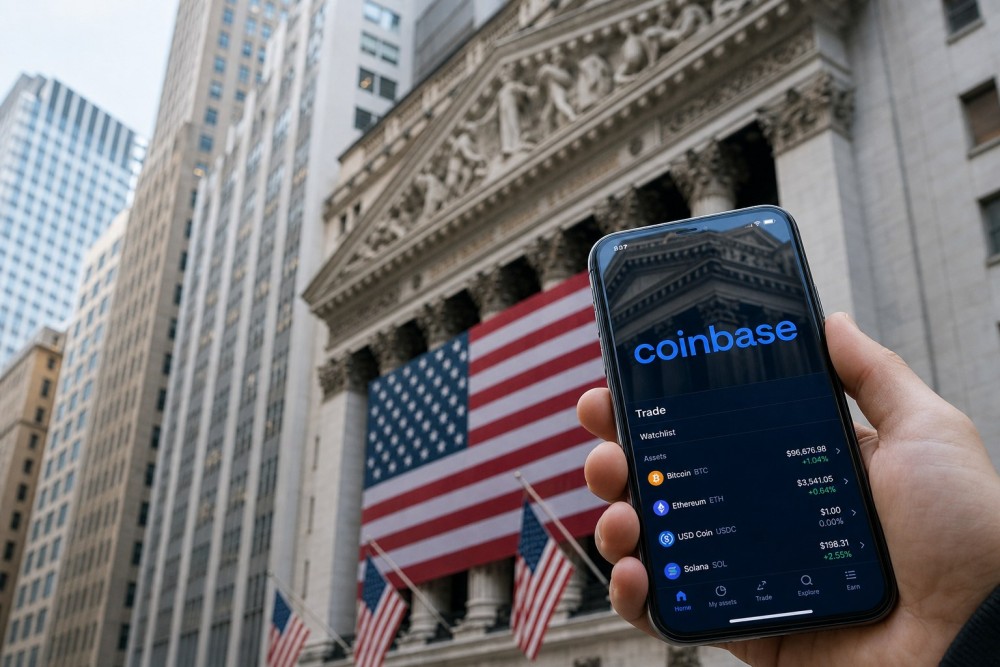
The coinbase s&p 500 story is back in focus at the one-year anniversary of the inclusion. Coinbase Global officially joined the index on 19 May 2025 as the first crypto-native company added to the S&P 500.
On the announcement day, COIN jumped 24 percent, the largest single-day move since the November 2024 Trump election rally, in what was read as the biggest institutional validation crypto had received.
A year later, the investor question has shifted. Did the index inclusion effect hold up, or was it short-lived euphoria that has already faded?
How Index Inclusion Creates Passive Demand
When a stock joins the S&P 500, passive funds that track the index are required to buy it. The buying is mechanical, not discretionary, to avoid tracking error against the benchmark. Bernstein estimated the Coinbase inclusion triggered roughly USD 16 billion of passive buying pressure, which helps explain the 24 percent run-up between announcement and effective date.
How Big Is the Passive Demand Flow
Academic research estimates around 8.7 percent of a newly added stock has to be absorbed by index funds. For a large-cap name like COIN, that translates into several billion US dollars of forced buying, concentrated between announcement and effective date.
Why This Matters for Retail Investors
Index inclusion sends two signals: the company has cleared the S&P profitability and market-cap thresholds, and structural demand from passive funds is now part of the trading picture. The catch is that the signal is usually already in the price by the effective date, so if you buy after the announcement you often miss most of the move.
Historical Cases: TSLA, FB, and the Post-Inclusion Pattern
Index inclusion studies give useful context. From 1976 to 1983, added stocks rose an average 2.8 percent on the announcement day; the 1989 to 1994 window averaged 3.1 percent; and a 2011 study found valuations rose 8.8 percent between announcement and effective inclusion.
Tesla and the Disappearing Index Effect
Tesla joined the S&P 500 in December 2020 with a 32-day gap between announcement and implementation, creating extreme buying pressure. Research from Greenwood and Sammon at Harvard Business School found the inclusion effect has shrunk over two decades as traders position before the formal announcement.
What That Means for COIN
The 24 percent announcement-day jump fits the historical pattern for unique-profile stocks, but action after the July 2025 peak shows passive demand does not guarantee a durable uptrend. COIN briefly touched USD 445 at the July 2025 peak before correcting to USD 240 to USD 270. Fundamentals, not flows, set the direction.
Want to buy Coinbase fractionally? Open a Gotrade account and access 600+ US stocks today.
COIN Q1 2026 Fundamentals
Q1 2026 gives you the latest read on Coinbase fundamentals. Total revenue came in at USD 1.4 billion, down 31 percent year over year, missing the USD 1.56 billion consensus. The shortfall was driven mostly by trading volumes, which fell 28 percent quarter over quarter.
Transaction Revenue and Volume Pressure
Transaction revenue printed at USD 755.8 million in Q1 2026. Consumer revenue fell 23 percent to USD 567 million, and institutional revenue dropped 27 percent to USD 136 million. Even so, Coinbase market share rose to a record 8.6 percent, up from 8 percent in Q4 2025.
Subscription and Custody Fees as a Buffer
Subscription and services revenue reached USD 584 million, or 44 percent of net revenue, with stablecoin revenue at USD 305 million as the single biggest line. This revenue is steadier because it is not tied to daily trading volumes. Coinbase captures roughly 50 percent of USDC economics and holds more than 25 percent of USDC supply inside its own products.
The Risks Unique to a Crypto-Exposed Stock
COIN carries two structural risks that set it apart from a traditional fintech name: price correlation with Bitcoin and exposure to SEC regulation.
Bitcoin Correlation and Crypto Volatility
The 30-day correlation between COIN and Bitcoin sits in the 0.65 to 0.85 range. When Bitcoin moves 10 percent in a day, COIN has historically moved 7 to 12 percent in the same direction. The correlation cuts both ways, so a crypto drawdown pulls COIN valuation down regardless of operating performance.
SEC Regulation and Headline Risk
SEC announcements on crypto classification, staking, or exchange oversight can drive 8 to 15 percent intraday moves in COIN. The 2026 regulatory backdrop is more accommodative, but headline risk has not disappeared. Long-term holders should factor regulatory uncertainty into the valuation; diversification still matters after a name joins the S&P 500.
Conclusion
Coinbase joining the S&P 500 in May 2025 was a milestone validation for crypto, and the 24 percent announcement-day jump lined up with the historical inclusion pattern. Recent research shows that effect has been shrinking for two decades.
Q1 2026 captures the real challenge: transaction revenue down 31 percent, even as subscription and stablecoin revenue support 44 percent of the top line. Watch non-transaction revenue growth, the Bitcoin correlation, and the path of SEC policy from here.
You can start investing in Coinbase and more than 600 other US stocks fractionally through Gotrade at transparent pricing.
FAQ
Q: When did Coinbase join the S&P 500?
A. Coinbase joined the S&P 500 on 19 May 2025, replacing Discover Financial Services, as the first crypto-native company in the index.
Q: How much did COIN jump after the inclusion announcement?
A. COIN jumped 24 percent on the 13 May 2025 announcement day and rose more than 25 percent total over the week into the effective date.
Q: Is COIN safe to hold after joining the S&P 500?
A. Index inclusion does not remove volatility. COIN remains highly correlated with Bitcoin at 0.65 to 0.85 and stays exposed to SEC policy shifts.