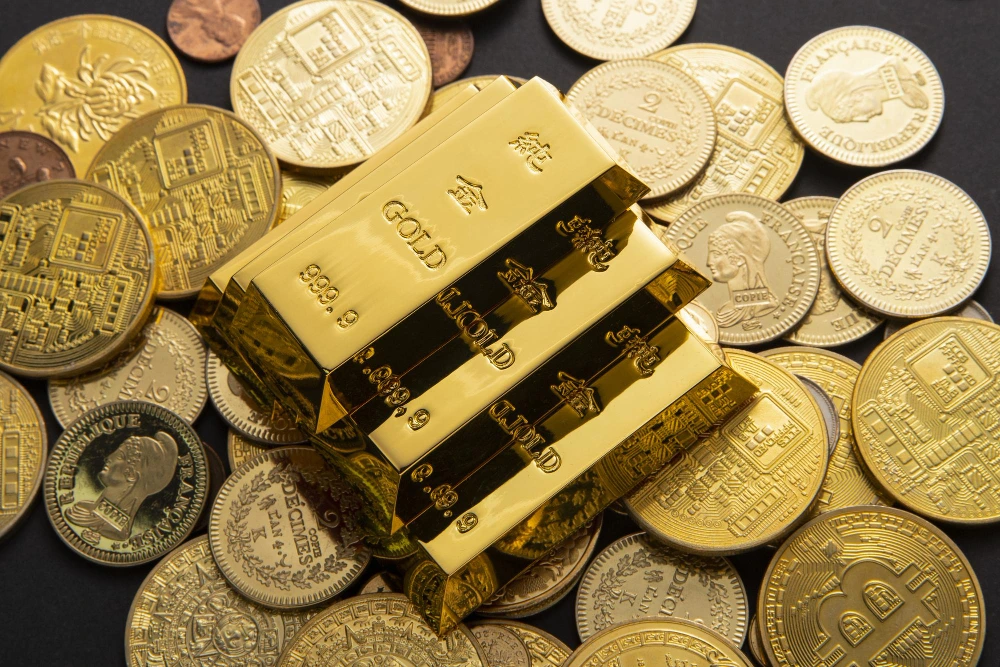
Physical gold means buying the actual metal: bars, coins, or jewelry. You own it outright, store it yourself or pay someone to store it, and sell it through a dealer or private buyer when you want to exit.
The practical differences:
Entry size: Gold ETFs can be bought in small amounts. Physical gold comes in fixed units — coins and bars — that start at several hundred to several thousand dollars per piece at current prices.
Buying and selling: ETFs trade during market hours at transparent prices. Physical gold requires finding a dealer, negotiating a spread, and handling authentication.
Ongoing costs: ETFs charge an annual expense ratio (typically 0.25–0.40% for the major gold funds). Physical gold requires storage and insurance costs on top of the initial dealer premium.
Ownership: Physical gold gives you direct, unambiguous ownership of an asset outside the financial system. ETF investors own shares in a fund, not gold bars.
Portfolio flexibility: ETFs can be bought, sold, or rebalanced in minutes. Adjusting a physical gold position takes days and involves transaction friction each time.
Neither option is objectively better. The right one depends on what you are trying to accomplish.
What you are actually buying when you buy physical gold
Physical gold comes in several forms, and they do not all behave the same way as an investment.
Gold bars are the most straightforward. They are refined to a defined purity, typically 99.5% or 99.9% (marked as 995 or 999.9 fineness), and come in sizes from 1 gram to 400 troy ounces. The larger the bar, the lower the dealer premium per gram — but also the harder it is to sell a portion of it if you only need to liquidate part of your position.
Gold coins are produced by government mints and carry a face value, though their actual worth tracks the gold price. Common examples include the South African Krugerrand, the American Gold Eagle, and the Canadian Maple Leaf. Coins typically carry a slightly higher dealer premium than bars because of the minting process, but they are easier to authenticate and easier to sell in smaller units.
Jewelry is the most widely held form of physical gold globally, but it is the weakest investment vehicle of the three. The price you pay for gold jewelry includes making charges — the cost of craftsmanship — which can add 10–30% to the raw gold cost. When you sell, jewelers buy back at the melt value of the gold, not the price you paid. A piece of gold jewelry purchased for $500 might be bought back for $300–350 depending on gold purity and the buyer's margin. If your goal is gold price exposure, jewelry is an inefficient way to get it.
Gold purity and certificates matter for resale. Gold that comes with an assay certificate from a recognized refinery or mint is easier to sell at fair prices. Bars without proper documentation may be bought back at a discount or refused by reputable dealers. Always ask for authenticity documentation at the time of purchase.
Dealer reputation is not a secondary concern. Prices for the same gold bar can vary by 2–5% between dealers, and buy-back prices vary just as much. Buying from an established, regulated dealer with clear pricing and a published buy-back policy saves friction later.
The costs that do not show up on the price tag
The spot price of gold — the price you see quoted on financial news — is not what you pay when you buy physical gold. Several costs sit between the spot price and your actual purchase price, and several more sit between the spot price and what you receive when you sell.
Dealer premium on purchase. Reputable dealers charge above spot to cover their sourcing, operations, and margin. During periods of stable demand, premiums on standard coins and small bars typically run 3–5% above spot. During price rallies when demand surges, that premium can reach 8% or higher. On a $2,600/oz position at a 5% premium, you are effectively paying $2,730 for $2,600 worth of gold before you have any price exposure.
Storage costs. Keeping gold at home creates insurance and theft risk. Bank safe deposit boxes cost $80–200 per year depending on size and institution. Third-party vault storage runs $100–300 per year for modest amounts. These costs are ongoing for as long as you hold.
Insurance. Home insurance policies typically cover gold to a limited amount and often require a separate rider for higher values. Dedicated gold insurance runs approximately 0.5–1% of the insured value annually.
The buy-sell spread. Dealers make money on both sides: they charge above spot when selling and pay below spot when buying. The difference between a dealer's sell price and their buy-back price on the same coin can be 5–8% in either direction. This spread means gold needs to appreciate meaningfully before you break even on a round trip.
A worked example. An investor buys one ounce of gold at $2,600 spot price, paying a 5% dealer premium ($130) for a total outlay of $2,730. They store it in a bank vault at $150 per year and pay $50 per year for a supplemental insurance rider. After three years, gold has risen to $2,900. They sell through a dealer who pays 3% below spot, or $2,813. Total paid: $2,730 purchase + ($200 annual costs x 3 years) = $3,330. Total received: $2,813. Result: a $517 loss on a position where gold itself rose $300 per ounce.
The ETF equivalent over the same period: $2,600 invested in IAU at 0.25%/year in fees costs approximately $97 over three years. Sell at the market price of $2,900 and the result is a gain of approximately $203 after fees. Same gold price movement, very different outcome because of cost structure.
Who physical gold actually suits
The cost disadvantage of physical gold is real, but it is not the whole picture. Physical gold serves specific purposes that ETFs cannot replicate.
It carries no counterparty risk. A gold bar in a vault does not depend on a fund manager, a custodian, a stock exchange, or a brokerage. For investors whose core concern is holding wealth entirely outside the financial system — relevant in economies with currency instability or where distrust of financial institutions runs deep — the premium and storage cost are essentially the price of that independence.
It works well for long-term preservation over a 10+ year horizon where storage costs become a smaller proportion of a growing position, and where the investor is not planning to rebalance frequently.
It suits investors who want an asset that can be physically passed on, used in specific cultural contexts, or accessed in scenarios where financial markets are unavailable.
Physical gold is less practical for anyone who: wants to build a position gradually in small amounts, needs flexibility to adjust allocation based on changing goals, or is working within a brokerage account where an ETF fits more naturally.
How Gold ETFs give you gold exposure without a vault
A Gold ETF is a fund that trades on a stock exchange. When you buy shares, the fund uses those funds to hold gold bullion in a secure vault managed by a custodian. The share price is designed to track the gold price, so when gold rises 5%, the ETF share price rises approximately 5% (minus a small drag from the expense ratio).
You do not need to arrange storage, insurance, or authentication. The fund handles custody. Your ownership is recorded as shares in your brokerage account, and you can sell those shares during market hours at the prevailing market price.
For practical portfolio monitoring, Gold ETFs show up alongside your other holdings with a clear market price, percentage change, and position value — no need to track separate assets across different account types or storage arrangements.
Fractional share investing, available on Gotrade, means you are not limited to buying whole shares. You can allocate a specific dollar amount — $50, $200, $1,000 — and the investment scales proportionally. That makes regular, consistent gold accumulation practical regardless of the gold price per share.
What Gold ETFs cost and where they can go wrong
Gold ETFs are convenient, but they are not cost-free or risk-free.
Expense ratio. This is the annual fee charged by the fund, expressed as a percentage of your investment. It is deducted from fund assets rather than charged separately, so it shows up as a slight drag on returns over time. GLD charges 0.40% annually. IAU charges 0.25%. On a $10,000 position held for five years, the difference between those two expense ratios is approximately $75 — not dramatic, but meaningful if you are a long-term holder with no strong reason to choose the higher-cost option.
Tracking difference. This is the gap between the ETF's actual return and the gold price return over a period. For well-managed, large funds like GLD and IAU, tracking difference is typically small. For smaller or less liquid funds, it can be more significant. Check the ETF's official factsheet for historical tracking difference data before buying.
Bid-ask spread. ETFs trade on exchanges with a bid-ask spread similar to stocks. For GLD and IAU, this spread is very tight because of high daily trading volume. For smaller gold ETFs, the spread can be wider and add to the cost of each trade.
Liquidity risk. Major gold ETFs like GLD and IAU have extremely high daily trading volumes, meaning you can buy and sell large positions without moving the price against yourself. Smaller or niche gold ETFs may not have that liquidity, which matters if you ever need to exit quickly.
Custodian and fund structure risk. ETF investors own shares in a fund, not gold directly. If the custodian fails or the fund faces operational problems, the resolution process takes time. For the largest funds, this risk is very low, but it exists and is distinct from the risk of holding a gold bar in a vault.
Currency exposure. US-listed gold ETFs are denominated in USD. For non-USD investors, the return in your home currency is affected by both the gold price and the USD exchange rate. A 10% rise in gold combined with a 5% depreciation of USD against your home currency reduces your effective return to approximately 5%. This is worth accounting for in your total return calculation.
A practical step: before buying any ETF, download and read the fund's official factsheet. It will show the expense ratio, tracking difference history, fund size, custodian details, and the methodology used to track gold.
Who Gold ETFs actually suit
Gold ETFs work well for investors who want gold as part of a broader portfolio without the logistics of physical storage.
They suit a beginner who wants to start with a small amount and add to it regularly — the fractional share structure means there is no minimum beyond the platform's minimum trade size.
They suit an investor who rebalances periodically, since buying or selling a percentage of a Gold ETF position takes the same amount of time and effort as buying or selling any other stock.
They suit anyone investing through a brokerage account who wants gold exposure to sit alongside their other holdings with consistent, transparent pricing.
They are less suitable for investors whose specific goal is to hold gold entirely outside the financial system, or who want the option to physically access the gold they own.
Why GDX and GDXJ are not the same as owning gold
Not all ETFs with "gold" in the name work the same way. This distinction matters before you buy.
Gold-backed ETFs (GLD, IAU) hold physical gold bullion in vaults. Their price tracks the gold spot price minus the expense ratio. When gold rises 10%, these ETFs rise approximately 10%. When gold falls, they fall proportionally. They are designed to give you gold price exposure with minimal additional complexity.
Gold miner ETFs (GDX, GDXJ) hold shares in gold mining companies, not gold itself. Their prices are influenced by the gold price, but also by mining company earnings, production costs, operational issues, labor disputes, regulatory changes, and broader stock market sentiment. In 2020, gold rose approximately 25%. GDX rose approximately 28–30% — amplified on the upside. But gold miner ETFs can also fall much further than the gold price during downturns, because a drop in gold prices compresses miner profit margins faster than it reduces the gold price itself.
The amplification effect of GDX. Gold miners run on the difference between the gold price and their cost of extraction. If a miner's cost is $1,400/oz and gold is at $2,000, their margin is $600. If gold drops to $1,700, their margin falls to $300 — a 50% decline in profitability on a 15% price drop. That leverage works in both directions. GDX is not a conservative gold exposure vehicle.
GDXJ goes further. Junior gold miners are typically earlier-stage exploration companies with no consistent production revenue. Their value is speculative: it depends on finding deposits, securing permits, and successfully developing mines — all of which can take years and carry high failure rates. A major miner can survive a prolonged gold price slump by cutting costs and dividends. A junior miner may not. GDXJ can move 40–50% during strong gold trends in either direction. Treating it as "a riskier version of GLD" understates the difference significantly.
The practical implication: if your reason for holding gold is portfolio stability or inflation hedging, GLD or IAU serve that purpose cleanly. GDX and GDXJ are gold-correlated equity investments that suit a different risk appetite and a different thesis about the mining sector specifically.
Before you buy a Gold ETF: what to check
Does this ETF track physical gold prices or shares in gold mining companies?
What is the annual expense ratio, and how does it compare to similar ETFs?
What is the fund's average daily trading volume and bid-ask spread?
How large is the fund by assets under management? Larger funds typically have better liquidity and lower closure risk.
What does the official fund factsheet say about tracking difference and custodian details?
Is the ETF denominated in USD, and what does that mean for your returns in your home currency?
Does the time horizon and risk profile match your reasons for holding gold?
The four Gold ETFs on Gotrade
SPDR Gold Shares (GLD) GLD is the largest gold-backed ETF by assets under management and among the most liquid in the world. It holds physical gold bullion in HSBC's London vault and is audited regularly. Expense ratio: 0.40%/year. GLD's high daily trading volume makes it the preferred choice for investors who trade frequently or in larger position sizes where liquidity matters. For long-term holders, the higher expense ratio vs IAU is the main trade-off.
iShares Gold Trust (IAU) IAU also tracks the gold price directly through physical gold held in vaults. Its expense ratio is 0.25%/year — meaningfully lower than GLD for long-term holders. On a $10,000 position held for five years, IAU saves approximately $75 in fees compared to GLD. The fund is large and liquid, though slightly less so than GLD. For a Gotrade investor building a long-term gold position gradually, IAU is typically the lower-cost starting point.
(Suggested visual: Gotrade ticker page screenshot for IAU)
VanEck Gold Miners ETF (GDX) GDX holds shares in major gold mining companies including Newmont, Barrick Gold, and Agnico Eagle. Its price correlates with gold but is not the same as gold price exposure. As explained above, miners carry operational, earnings, and equity risk on top of gold price risk. GDX amplifies gold price moves — sometimes significantly — in both directions. It suits investors who have a specific view on the mining sector and understand they are taking on equity risk alongside commodity exposure.
VanEck Junior Gold Miners ETF (GDXJ) GDXJ holds smaller, earlier-stage gold mining companies. Volatility is higher than GDX, reflecting the speculative nature of junior mining. These companies are earlier in the development cycle, carry more operational uncertainty, and are more sensitive to gold price swings given their thinner or non-existent profit margins. GDXJ is appropriate for investors who specifically want exposure to junior miners as an equity bet — not as a conservative alternative to GLD or IAU.
Conclusion
Gold ETFs and physical gold both give you gold exposure. What they give you very differently is how you access it, what it costs to maintain, and how easily you can adjust your position over time.
For most investors building a portfolio that includes gold as a hedge or diversifier, Gold ETFs are the more practical starting point: lower entry cost, no storage logistics, transparent pricing, and full flexibility to adjust the position without finding a dealer. At current gold prices, the cost gap between ETFs and physical gold has widened further because dealer premiums, storage fees, and buy-sell spreads are all proportionally larger on a per-ounce basis than they were at lower price points.
Physical gold still makes sense for investors who specifically want direct ownership outside the financial system, plan to hold for a decade or more, and have the infrastructure to store and insure it properly.
For anyone considering mining exposure through GDX or GDXJ — understand the distinction from gold-backed ETFs before buying. The price behavior and risk profile are different enough that they warrant separate analysis.
The practical next step: check GLD and IAU on Gotrade's ticker page. Compare their current prices, expense ratios, and 52-week ranges. Decide what percentage of your portfolio makes sense in gold given your other holdings. Then start with a position size you are comfortable holding through a 20% drawdown — because gold, like any asset, can and does fall.
FAQ
Is a Gold ETF the same as owning physical gold?
No. A Gold ETF tracks gold prices but does not involve physical ownership.
Are Gold ETFs safe?
They are regulated and widely used, but involve custodial structures rather than personal ownership.
Is physical gold better during inflation?
Both can hedge inflation, but Gold ETFs offer more flexibility and liquidity.
Can beginners buy Gold ETFs?
Yes. Gold ETFs are often easier and more accessible for beginners than physical gold.
References