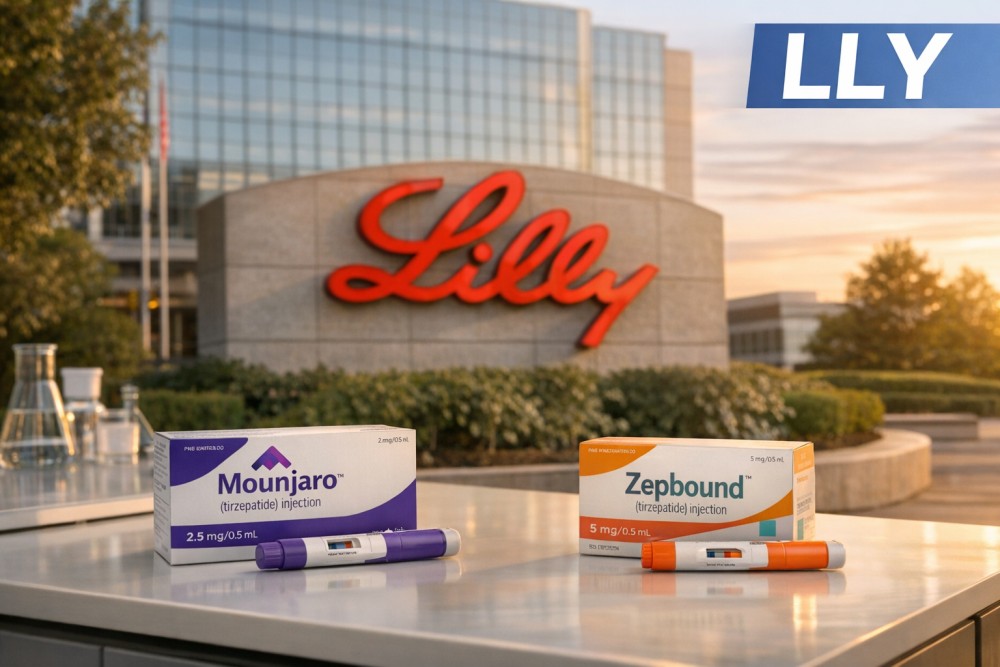
Eli Lilly Q1 2026 earnings land Wednesday April 30 pre-market US. If you already hold Eli Lilly (LLY), the print is less about a buy decision and more about how the GLP-1 franchise is tracking.
Mounjaro plus Zepbound delivered roughly 56% of LLY revenue last year. That concentration is why three signals on the call should reshape how you size and manage your existing position.
This is an existing-holder lens, not a thesis pitch. You already own LLY, so the question is whether Wednesday confirms the franchise story or shows the first cracks worth trimming around.
The setup matters: pharma was untouched in this week's earnings batch, so LLY is the cleanest read-through into the broader GLP-1 cohort. Watch how peers trade post-print before sizing any other moves.
3 GLP-1 Signals That Will Move LLY This Week
1. Mounjaro diabetes vs Zepbound obesity revenue split
According to Yahoo Finance, Mounjaro and Zepbound generated combined 2025 sales of $36.5 billion, around 56% of total Eli Lilly revenue.
The split between the two matters more than the headline number. Mounjaro carries diabetes pricing power, while Zepbound carries the obesity volume but more pricing exposure.
If Wednesday shows Zepbound growth decelerating against Mounjaro on the same tirzepatide molecule, the obesity-pricing thesis hits faster than the buy-side has modeled.
For your LLY position, watch the year-on-year growth rates side by side. A widening gap with Zepbound trailing is the signal that revenue mix is shifting toward lower-price obesity scripts.
If both grow in line, the franchise is healthy and your existing weight does not need an active trim. Use the pre-market reaction to confirm before doing anything.
2. Manufacturing capacity and Indianapolis plant ramp
The earlier supply ceiling on Mounjaro and Zepbound was the single biggest reason FDA listed both drugs on shortage through most of 2024. That backdrop is what the Indianapolis and Lebanon, Indiana capacity build was supposed to fix.
On Wednesday, the question is whether the autoinjector and vial lines are running at the throughput management committed to last quarter. Any commentary about further capex pull-ins is a positive signal for 2027 volume.
Soft language about "phased ramp" or delayed lines is the warning sign. Novo Nordisk (NVO) can keep clawing back share if Wegovy supply normalises at the same time as a Lilly capacity miss.
3. Pricing pressure from compounding pharmacies and Medicare
Pricing is now the cleanest threat to the LLY GLP-1 thesis, because volume has largely been solved. According to FinancialContent, branded GLP-1 cash prices have collapsed from over $1,000 to roughly $299 to $350 per month.
Medicare obesity coverage opens by July 2026, with CMS-negotiated maximum fair pricing on semaglutide already at $274 per 30-day supply. Lilly's LillyDirect single-dose vial program at around $299 is the company's response, but it trades unit margin for volume.
Listen on Wednesday for gross-to-net commentary on Zepbound. If gross-to-net erosion accelerates, the 2026 EPS bridge tightens even with strong script growth.
Before Wednesday's open, pull up your LLY position and check the weight against your full healthcare exposure. If you also hold Pfizer (PFE), Merck (MRK), or Amgen (AMGN), your real pharma sleeve is bigger than LLY alone. Review your portfolio in the Gotrade app.
Post-Print Scenarios for LLY Shareholders
A clean beat with Zepbound revenue ahead, gross-to-net stable, and capacity commentary upbeat is the bull scenario. In that case, existing holders can keep current sizing and let the print do the work, with no need to add into strength.
An in-line print with mixed commentary, where revenue beats but pricing language softens, is the most likely outcome. Position-trim discipline matters here. Consider rebalancing if LLY now sits above your target healthcare weight, especially if you have not touched the position since the 2024 to 2025 rally.
A miss on either Mounjaro or Zepbound revenue, paired with explicit gross-to-net pressure, is the scenario that forces a real review. The first move is to size the position back toward your target rather than to exit. Earnings-driven volatility tends to overshoot in both directions, and selling the day of a miss historically gives you the worst fill.
Conclusion
LLY Wednesday is not a referendum on whether to own the stock. It is a check on whether three pillars under your existing position still point the same way they did last quarter.
Those pillars are the Mounjaro-Zepbound mix, manufacturing throughput, and gross-to-net trajectory. Read the print through that frame and you can walk into Thursday with a calibrated view rather than a reactive one.
Pair the takeaways with the framework in our guide to analyzing a stock before earnings so the read-through is structured, not headline-driven. The point is to act on data, not on the first ticker scroll after the bell.
Open the Gotrade app now and review your LLY weight against your other healthcare positions. Use the watchlist to track the post-print move on NVO, PFE, MRK, and AMGN as the read-through propagates across the pharma sleeve.
FAQ
Q: When does LLY report Q1 2026 earnings?
LLY reports Wednesday April 30, 2026 pre-market US.
Q: What share of LLY revenue comes from Mounjaro and Zepbound?
Combined GLP-1 sales were about 56% of total revenue in 2025.
Q: When does Medicare start covering obesity drugs?
Medicare obesity coverage opens no later than July 2026 under the new pilot.