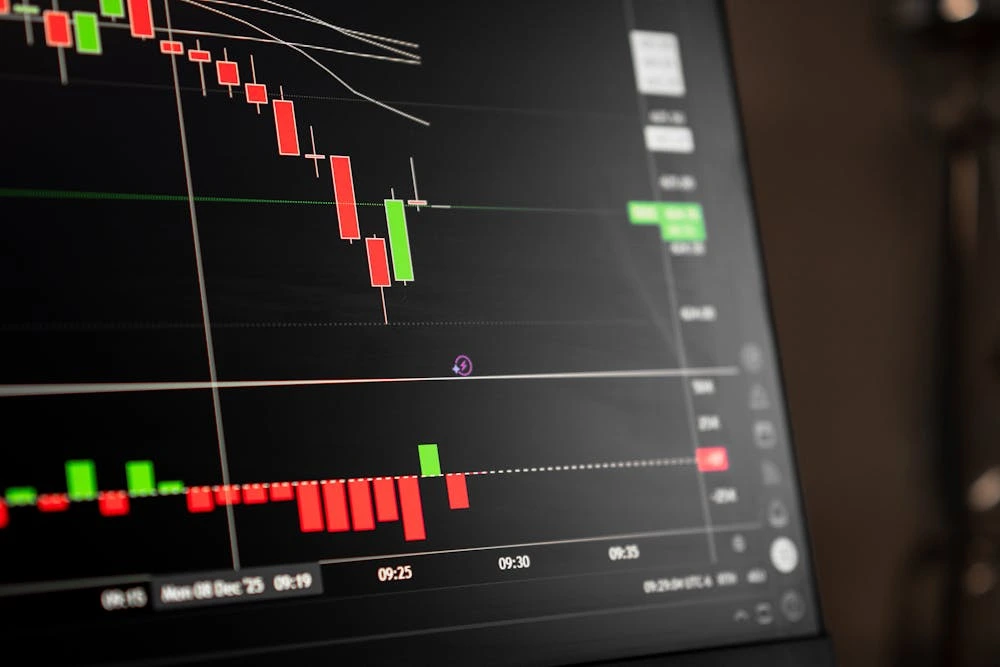
Multi-timeframe analysis is a way to read the same asset across several chart timeframes. Instead of relying on one chart, traders compare higher and lower timeframes to understand trend direction, possible entry areas, and risk more clearly.
This approach can help reduce false signals and keep trades aligned with broader market structure. However, it does not guarantee better results. It works best when combined with clear risk management and a consistent trading plan.
What Is Multi-Timeframe Analysis
Multi-timeframe analysis means analyzing the same asset on more than one timeframe.
Instead of trading from a single chart, traders look at higher, middle, and lower timeframes together. Each timeframe provides different information about trend, momentum, and noise. The goal is not to predict more, but to see the market more clearly.
Understanding timeframe roles
| Timeframe Role | Purpose | Common Examples |
|---|
| Higher timeframe | Identify the main trend and key support or resistance levels | Weekly or daily chart |
| Middle timeframe | Find potential setups within the larger trend | 4-hour or 1-hour chart |
| Lower timeframe | Fine-tune entry, exit, and risk placement | 15-minute, 5-minute, or shorter chart |
Why Multi-Timeframe Analysis Matters
Markets move in layers.
Trends exist across different horizons
A stock can be in a long-term uptrend while pulling back in the short term. Looking at only one timeframe can distort this picture.
Reduces false signals
Many indicators and patterns fail when taken out of context. Higher timeframes help filter low-quality signals from lower timeframes.
Improves decision confidence
When multiple timeframes align, the trade idea can feel more structured. However, confidence should not replace risk management. Even aligned setups can fail.
How Multi-Timeframe Analysis Works
Multi-timeframe analysis follows a top-down approach.
Start with the higher timeframe
The higher timeframe defines the primary trend and key levels. Daily or weekly charts are commonly used for this step.
This timeframe answers the question: what is the market direction?
Move to the execution timeframe
The middle timeframe helps identify setups within the larger trend. This is often a 1-hour or 4-hour chart. It refines structure without excessive noise.
Use the lower timeframe for entries
The lower timeframe is used to fine-tune entries and exits. This helps control risk and improve timing. Lower timeframes should not override higher timeframe direction.
Choosing Timeframes That Work Together
Not all timeframe combinations make sense.
Maintain logical spacing
Timeframes should be meaningfully different. For example, daily, 4-hour, and 15-minute charts work well together. Using timeframes that are too close adds confusion.
Match timeframe with trading style
Swing traders often use daily and 4-hour charts. Day traders may use 1-hour and 5-minute charts.
The structure should fit your strategy, not the other way around.
Consistency matters more than precision
Using the same timeframes consistently improves decision quality. Frequent switching leads to second-guessing.
Gotrade Tips for Multi-Timeframe Analysis
When analyzing US stocks or ETFs in Gotrade, start by checking the broader trend before focusing on short-term movement. You can use a watchlist to track stocks or ETFs that are approaching key levels, then review whether the short-term setup still matches the larger trend.
Before placing a trade, check the ticker, instrument type, order value, and risk level. Multi-timeframe analysis can help with structure, but it should not be the only reason to buy or sell.
Common Mistakes in Multi-Timeframe Analysis Trading
Multi-timeframe analysis is often misused.
Overloading with too many timeframes
Looking at too many charts creates conflicting signals. This leads to hesitation and missed trades.
Letting lower timeframes dominate
Lower timeframes are noisy and emotional. They should support, not contradict, higher timeframe direction.
Changing bias mid-trade
Switching timeframes during a trade often leads to poor decisions. Bias should be set before entry.
Treating alignment as certainty
Multi-timeframe alignment improves probability, not certainty. Risk management is still required.
Practical Example of Multi-Timeframe Analysis
An example clarifies the process:
A trader looks at a stock on the daily chart and sees a clear uptrend. Price is above key moving averages and structure remains intact.
- On the 4-hour chart, price is pulling back toward support. This suggests a potential opportunity rather than weakness.
- On the 15-minute chart, price shows signs of stabilization and higher lows. The trader enters with defined risk, aligned with the higher timeframe trend.
The trade works not because of prediction, but because of alignment.
Multi-Timeframe Analysis and Trading Discipline
Multi-timeframe analysis supports discipline. It encourages patience by waiting for alignment.
It reduces emotional reactions to short-term volatility. Most importantly, it shifts focus from prediction to structure.
Conclusion
Multi-timeframe analysis helps traders see the market from multiple perspectives at once. By understanding what multi timeframe analysis is, why it matters, and how multi timeframe analysis trading works, traders can improve clarity, timing, and risk control.
This approach does not eliminate losses, but it reduces unnecessary mistakes. When used consistently, it creates a structured decision-making process rather than reactive trading.
When trading stocks or ETFs through the Gotrade app, using multi-timeframe analysis can help you align entries with broader trends and make more disciplined trading decisions.
FAQ
What is multi-timeframe analysis?
Multi-timeframe analysis is the practice of analyzing price across multiple chart timeframes.
How many timeframes should I use?
Most traders use two or three timeframes to avoid confusion.
Is multi-timeframe analysis suitable for beginners?
Yes, as long as it is kept simple and consistent.
Does multi-timeframe analysis guarantee better results?
No. It improves context, not certainty.
Reference: