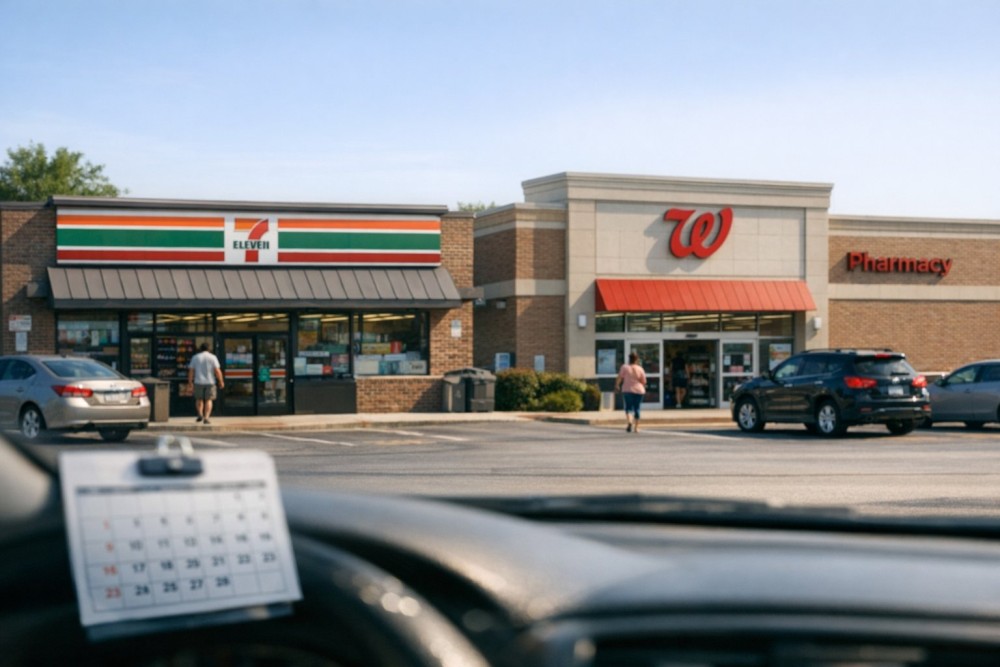
The Realty Income vs Agree Realty debate is the cleanest matchup in monthly dividend investing right now. Both pay every month. Both run triple-net leases on retail tenants.
One is the giant. Realty Income (O) trademarked "The Monthly Dividend Company" and owns more than 15,500 properties.
The other is the challenger. Agree Realty (ADC) only switched to monthly dividends in 2021, but its smaller portfolio and faster growth have built a loyal following on Seeking Alpha and dividend Twitter.
Triple-Net Lease 101: Why This Model Prints Cash
Triple-net (NNN) leases shift three big costs to the tenant: property taxes, insurance, and maintenance. The landlord collects rent and walks away.
That structure is why net-lease REITs throw off such steady cash flow. Vacancy is rare because leases run 10 to 15 years. Cost surprises are rare because the tenant absorbs them.
Names like Simon Property Group (SPG) and VICI Properties run different lease structures, so they are not direct comps. For pure NNN retail, O and ADC are the two cleanest choices on the US market.
Dividend Growth Track Records: 30+ Years vs 12+ Years
Realty Income is in a different league on history. According to Realty Income's Q1 2026 release, the company announced its 134th dividend increase since its 1994 NYSE listing, plus its 31st consecutive year of growth. That qualifies it as an S&P 500 Dividend Aristocrat.
Realty Income still calls itself "The Monthly Dividend Company" because it has paid every month since 1969.
Agree Realty is the younger story. ADC raised its dividend at a roughly 6% compound annual rate over the past decade and switched from quarterly to monthly payouts in January 2021. It has about 12 years of consecutive dividend growth, which is solid but not Aristocrat tier.
O wins on the streak. ADC wins on recent percentage growth rate.
Yield, AFFO Multiple, and Tenant Quality Side-by-Side
The numbers below reference each company's most recent quarterly disclosures and 2026 investor materials.
Dividend Yield Right Now
Realty Income trades around a 5.3% yield based on its $3.246 annualized dividend as of March 31, 2026. Agree Realty sits closer to the mid-4% range, recently quoted around 4.4% to 4.6%. O wins on raw current yield by roughly 70 to 90 basis points.
P/AFFO Multiple and Growth
ADC trades at roughly 16 to 17 times forward AFFO, based on 2026 AFFO guidance of $4.54 to $4.58. Realty Income trades at a lower multiple after underperforming in 2024 and 2025, with 2026 AFFO guidance of $4.41 to $4.44.
The market is paying up for ADC's faster growth. ADC's 2026 guidance implies roughly 5.4% AFFO growth at the midpoint. Realty Income's implies 3.0% to 3.7%.
Tenant Quality and Concentration
| Metric | Realty Income (O) | Agree Realty (ADC) |
|---|---|---|
| Dividend yield | ~5.3% | ~4.4%-4.6% |
| 2026 AFFO guidance | $4.41-$4.44 | $4.54-$4.58 |
| Forward P/AFFO | ~13x-14x | ~16x-17x |
| AFFO payout ratio | ~74% | ~69%-71% |
| Properties | ~15,500+ | ~2,756 |
| Top tenant | ~3.3% (none over 4%) | Walmart at 5.6% |
| Investment-grade ABR | ~36% | ~65% |
| Dividend growth streak | 31 years | ~12 years |
ADC has higher tenant credit quality but more concentration up top. O has the bigger, more diversified portfolio, with a lower share of investment-grade rent.
Want to compare these two side by side in your own portfolio? You can buy Realty Income (O) and other US dividend REITs in fractional shares on Gotrade from $1.
Which Fits Income Portfolios at Today's Valuations
If you want maximum current income and a 3-decade growth streak, Realty Income (O) is hard to beat. The 5%+ yield, the lower P/AFFO multiple, and the Aristocrat status are exactly what most retiree-style income portfolios need.
If you want faster dividend growth and tighter tenant credit quality, ADC is the cleaner pick, but you pay for it in a higher multiple and a lower starting yield.
Many income investors hold both. The two are highly correlated but not identical, and owning a piece of each smooths single-name risk while keeping the monthly cadence intact.
Conclusion
Realty Income vs Agree Realty is not a clean winner-take-all comparison. It is a yield-versus-growth tradeoff, dressed up as monthly dividend stocks.
O gives you the higher yield, longer streak, and more diversified base. ADC gives you higher-credit tenants and faster AFFO growth at a richer multiple. Both survive rate cycles and tenant bankruptcies.
You can buy fractional shares of Realty Income (O) and explore other monthly dividend ideas across US stocks on Gotrade from $1.
FAQ
Is Realty Income (O) safer than Agree Realty (ADC)?
O has lower tenant concentration with no single tenant above 4% of rent, plus a 31-year dividend growth streak. ADC has higher investment-grade tenant exposure at roughly 65% of rent. Both rate as low-risk for net-lease REITs.
Why did Agree Realty switch to monthly dividends?
ADC moved from quarterly to monthly payouts in January 2021 to align with retail income investors who prefer steady monthly cash flow. The switch did not change total annual dividend amounts.
What is a triple-net lease REIT?
A triple-net lease REIT owns properties where tenants pay property taxes, insurance, and maintenance on top of rent. This shifts most operating costs to the tenant, leaving the REIT with predictable cash flow.
Which REIT has a higher dividend yield in 2026?
Realty Income (O) currently yields around 5.3%, roughly 70 to 90 basis points above Agree Realty (ADC), which yields in the mid-4% range. O wins on starting yield, ADC wins on dividend growth rate.
Can I buy these REITs in fractional shares on Gotrade?
Yes. You can buy Realty Income (O) and most other US-listed REITs in fractional shares on Gotrade, starting from $1. ADC is also tradable as a standard US-listed stock.