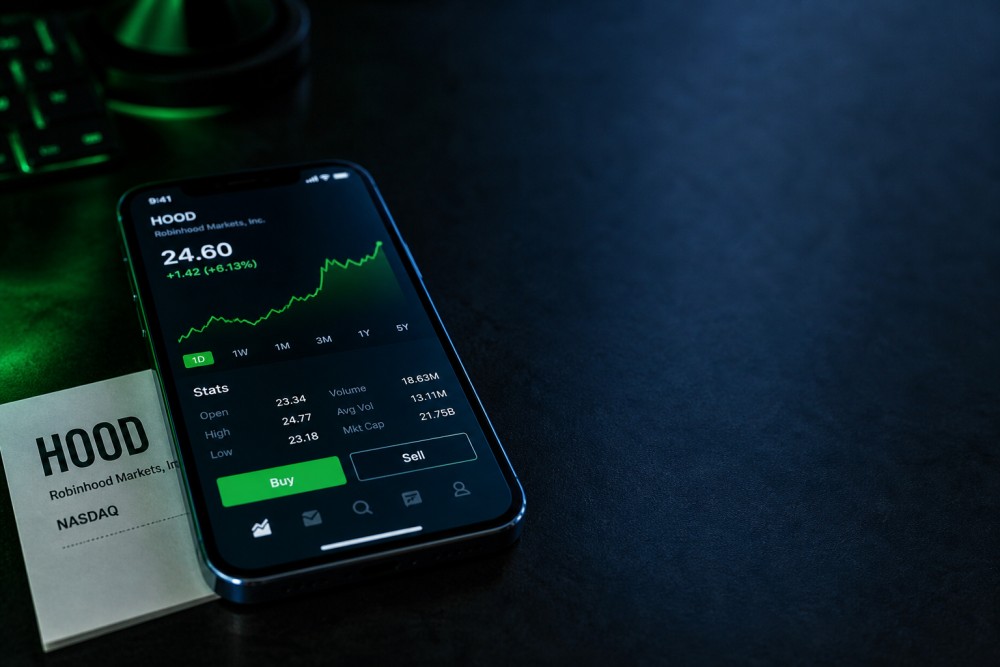
Robinhood stock 2026 is a tricky call. HOOD trades near record highs after a multi-quarter run, so the question is no longer whether it can grow. It is whether the price already reflects that growth.
US markets are at record highs this June, and retail trading activity is strong. That backdrop has lifted brokers like Robinhood, but it also raises the stakes for anyone buying today.
Below we walk through what drove the rally, where new revenue comes from, the bull versus bear debate, and a simple framework to decide whether to buy, hold, or trim. The goal is a decision you can defend, not a price prediction.
Why HOOD Has Surged With the Retail Trading Boom
Robinhood makes most of its money when people trade, so its results rise and fall with retail risk appetite. With markets at record highs in 2026, that appetite has been strong, and trading volumes have followed.
The numbers reflect it. Per The Motley Fool, total revenue grew 15% year over year to $1.07 billion in the first quarter of 2026, even as one segment cooled sharply.
The deeper change is the customer mix. Robinhood has added retirement accounts, a paid Gold subscription, and more active traders, which makes each user worth more over time. That is what convinced the market to value HOOD as a platform, not a single trading app.
You can track Robinhood (HOOD) alongside peers like SoFi (SOFI) to see how the broader retail-finance group moves together when sentiment shifts.
Crypto, Prediction Markets, and New Revenue Lines
The headline story for Robinhood is diversification. The company now earns money from crypto, prediction markets, retirement accounts, Gold subscriptions, and tokenized stocks in Europe.
Prediction markets are the new growth engine
Event contracts, the core of its prediction-markets business, generated $147 million in the first quarter, a 320% jump from a year earlier. Monthly volume climbed from under $100 million in early 2024 to over $13 billion by late 2025.
That speed matters because these contracts carry high margins and are not tied to stock prices. A second engine that can run when equities are quiet is exactly what reduces the boom-and-bust feel of the business.
Crypto is still a swing factor
Crypto remains a powerful but cyclical line. The same quarter saw crypto revenue fall 47% to $134 million, a reminder that this segment moves sharply with token prices.
Crypto trading also keeps Robinhood tied to peers like Coinbase (COIN), whose results often signal where digital-asset activity is heading. When crypto cools across the industry, it tends to show up in Robinhood's numbers too.
Bull vs Bear Case After the Record Run
The bull case is straightforward. Revenue is broadening beyond equities, operating leverage is improving, and prediction markets are scaling fast. One analyst cited by The Motley Fool sees prediction-market volume reaching $1 trillion a year by 2030.
The bear case is about cyclicality. Robinhood's revenue still leans on retail enthusiasm and crypto activity, both of which can reverse quickly if markets cool.
There is also a competitive angle. Robinhood is no longer just a disruptor, it now sits next to incumbents on features and pricing, a contrast we covered in our Robinhood (HOOD) vs Charles Schwab (SCHW) 2026 guide.
Sell-side opinion sits in between. According to CNBC, Robinhood remains a frequent subject of analyst calls in 2026, with a broadly constructive but far from unanimous view on the stock.
Want exposure to the retail-trading theme without buying a full share? Open a Gotrade account and start with fractional shares from $1.
Buy, Hold, or Trim: Valuation and Risks
After a strong run, valuation is the crux. A stock priced for fast growth needs that growth to keep arriving, or the multiple compresses and the price falls even if results stay fine.
So the real question is not whether Robinhood is a good company. It is how much future growth you are paying for, and how confident you are that retail activity stays elevated.
If you do not own HOOD, dollar-cost averaging a small position is gentler than chasing the high in one buy. If you already hold a winner, trimming back to your target weight locks in gains without abandoning the thesis entirely.
The main risks to watch are a retail-trading slowdown, a deeper crypto downturn, and regulatory questions around prediction markets. None of these is a thesis-breaker on its own, but together they argue for position sizing you can sleep with.
Conclusion
Robinhood has earned its rerating by turning a one-product trading app into a broader financial platform, and the prediction-markets engine gives it a genuinely new growth lever. The catch is that the easy gains may already be in the price, so your entry point and position size matter as much as the story.
For most investors, the sensible move is to decide your target weight first, then build or trim toward it rather than making one all-in call. Want to act on your view of HOOD with fractional shares from $1? Open a Gotrade account to get started.
FAQ
Is Robinhood stock a buy in 2026?
Analysts are broadly constructive, but after the record run a small, scaled-in position fits most investors better than chasing the high.
What is driving HOOD's revenue growth?
Diversification into prediction markets, crypto, retirement accounts, and subscriptions is spreading revenue beyond core equity trading.
What is the biggest risk to HOOD stock?
Its revenue still depends on retail-trading enthusiasm and crypto activity, both of which can drop quickly when markets cool.
Should I take profits on Robinhood?
Trimming a large winner back to your target weight locks in gains while keeping exposure if the growth story continues.