The Tesla Q1 2026 earnings print landed with a split personality. The income statement looked clean, but the guidance reset the stock setup for the rest of the year.
Revenue rose 16 percent year over year. Capex guidance jumped 25 percent above the prior plan in a single quarter.
For investors holding Tesla (TSLA), this report is the clearest signal yet that the company is shifting from a car maker into an AI and robotics platform.
TSLA Q1 2026 Headline Numbers
Total revenue came in at $22.4 billion, up 15.8 percent year over year. Auto revenue rose 16 percent to $16.2 billion.
Adjusted earnings per share landed at $0.41, up roughly 52 percent. That beat the consensus estimate of $0.37.
Gross margin reached 21.1 percent, the strongest reading in several quarters. Auto gross margin excluding regulatory credits improved to 19.2 percent.
Operating income climbed to $0.9 billion. Q1 free cash flow stayed positive at around $1.4 billion.
The energy storage business reported $2.41 billion in revenue, down 12 percent from the year ago period as the segment digests price normalization.
According to TIKR, the company also reported its highest order backlog in over two years entering Q2. That backlog matters because it gives the auto segment visibility into the next two quarters even as deliveries face tougher comparisons.
The earnings calendar matters here. If you want to learn how to position around prints like this, our guide on how to use the earnings calendar to plan trades walks through the playbook for high volatility names.
Robotaxi Update: Austin, Dallas, and Houston Rollout
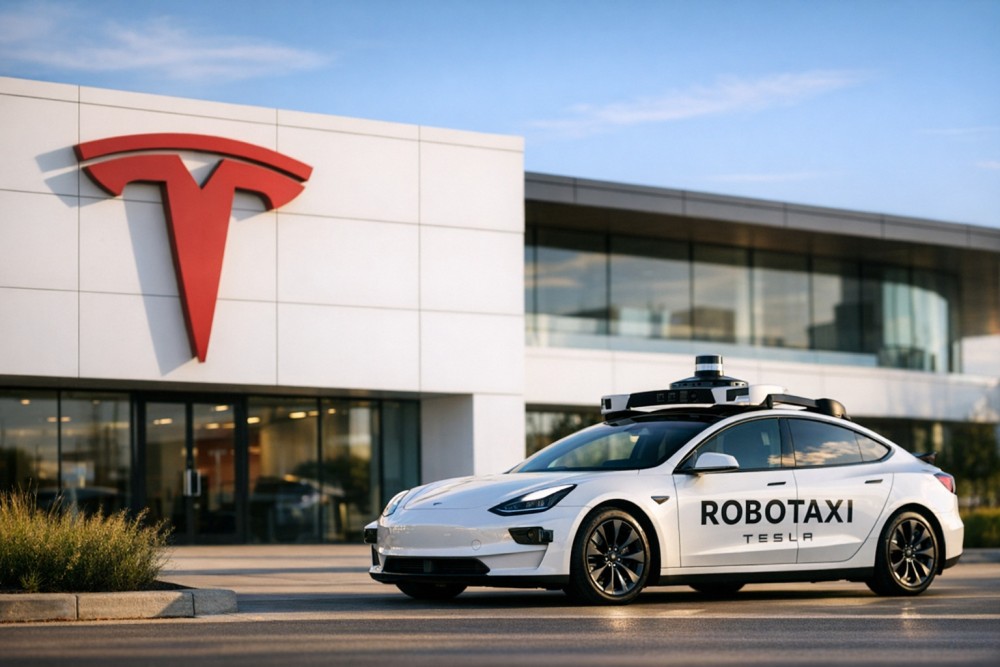
Tesla expanded its unsupervised Robotaxi service to three Texas cities during Q1. Austin remains the lead market, with Dallas and Houston going live in April.
Paid Robotaxi miles nearly doubled sequentially. Management is targeting unsupervised Full Self-Driving in roughly a dozen US states by year end.
The catch is timing. CEO Elon Musk said Robotaxi revenue will not be material in 2026, with meaningful contribution pushed into 2027.
That gap between product launch and revenue is the central tension in the stock right now. Tesla has the technology in market, but the unit economics scale slowly while the fleet is still small.
Trade Tesla and 4,000+ US stocks with fractional shares from US$1, zero commission. Open your Gotrade account today and act on the Q1 setup.
Hardware 3 FSD Limitation and Customer Impact
The most awkward disclosure on the call was hardware. Vehicles built with Hardware 3 cannot support unsupervised FSD without expensive computer and camera retrofits.
That fleet is large. Many cars sold between 2019 and 2023 carry the older chip and were marketed with future autonomy in mind.
The implication is concrete. Older Tesla vehicles cannot be added to the Robotaxi fleet at scale, which caps near term monetization of the installed base.
This also creates a customer service question. Owners who paid for FSD on Hardware 3 cars now face a clear gap between what was promised and what the chip can deliver without retrofit.
For long term shareholders, this is a reminder that durable returns come from understanding what you actually own. Our piece on 12 principles of successful traders lays out how to manage that conviction through volatile prints.
Capex Lift to $25B: Cybercab, Optimus, and AI Compute
The capex line is where the report changed the narrative. Tesla raised 2026 capex guidance to over $25 billion, roughly $5 billion above the prior plan.
That figure is about three times its 2025 spend. According to TechCrunch, the budget covers AI training infrastructure, chip design, the Austin semiconductor research fab, and the Cybercab and Optimus production ramps.
Cybercab production has just started. Optimus humanoid production is targeted for late summer with a slow initial ramp.
The Fremont factory is being retooled for Optimus as Model S and Model X production winds down. Tesla is now competing for AI compute alongside NVIDIA (NVDA) customers and other hyperscalers.
The cost is real. Free cash flow is expected to turn negative for the remaining three quarters of 2026.
That is the bull and bear case in one line. Bulls see the AI build as a foundation for a higher revenue base, similar to the growth thesis described in our growth investing guide. Bears see negative cash flow against a slowing core auto business that still competes with Ford (F) and other legacy brands.
Conclusion
Tesla Q1 2026 earnings cleared the bar on the income statement and reset expectations on capital allocation. Revenue, margin, and EPS came in strong.
The Robotaxi rollout in Austin, Dallas, and Houston gives the AI story a tangible product. The Hardware 3 limitation and the $25 billion capex guide are the costs of that pivot.
If you want exposure to TSLA without committing thousands of dollars, Gotrade apps lets you buy fractional shares from US$1. Start your position today and follow the AI build quarter by quarter.
FAQ
What was Tesla Q1 2026 revenue?
Tesla reported $22.4 billion in Q1 2026 revenue, up 15.8 percent year over year.
How much is Tesla spending on capex in 2026?
Tesla guided to over $25 billion in 2026 capex, about $5 billion above the prior plan and roughly three times its 2025 spend.
Where is Tesla Robotaxi available now?
Tesla Robotaxi operates in Austin, Dallas, and Houston, with plans to expand to roughly a dozen US states by the end of 2026.
Why does Hardware 3 matter for Tesla owners?
Hardware 3 vehicles cannot support unsupervised Full Self-Driving without costly retrofits, which limits how many existing Teslas can join the Robotaxi fleet.