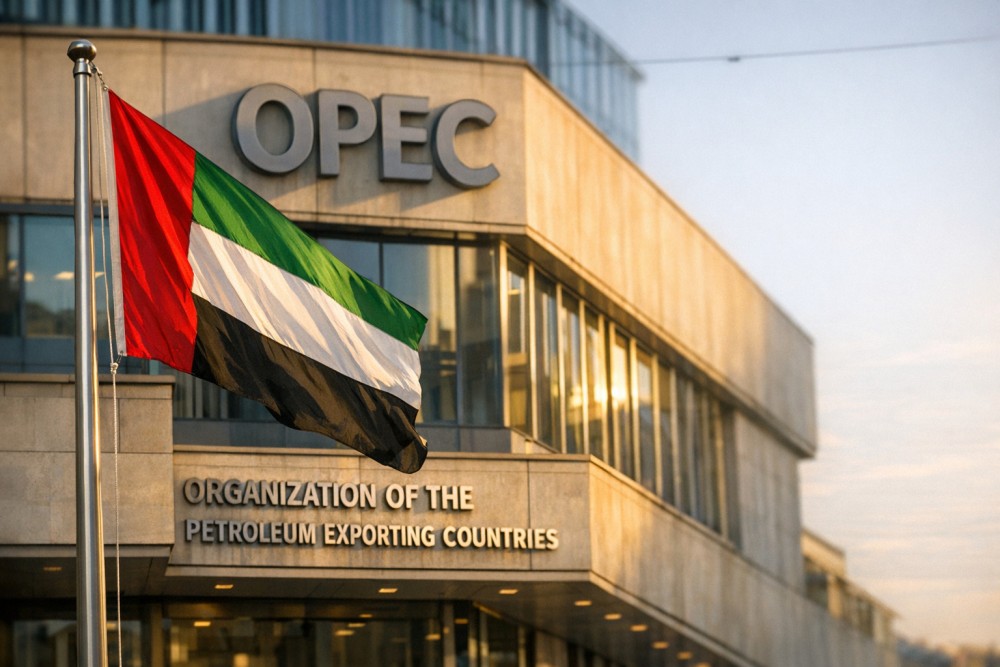
The UAE leaves OPEC on May 1, 2026, removing the cartel's third-largest producer after nearly six decades of membership. The decision was announced on April 28 and reshapes the supply side of the global oil market.
Crude prices reacted in two directions. They first fell on supply-glut fears, then rebounded as Iran-related risk premiums returned.
For US retail investors, the exit creates clear winners and losers across the energy complex. Below is the practical read for your portfolio.
Why the UAE Exited OPEC and Geopolitical Read
Abu Dhabi spent years pushing for a higher production quota inside OPEC+. Its quota of about 3.2 million barrels per day sat well below its sustainable capacity, which sits closer to 4.85 million.
According to Al Jazeera, the UAE Energy Minister cited a careful look at current and future production policies and pointed to national interests rather than consultation with Saudi Arabia.
The split also reflects deeper Gulf rivalry. The UAE wants to monetize barrels before global demand peaks, while Saudi Arabia still anchors the cartel's pricing strategy.
The geopolitical context matters too. The exit landed during the active Iran conflict and disruption around the Strait of Hormuz, which has already squeezed global supply.
The UAE has also invested over $150 billion in Abu Dhabi National Oil Company expansion. That capital wants returns, and OPEC quotas were the friction point.
For investors, the takeaway is simple. OPEC just lost one of its few holders of meaningful spare capacity, and its ability to defend a price floor is now structurally weaker.
Crude Oil Price Reaction and Forward Curve
The first reaction was a 2 to 3 percent dip in near-term futures on supply-glut fears. That move did not last.
According to Euronews, WTI crude traded above $105 per barrel and Brent crude cleared $112 within 24 hours of the news, both around 4 percent higher.
The forward curve tells the real story. Front-month contracts stay elevated as long as Hormuz traffic is constrained.
Longer-dated contracts, by contrast, are pricing in a looser market. UAE barrels released from the OPEC ceiling would add real volume by 2027 if Abu Dhabi hits its 5 million barrel per day target.
Implied volatility on Brent options has also widened. Options markets are now pricing in a wider range of outcomes for the second half of 2026.
Want exposure to the energy theme without picking a single stock? Open a Gotrade account and trade fractional shares of XOM, CVX, OXY, EOG, or energy ETFs from US$1, with zero commission. Start with energy stocks here.
Beneficiaries: XOM, CVX, OXY, EOG
US upstream and integrated producers are the most direct beneficiaries of the new oil regime.
Higher near-term Brent and WTI flow straight into upstream cash flow, while the supply uncertainty pushes capital toward US shale rather than OPEC barrels.
Exxon Mobil (XOM) has the most diversified portfolio, with strong Permian and Guyana exposure that benefits as integrated majors gain pricing power.
Chevron (CVX) is the higher-yield name in the group, with a downstream business that smooths cash flow if prices retrace.
Occidental Petroleum (OXY) is the highest-beta major to crude, given its Permian-heavy mix and its leverage profile.
EOG Resources is a pure shale operator with a strong balance sheet and break-evens around $40 to $45 per barrel, which means meaningful free cash flow at current strip prices.
Beyond the four single names, large-cap energy ETFs like XLE and XOP capture the same theme with built-in diversification. Retail investors who want exposure without single-stock risk often start there.
Investors should remember that geopolitical events impact stock portfolios in non-linear ways, so position sizing matters more than picking the single best name.
Pressured Names: Refiners, Airlines, Trucking
Higher crude is not a tide that lifts every energy-adjacent boat.
Refiners face crack spread compression when crude rises faster than gasoline and diesel. Independent refiners with thinner hedges are the most exposed.
Airlines lose first. Jet fuel is roughly 25 to 30 percent of operating costs, and most carriers cannot hedge their full 2026 book at current futures levels.
Trucking and freight margins also compress. Diesel surcharges only partly pass through, and contract rate negotiations lag spot fuel by weeks.
Consumer discretionary names with high logistics exposure also feel the pinch. Watch retailers and food delivery operators where freight costs flow directly into gross margin.
The broader market reaction often looks like a brief drawdown rather than a crash. Market corrections in commodity-shock periods historically last around three months before recovery, which favors disciplined rebalancing over panic selling.
Conclusion
The UAE leaving OPEC is a structural shift, not a one-day headline. Spare capacity inside the cartel just got smaller, and US shale is positioned to fill the gap.
For retail investors, the practical move is to review your energy exposure now. Tilt toward upstream names like XOM, CVX, OXY, and EOG, and trim airline and refiner overweights if you have them.
You can act on this with fractional shares from US$1 and zero commission. Open a Gotrade account here and start positioning today.
FAQ
Has the UAE actually left OPEC?
Yes. The UAE announced its exit on April 28, 2026, with the withdrawal effective May 1.
Which US energy stocks benefit the most?
Upstream and integrated names like XOM, CVX, OXY, and EOG benefit most from sustained higher crude prices.
Will gasoline prices rise at the pump?
Near-term yes, given Hormuz disruption. Longer-term pressure eases as UAE barrels enter the market without an OPEC ceiling.
Are airlines a good buy on this news?
Probably not in the short term. Higher jet fuel costs and limited hedging make most carriers vulnerable until crude stabilizes.