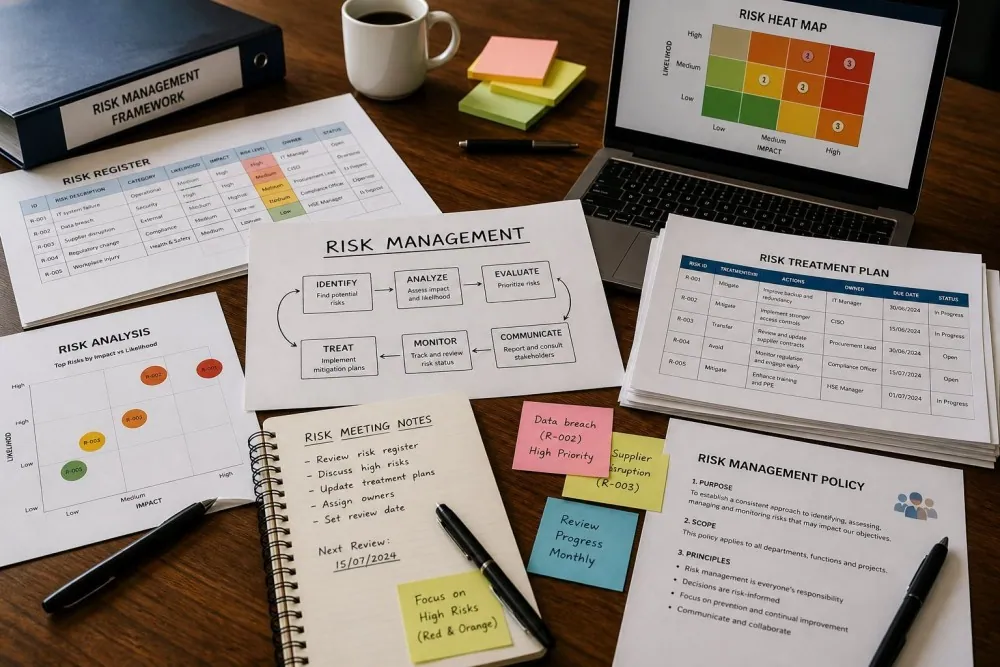
Risk management is not optional when investing and trading.
You should know your psychological and financial limits, set a strategy that suits your profile, and follow the plan thoroughly.
Evaluate your risk profile regularly to prevent putting yourself in difficult positions.
What Is Risk Management in Investing?
Risk management means identifying and reducing financial risks in your portfolio by means of knowing, mitigating and accepting specific levels of uncertainties during decision making.
Since investing (and day trading alike) involves risks and volatility, you will encounter wins and losses. This requires you to keep your losses smaller than your profits, by managing multiple types of risks.
The Main Types of Investment Risk
Every investment carries risk, and there is no such thing as bulletproof strategy. What you can do is understand each risk, calculate and decide how risk you are willing to take that is still profitable in the long run.
The U.S. Securities and Exchange Commission's investor education site, Investor.gov, lists several of these as core risks for every investor. These are the five that matter most for someone buying US stocks from outside the United States.
Market Risk
Market risk is the chance that stock prices fall across the whole market. Usually, it's some global or national phenomenon that affects almost every company. Prime examples are the 2008 market crash and prices fall during COVID-19 pandemic.
In February and March 2020, the S&P 500 fell by about a third in around five weeks as the pandemic spread worldwide, and most stocks fell with it.
Diversification does not really prevent market risk, because it hits nearly every company whose stocks you may own. The main way to manage this risk is by limiting how much of your total (real life) wealth you put into stocks. There are other ways and places to save your earnings, and you should explore those besides stocks.
Concentration Risk
Concentration risk is high when you put all your eggs in one basket. Putting all your money into one stock or one sector (industry) will raise this risk. This is when diversification will help you.
Sometimes, your portfolio looks diverse, but most of them are stocks that tend to rise and fall together.
Study the possibilities of spreading your money across multiple companies and industries. Whether you are day trading or investing for the long run, you should also consider looking at diversified instruments.
Liquidity Risk
Sometimes, you may encounter liquidity problem when there is not enough people willing to buy your stocks, hence you have difficulties selling them. Popular US stocks are usually heavily traded with plenty of buyers and sellers, so this risk is generally low for them during normal market hours.
Liquidity risk rises when you have small, thinly traded stocks, where the gap between the buying and selling price (the bid-ask spread) can be wide. In this situation, you will need more time to sell your stocks.
When buying slow moving stocks, only use money that you are not going to need shortly. If you invest money you may need for rent, school fees, or an emergency, you will be forced to sell, sometimes at a bad moment. Limiting your budget for low-liquidity stocks will lower this risk.
Currency Risk for Non-US Investors
US stocks are priced in US dollars. If your home currency is something else, your real return (profits and losses) will also depends on dollar's position against your currency.
If the dollar strengthens against your currency, the US stocks you hold will be worth more when you convert back, even if the stock price did not move. If the dollar weakens, part of your gain can disappear, or a small loss can become bigger. Beware of your currency fluctuation against USD, and take it into considerations when buying or selling US stocks.
Behavioral Risk
Behavioral risk is when your own decisions are harming your profit. Things like panic-selling when you see a price drop, buying stocks for the hype, holding a stock too long instead of cutting losses, trading too often, buying too many stocks, and so on.
This is the one risk on the list that you can learn to control. Learn the basics, practice with virtual trading tools, and you should come up with a trading plan. make sure your position sizes and exit rules are all decided before you buy. This prevents you from making decisions based on emotion, and lower the risk of taking losses due to your own behavior.
A Practical Risk Management Framework in 6 Steps
Step 1: Know Your Risk Tolerance and Risk Capacity
Risk tolerance means how much pressure you can take emotionally, before you start making bad decisions. Risk capacity means how much money you can afford to lose and still make correct decisions without putting your quality of life in danger.
Risk tolerance and capacity depends on your experience, goals, interests, knowledge, economic conditions, and many more. One investment strategy with the same amount of money will likely lead to different results for different people.
You should not put more money than you can afford to lose, and you should not buy financial instruments or assets with risks higher than what you can emotionally handle. You should only invest or trade while being able to live a normal life.
Step 2: Size Every Position Before You Buy
Position sizing means limiting the amount of money you can put into a single trade. A good rule of thumb for retail investors and traders is to risk no more than 2% of your capital on a single trade. This is just a general practice, and many fund managers put even lower limits.
Theoretically, with a 2% risk limit and stops that fill as planned, five losing trades in a row cost about 10% of your capital. You can try it in this position size and risk calculator:
Position Sizing Calculator
Step 3: Diversify Across Stocks, Sectors, and Asset Types
Always look for potential ways to diversify. Is there other types of assets and investments you are interested in besides stocks, or whatever instrument you currently have? If you hold multiple instruments, are they coming from the same or close sectors and industries? have you looked into ETFs or other kinds of bundled instruments? The more you know about different assets from different sources, the more you will feel comfortable diversifying your investments.
Step 4: Plan Your Exit Before You Enter
You should always know the point where you will cut your loss and exit, before buying your stocks. Be disciplined, learn to stop the bleeding, and move on. On the other hand, you should know how much gain you are aiming for, and where exactly to sell for profit.
Step 5: Learn the Math of Drawdowns
Drawdown in stock market means the drop from the highest recent value (peak) to the lowest subsequent value (trough) before recovering. A 10% loss needs 11% recovery to break even. A 20% loss needs 25%, and so on.
Step 6: Rebalance and Review on a Schedule
Dedicate some time to assess whether your portfolio is rightly balanced and diverse enough, for the risk level that you want. When some of your investments go up and down, the percentage of your money tied up in one item can be higher than it should be. You can move your money if the composition is deemed too risky.
Common Risk Management Mistakes to Avoid
Not cutting your losses, hoping that your investment will bounce back
Borrowing money or using leverage as a beginner
Trading without a plan
Not setting up an exit plan (example: stop-loss order)
Overconfidence and not diversifying
Frequently Asked Questions About Risk Management
What is the 1% or 2% rule in investing?
The 2% rule means risking no more than 2% of your total capital on a single trade.
Is a stop-loss order always a good idea?
A stop-loss order is an instruction to sell once the price falls to a level you set. It is not guaranteed: if the price gaps past your stop, for example overnight, it can fill lower and your loss can be larger than planned. However, you may also lose opportunities when the stock recovers even higher after the fall.
How many stocks do I need to be diversified?
There is no rule for this. 20-30 entities are common among traders, while having 200+ entities can be called "maximum diversification".
Gotrade is the trading name of Gotrade Securities Inc., which is registered with and supervised by the Labuan Financial Services Authority (LFSA). This content is for educational purposes only and does not constitute financial advice. Always do your own research (DYOR) before investing.
Sindhu Partomo is a copywriter and content writer with 8+ years of experience in agencies, B2B, and SaaS. He has been writing about business and finance since 2023, and holds a bachelor degree from University of Indonesia.
Hendrie Saputra holds a Master of Business Administration (MBA) with a concentration in Business Risk & Finance, along with professional experience in finance, marketing, and project management. He is experienced in analyzing market data and developing research-driven business strategies.