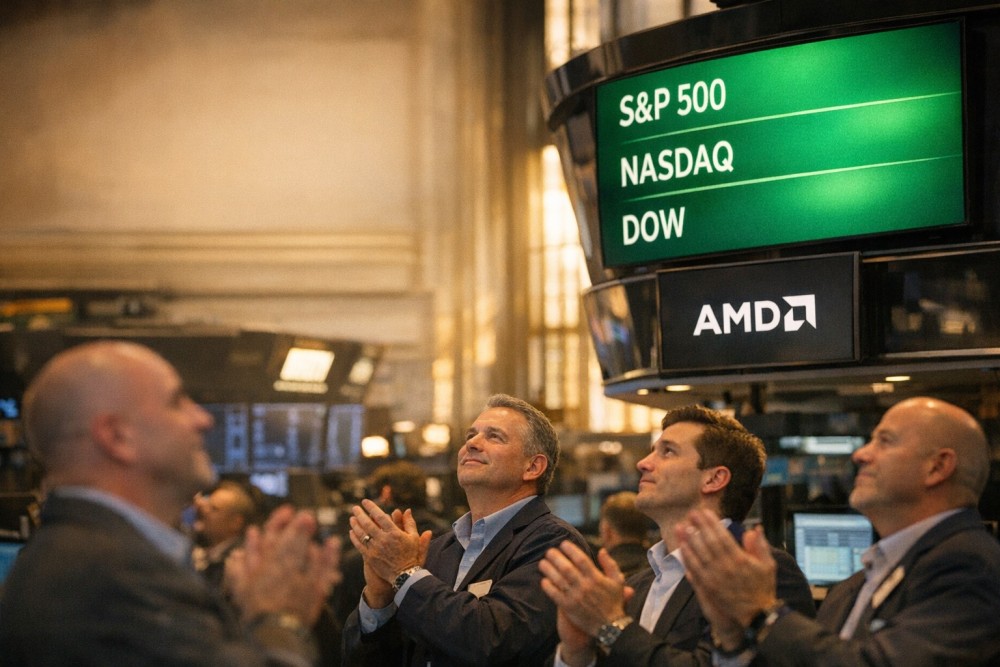

Gotrade News - Advanced Micro Devices (AMD) set off a broad chip rally on May 6 after a stronger Q1 print and a sharply higher long-term forecast for AI server processors.
According to Reuters, AMD raised its server-CPU total addressable market growth target to more than 35% compounded through 2030, up from 18%, citing the shift toward AI inference workloads.
Key Takeaways
- AMD traded up roughly 18% in premarket and was on track for a record close after raising its server CPU TAM forecast.
- Nvidia slipped about 1% to $196.45 with a market cap near $4.8 trillion, while Alphabet rose 1.24% to $384.35.
- The Alphabet to Nvidia market value gap narrowed to roughly $150 billion as TPU adoption gained traction with hyperscaler customers.
Why The AMD Print Mattered
AMD posted upside on revenue and guidance, with data center growth flagged as the primary driver. As reported by CNBC, the company guided current quarter sales above consensus on the back of accelerator and EPYC server demand.
The bigger signal sat below the headline number. Management lifted its addressable market math, telling investors the inference build out has barely started across enterprise customers.
That reframing supported a higher multiple. AMD trades around 39.66 times forward earnings, well above Nvidia near 21 times, but bulls argued the growth slope now justifies the spread.
The bull case rests on inference economics. AI inference workloads scale with deployed model usage, not training cycles, so the demand curve is less lumpy than the 2024 training boom.
That gives accelerator and CPU vendors a more durable revenue profile. Sell side analysts now treat the data center segment as a multiyear growth engine rather than a single cycle bet.
Sector Read Through
The catalyst pulled most chip names higher in early trade. Intel rose roughly 6%, ARM gained about 11%, Qualcomm added near 4%, and Marvell climbed 1.7%.
Memory was a notable mover. Micron Technology (MU) rose 6.4% as traders read the AMD forecast as positive for high bandwidth memory tied to AI accelerators.
Asia trade joined the move overnight. Samsung Electronics rallied on the Seoul session, with investors linking the bid to the same AI memory and foundry tailwinds.
The breadth of the move suggests a rotation, not a one stock event. Generalist funds added exposure across the chain, from accelerators to memory to foundry, rather than chasing a single ticker.
Alphabet Tightens The Race With Nvidia
Alphabet quietly stole part of the spotlight. According to The Motley Fool, the company is rolling out new TPU capacity that hyperscale customers are testing as a credible alternative to Nvidia GPUs for inference.
That shift showed up in the tape. Alphabet (GOOGL) closed the perceived gap with Nvidia (NVDA) to about $150 billion in market value as Nvidia drifted lower on the day.
The point is not that Nvidia has lost its lead. Investors are simply pricing a wider field of credible AI silicon suppliers, which compresses the scarcity premium Nvidia carried through 2025.
What Strategists Are Saying
Matt Britzman of Hargreaves Lansdown captured the new lens cleanly. "AMD story is no longer just about having a GPU pipeline to challenge Nvidia," he said. "It's increasingly about a broader compute opportunity."
That framing matters for portfolio construction. The trade is moving from a single name AI bet to a basket of accelerator, memory, and foundry exposure across Intel (INTC), AMD, and Micron.
Valuation discipline still applies. AMD at 39 times forward earnings prices in flawless execution, and any miss on data center growth would compress the multiple quickly.
Risk management therefore needs explicit position sizing. A simple rule is to scale exposure to the most expensive name down once it crosses two standard deviations above its three year average multiple.
The Competitive Backdrop
Pressure on Nvidia is not only domestic. Chinese AI labs continue to push lower cost inference, with DeepSeek's V4 preview pricing output tokens at $3.48 per million versus $30 at Anthropic and $25 at OpenAI.
That cost curve is reshaping accelerator demand outside the United States. Huawei has guided AI chip revenue near $12 billion for 2026, up about 60% year over year, partly attributed to V4 driven Ascend orders.
None of this was the May 6 catalyst, but it forms the structural backdrop. Investors are pricing a chip cycle with more credible suppliers, lower inference costs, and faster TAM expansion than the consensus held a quarter ago.
What To Watch Next
The next read comes from hyperscaler capex commentary and Nvidia's own guide later this month. Any signal that TPU and custom silicon are taking share will keep Alphabet bid and Nvidia rangebound.
For active investors, the setup favors a basket approach. Pairing AMD, Micron, and Alphabet exposure against a trimmed Nvidia position captures the rotation without abandoning the AI theme outright.
Earnings season still has key prints ahead from foundry and memory peers. Those reports will test whether the broader chip cycle thesis is supported by hard order book data or limited to the headline names.
Investors should also watch hyperscaler commentary on TPU and custom silicon mix. Any quantification of Nvidia share loss would mark a structural shift rather than a single session rotation.
Sources
Investing.com, AMD forecast sparks AI-driven rally in US chipmaker stocks.
CNBC, AMD's stock soars 20% as data center growth pushes revenue and guidance past estimates.
The Motley Fool, Alphabet Just Signaled That the Next Phase of the AI Revolution Has Arrived.