

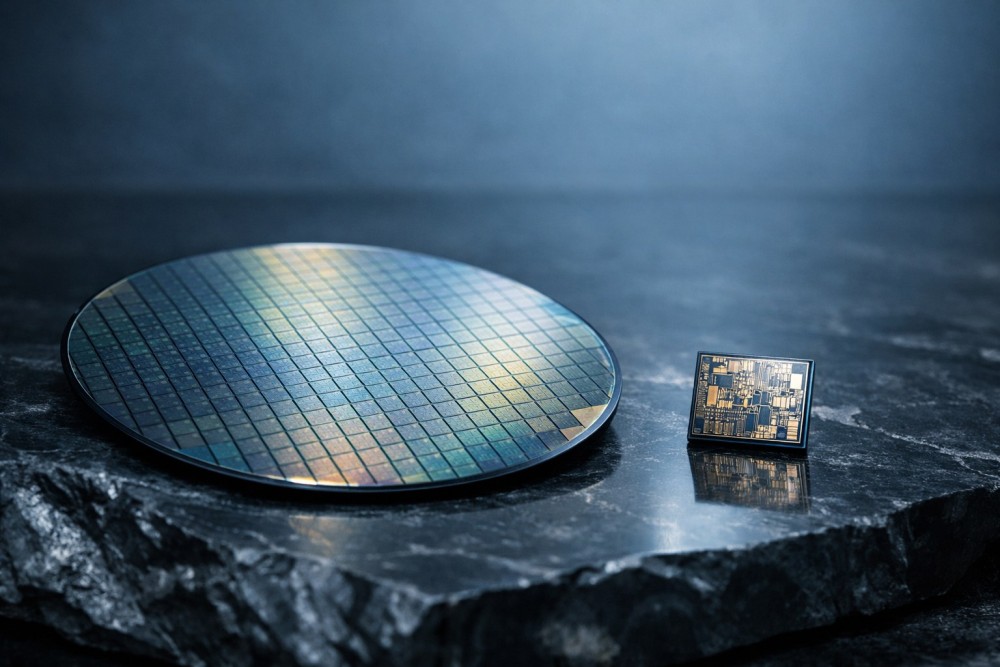
Gotrade News - Arm Holdings (ARM) delivered record fiscal fourth-quarter results on May 7, 2026, but shares still tumbled after management revealed it could not secure enough manufacturing capacity to meet booming demand for its new in-house AGI CPU and warned that smartphone unit growth would turn negative due to a memory chip shortage.
The British chip-design firm reported revenue of $1.49 billion for the quarter, edging past the $1.47 billion analyst consensus, while earnings per share of $0.60 beat the $0.58 estimate. Licensing revenue jumped 29% year-over-year to $819 million, and royalty revenue climbed 11% to $671 million, reflecting the dual engine of new design wins and existing chip shipments across Arm's vast ecosystem.
Despite the headline beat, the stock fell 7.25% in morning trading to $220.10 on May 7, a sharp reversal from the 13% pop the shares enjoyed in after-hours trading the day before. The whiplash captured the market's disappointment after investors absorbed the fine print of management's commentary on supply constraints and near-term handset weakness.
Chief Executive Rene Haas disclosed that customer demand for the company's homegrown AGI CPU had doubled to more than $20 billion within six weeks of launch, while existing customers had committed to over $2 billion in orders across the next two fiscal years. The problem, according to Haas, is that supply commitments had only been secured for the first $1 billion tranche, capping how much of that demand Arm can convert to revenue in the near term.
That mismatch was compounded by Haas flagging that smartphone unit growth would "flip to negative" because of a memory chip scarcity rippling through the handset supply chain. Smartphones remain a material revenue contributor for Arm, whose architecture powers Apple's iPhone and a long list of Android flagships, so any softness in unit shipments feeds directly into royalty volumes.
AI Data Center Story Still Intact
The brighter side of the report was Arm's continued momentum in artificial intelligence and data center deployments. The company upgraded its AI data center growth outlook for the year, citing rapid adoption of Arm-based server CPUs by hyperscalers building out AI training and inference clusters. Management said the company holds roughly 50% CPU compute market share among the largest cloud operators, including Amazon's AWS unit and Alphabet's Google Cloud.
That positioning has long been the bull case for Arm shareholders. Hyperscalers favor Arm-based silicon for the power efficiency it brings to dense racks running large language model workloads, and the company's licensing model means it benefits whether the end customer designs its own chip or buys merchant silicon from partners such as Nvidia (NVDA), whose Grace CPU is built on Arm's Neoverse cores. The Investing.com report noted that the AI tailwind was the main reason the stock initially surged after-hours before the supply-cap commentary cooled enthusiasm.
The licensing growth of 29% year-over-year underscores that customer interest in new Arm designs is broad-based, spanning automotive, edge AI, and custom data center silicon. Royalty growth of 11% is more modest, reflecting the lag between when a chip is licensed and when it ships in volume, which is typically two to three years.
Valuation and Analyst Reaction
Even after the May 7 decline, Arm trades at a price-to-earnings multiple of roughly 130, a level that several analysts described as stretched relative to peers. That valuation leaves little room for execution missteps, which helps explain why the supply commentary triggered such an outsized share reaction.
Raymond James analyst Simon Leopold noted that supply constraints led management to withhold raising its revenue forecast, even though customer demand signals would normally support a guidance hike. Leopold framed the supply situation as a near-term overhang rather than a structural problem, but the message to investors was that the upside from the AGI CPU launch will be back-end loaded into fiscal 2027 and beyond rather than landing immediately, as detailed in Investing.com's coverage of the report.
Operating expenses also continue to rise as Arm invests in its own chip design teams, which adds margin pressure on top of the supply story. The company maintained its full-year revenue outlook at approximately $10 billion, a figure that several investors had hoped would be raised given the strength of the new CPU pipeline. The Motley Fool's read on the print framed the result as a growth story hitting a speed bump rather than a thesis-breaker, with the data center engine still firmly intact.
For traders watching the name, the next catalysts to track are commentary on incremental wafer allocations from Arm's foundry partners, any update on whether the $2 billion of committed customer demand can be expanded, and signs that the memory chip shortage in handsets is easing. A clearer view on those three variables would help the market separate the temporary supply-driven cap on revenue from the underlying strength of the AGI CPU and data center franchise that has powered the multi-year bull case.
Key Takeaways
- Arm Holdings reported fiscal Q4 revenue of $1.49 billion and EPS of $0.60, beating consensus on both lines.
- Licensing revenue grew 29% year-over-year to $819 million; royalty revenue grew 11% to $671 million.
- Shares slid 7.25% to $220.10 on May 7, 2026, despite the earnings beat.
- CEO Rene Haas said AGI CPU customer demand doubled to over $20 billion in six weeks, but supply is only locked in for the first $1 billion.
- Smartphone unit growth is expected to turn negative due to a memory chip shortage affecting the broader handset supply chain.
- Arm holds about 50% CPU market share among major hyperscalers, including Amazon and Alphabet, supporting the data center growth narrative.
- The stock trades at a P/E of roughly 130, leaving little margin for execution issues.