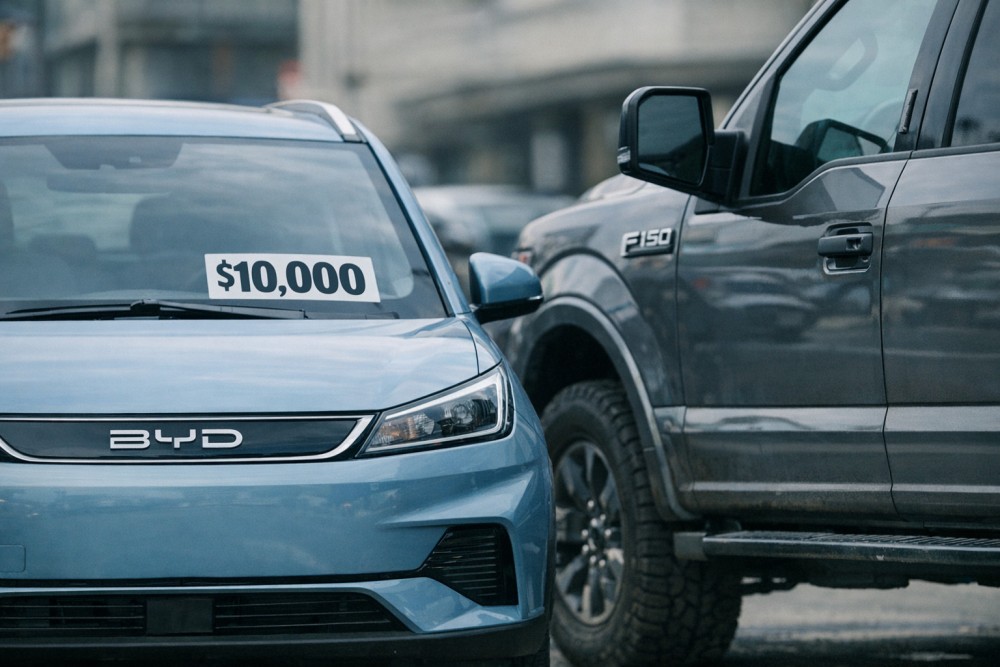
Gotrade News - Chinese electric vehicles on display at the Beijing Auto Show start at roughly $6,560 for the Wuling Hongguang MiniEV, while five top-selling Chinese EVs cluster in a $10,000 to $12,000 band. The average US new car price stands at $51,456 according to Kelley Blue Book, implying a roughly five-to-one price gap.
According to Watcher.Guru on Tuesday (28/04), models like the Geely EX2 EV are drawing attention for spacious interiors and feature density at entry-level price points. The report frames the price differential as a structural disruption risk for legacy global automakers if Chinese supply ever reaches open Western markets.
--- - Five best-selling Chinese EVs sit in a $10,000 to $12,000 band versus a $51,456 US new car average - US 100% import tariffs on Chinese EVs remain in force, blocking direct competition in the domestic market - BYD passed Tesla as the world's top EV seller in 2025 with 2.26 million units versus 1.64 million ---
The Wuling Hongguang MiniEV anchors the bottom of the Chinese price stack at $6,560 per unit. Geely's EX2 EV and several other compact models populate the $8,000 to $12,000 tier with full feature sets.
Auto analyst Felipe Munoz highlighted interior quality and spatial perception in Geely's compact platform. American observer Ethan Robertson documented the lineup at the Beijing Auto Show in a video series circulating on US social platforms.
Tesla remains the dominant US-listed EV pure play but has lost its global volume crown to BYD. According to Al Jazeera in early 2026, BYD sold 2.26 million battery electric vehicles in 2025 versus Tesla's 1.64 million.
Ford CEO Jim Farley publicly described BYD as best in class on cost, supply chain, manufacturing, and intellectual property. According to Fortune on April 20, Farley is now reorienting Ford's strategy explicitly around the China cost curve rather than Tesla.
General Motors and Ford have both scaled back near-term EV production targets in North America. The Detroit News reported in February 2026 that the Big Three's global market share fell from 21.4% in 2019 to roughly 15.7% in 2025.
Chinese EVs are walled off from the US market by a 100% import tariff first imposed under President Biden and retained under President Trump. The tariff currently prevents direct retail competition between Chinese OEMs and US-listed automakers on American soil.
Canada moved in a different direction in January, cutting tariffs to allow up to 49,000 Chinese-made EVs at a 6.1% rate. The change gives BYD a partial North American foothold without crossing the US border.
According to CNBC on February 6, the broader US EV retreat is increasing China's leverage over global EV supply chains and battery inputs. The dynamic affects Tesla, Ford, and GM differently based on each company's China sourcing and export exposure.
BYD trades in the US over the counter as BYDDY, an ADR providing public-market exposure to the Chinese EV leader. The instrument is one of the few liquid ways for US investors to express a direct view on the China EV cost advantage.
Tesla's premium pricing strategy and software margin model give it more insulation than mass-market US peers. Ford and GM, by contrast, sit closer to the price tier most exposed to a future Chinese EV entry under any tariff rollback scenario.
Exposure to global EV and US auto themes can be built through the Gotrade app with access to more than 4,000 US-market tickers.