DeepSeek Slashes V4-Pro 75%, Zhipu and MiniMax Shares Tumble
Rendy Andriyanto
Gotrade Team
Reviewed by Gotrade Internal Analyst
Share this article
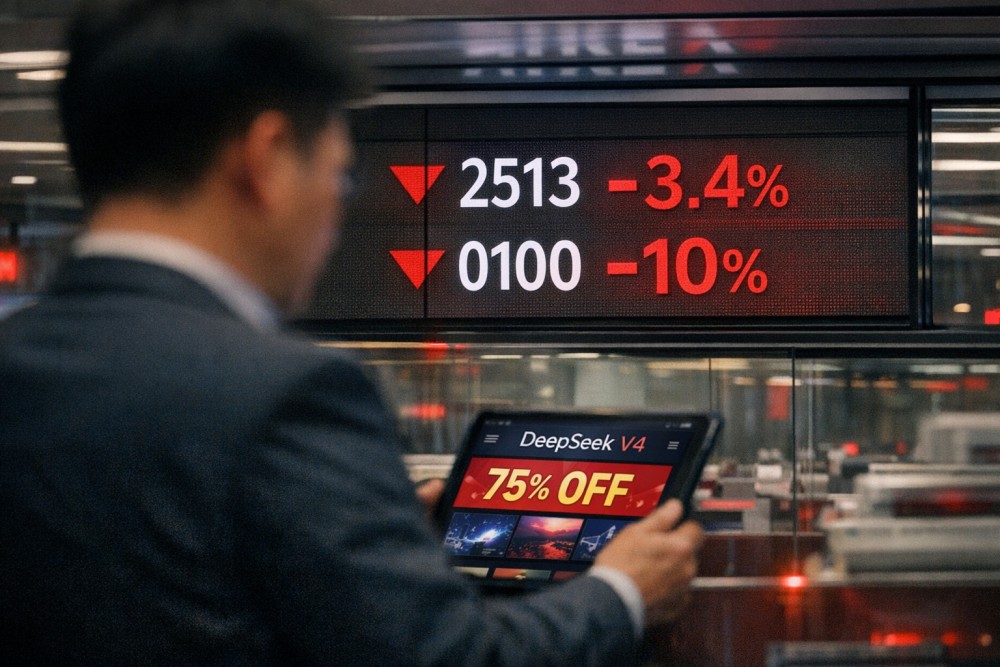
Gotrade News - DeepSeek cut prices on its newly launched V4-Pro AI model by 75% through May 5. The aggressive move pressured Chinese AI peers in Hong Kong trading on Monday (27/04).
Key Takeaways
DeepSeek V4-Pro carries a 75% discount through May 5, with API cache prices cut to one-tenth.
Zhipu (2513) fell 3.4% and MiniMax (0100) slid 10% in Hong Kong on Monday.
API pricing has become the central battleground in China's AI sector.
According to Investing.com, DeepSeek launched V4 in two variants, a premium Pro and lighter Flash. The model was adapted for Huawei chip technology and aimed at AI agent workloads.
DeepSeek said V4-Pro outperforms other open-source models on world-knowledge benchmarks. The company added it trails only Google's closed-source Gemini-Pro-3.1 in that category.
Cache hit prices were cut 90% across the entire API suite and took effect immediately. The strategy targets developer adoption and lower compute costs as scaling barriers ease.
Zhipu, also known as Knowledge Atlas Tech (2513), declined 3.4% in Monday's session. MiniMax Group (0100) slid 10% after shedding around 9% on Friday following DeepSeek's announcements.
Both startups extended losses from the prior week as competition concerns intensified. Investors fear margin compression across China's domestic AI sector amid the price war.
Investing.com cited industry voices saying API pricing has become a major industry battleground. Developers want lower costs to scale adoption beyond niche use cases.
Tencent Holdings (TCEHY) unveiled its first flagship AI model Hy3 during the same window. The model was developed with input from a former OpenAI researcher to strengthen global capability.
Competition is heating up amid U.S. technology restrictions accelerating Chinese domestic alternatives. Pricing pressure is expected to spread to other regional AI providers in the near term.
V4 was released as open source with performance claims close to closed-source rivals. Compute efficiency is the key selling point as access to advanced chips remains constrained for Chinese players.
Investing.com noted lower inference and usage costs are now a key battleground globally. Firms race to attract developers and enterprise users with cheaper and more efficient large language models.
We see continued downside risk for pure-play Chinese AI names in the near term. Retail investors should track developer adoption and margin trends as recovery signals for the sector.
Gotrade is the trading name of Gotrade Securities Inc., which is registered with and supervised by the Labuan Financial Services Authority (LFSA). This content is for educational purposes only and does not constitute financial advice. Always do your own research (DYOR) before investing.