
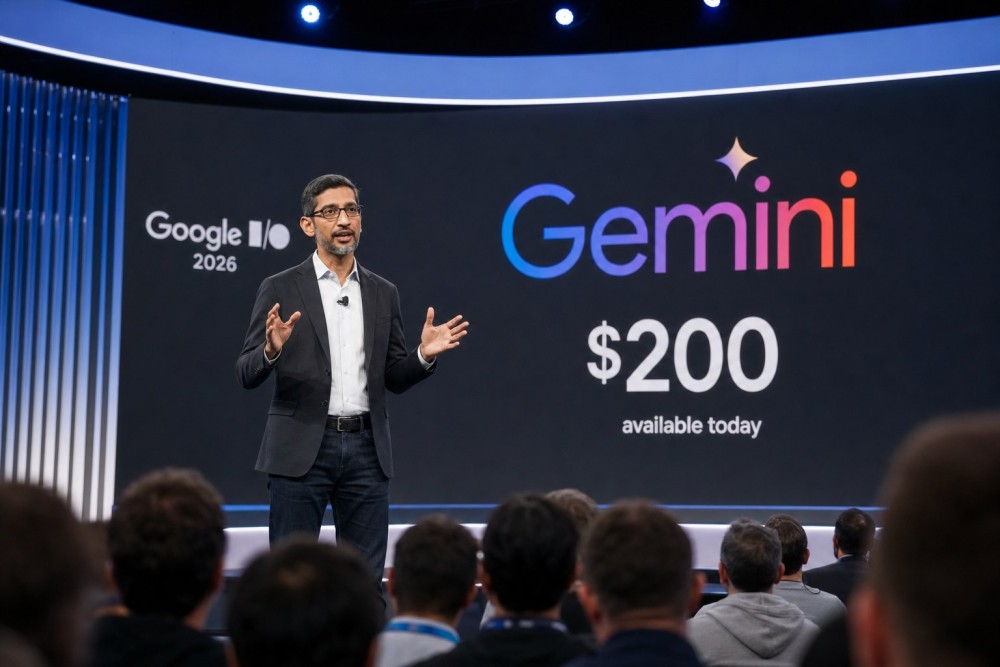
Gotrade News - Google showcased a cheaper Gemini 3.5 Flash model at its I/O 2026 conference to win enterprise AI customers. Parent Alphabet (GOOGL) shares still fell 2.34 percent on the announcement day.
The pricing cut targets enterprise clients that OpenAI and Anthropic have dominated so far. Investors worry the discount strategy could compress Google Cloud margins despite broadening Gemini adoption across developers.
Key Takeaways
- Google launched Gemini 3.5 Flash and cut the Ultra subscription from $250 to $200 per month.
- DeepMind hired more than 20 Contextual AI researchers under an $80 million to $90 million licensing deal.
- GOOGL stock fell 2.34 percent even as monthly Gemini users reached 900 million.
Aggressive Pricing Strategy at I/O 2026
According to Investing.com, Google introduced a new Developer tier priced at $100 per month for engineers and professional users. The Ultra tier was simultaneously reduced from $250 per month to $200 per month.
CEO Sundar Pichai said heavy users could save more than $1 billion annually by switching to Gemini. He claimed Google models deliver performance similar to other frontier systems at up to one-third the cost.
The strategy positions Alphabet (GOOGL) between two competitive poles in the AI industry. Google is challenging the enterprise focus of OpenAI and Anthropic while leveraging consumer reach that hardware-focused Nvidia (NVDA) lacks.
Gemini monthly users reached 900 million, doubling from 400 million in May 2025. AI Overviews in Search now serves 2.5 billion users each month across global markets.
Talent Acquisition Through Contextual AI
On the same day, Bloomberg reported that DeepMind recruited more than 20 researchers from startup Contextual AI. As reported by Investing.com, the non-exclusive licensing arrangement is valued between $80 million and $90 million.
Contextual AI co-founder and CEO Douwe Kiela is among those joining DeepMind in the deal. The structure continues Google's acquihire pattern that avoids review by United States antitrust regulators.
Earlier in 2025, Google paid $2.4 billion to license Windsurf's AI code generation technology. The company also licensed Character.AI's chatbot technology in 2024 under a similar talent-and-IP arrangement.
The pattern accelerates DeepMind's research capacity expansion without triggering formal acquisition reviews. Investors view it as a signal that Google wants to narrow its model gap with rivals like Meta Platforms (META).
The dual challenge of enterprise pricing pressure and rising talent acquisition costs weighs on near-term margins. Google Cloud operating profit could compress if the discount and acquihire race continues throughout 2026.
Smart glasses launching in autumn 2026 with Samsung and Warby Parker represent a longer-term hardware bet. A successful consumer launch could offset enterprise margin pressure created by the new pricing strategy.