
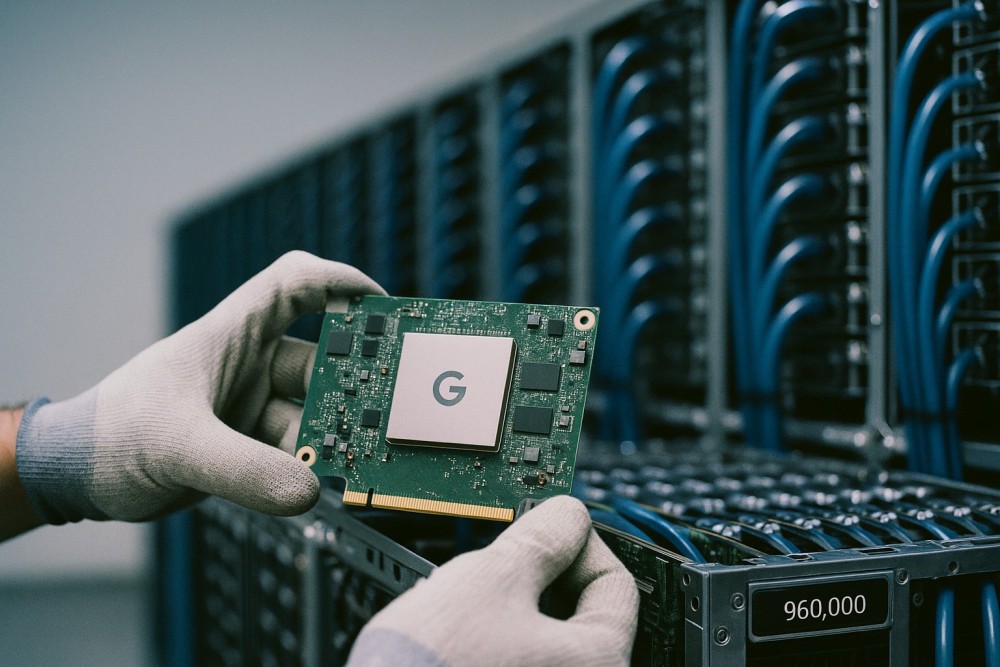
Gotrade News - Google (GOOGL) is escalating its challenge to Nvidia (NVDA) in the AI chip market with a multi-pronged strategy spanning custom silicon, massive GPU clusters, and dedicated chips for both training and inference workloads. The company's latest infrastructure push, announced April 22, 2026, includes the A5X platform capable of scaling to 960,000 Nvidia Rubin GPUs across data centers.
Google's seventh-generation TPU, codenamed Ironwood, is the centerpiece of its inference strategy. The chip delivers 10 times the peak performance of its predecessor, the TPU v5p, and is now generally available to Google Cloud customers.
Key Takeaways
Ironwood's specifications are impressive: 192 gigabytes of HBM3E memory per chip with 7.2 terabytes per second of bandwidth. A single superpod of 9,216 liquid-cooled Ironwood chips produces 42.5 FP8 exaflops, making it one of the most powerful inference clusters commercially available.
Google's next generation strategy splits the TPU product line explicitly into specialized variants. Broadcom is designing the TPU v8 training chip, codenamed Sunfish, while MediaTek is building the cost-optimized inference variant, codenamed Zebrafish, both targeting TSMC's 2-nanometer process node for late 2027.
The four-partner chip supply chain with Broadcom, MediaTek, Marvell, and Google represents a direct challenge to Nvidia's vertically integrated approach. By splitting training and inference into dedicated chips, Google aims to optimize cost efficiency for each workload type rather than relying on general-purpose GPUs.
Customer adoption is validating the strategy. Meta (META) signed a multibillion-dollar deal in February 2026 for TPU-powered AI infrastructure, marking a significant win against Nvidia's dominance in social media AI workloads.
Anthropic's commitment is even larger, with access to approximately one million TPU chips and roughly 3.5 gigawatts of next-generation compute starting in 2027. These deals demonstrate that Google's cloud AI hardware is gaining traction among the most compute-intensive AI companies in the world.
ASML CEO Christophe Fouquet added context to the chip expansion race, stating his company "will avoid by all possible means" becoming a bottleneck for AI-driven semiconductor expansion. The lithography equipment maker's capacity is critical to both Google's and Nvidia's roadmaps.
For investors, Google's chip offensive represents both a competitive threat to Nvidia's GPU dominance and a growth catalyst for Alphabet's cloud division. The question is whether dedicated TPU inference chips can capture meaningful share from Nvidia's CUDA ecosystem, which remains deeply embedded in enterprise AI workflows.
Sources: Seeking Alpha, Data Center Frontier, The Next Web, SemiAnalysis