

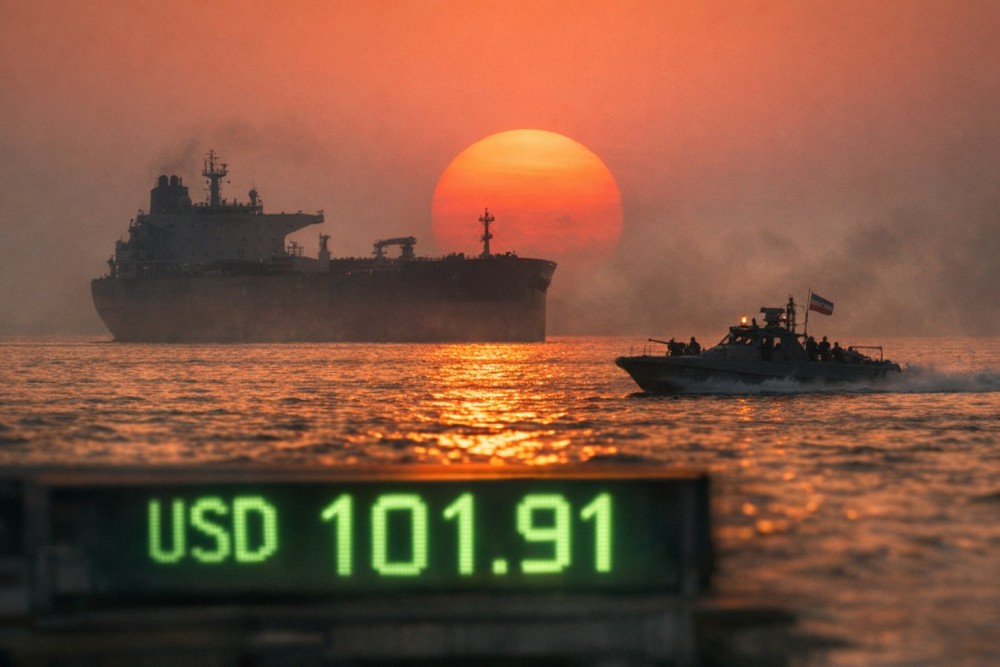
Gotrade News - Global oil prices surged sharply past the psychological $100 per barrel level. Tensions in the Strait of Hormuz triggered fears of the largest energy supply disruption in history.
Iran seized two container ships in the strait following the extension of a ceasefire. At least three additional container ships were reportedly fired upon in the same waters.
Key Takeaways:
- Brent crude rose 3.48% to $101.91 per barrel, the highest level this year
- Iran seized 2 container ships in the Strait of Hormuz, which handles 20% of global energy supply
- U.S. gasoline stockpiles fell 4.6 million barrels, far exceeding the expected 1.5 million barrel decline
Oil Price Surge
Brent crude closed up $3.43, or 3.48%, at $101.91 per barrel. Meanwhile, WTI gained $3.29, or 3.67%, to settle at $92.96 per barrel.
The rally came after both benchmarks had already risen roughly 3% in the prior session. During trading, U.S. crude briefly spiked more than $4 per barrel.
EIA data showed U.S. crude stockpiles rose 1.9 million barrels to 465.7 million barrels. However, gasoline inventories dropped 4.6 million barrels to 228.4 million barrels, far exceeding the expected 1.5 million barrel drawdown.
Distillate stockpiles also fell 3.4 million barrels to 108.1 million barrels. The decline surpassed market expectations of a 2.5 million barrel drop.
Strait of Hormuz Crisis
The Strait of Hormuz handles roughly 20% of global oil and gas supply, making it the world's most critical energy chokepoint. The seizure of ships by Iran's Revolutionary Guard created the largest supply disruption in history.
Mohammad Baqer Qalibaf stated that a meaningful ceasefire requires commitment without violations. Reopening the strait was deemed unlikely as long as the U.S. blockade remains in effect.
Bob McNally of Rapidan Energy assessed that Iran believes it holds a stronger negotiating position than the U.S. Markets remain skeptical that any ceasefire will restore normal shipping through the waterway.
Shares of major energy companies like Exxon Mobil (XOM) stand to benefit from surging oil prices. Investors are also watching Chevron (CVX) and ConocoPhillips (COP) as key barometers of the energy sector.
The crisis adds pressure on economies that depend on oil imports worldwide. Consumer fuel costs could face sustained upward pressure if oil holds above $100 per barrel.
Geopolitical uncertainty in the Middle East is pushing market participants into defensive positions. Oil price volatility is expected to remain elevated until the Strait of Hormuz conflict subsides.
Sources:
- Kompas Money, Harga Minyak Mentah Dunia Melonjak Tembus USD 100 per Barel, 2026.
- IDX Channel, Harga Minyak Dunia Melonjak di Tengah Ketegangan Selat Hormuz, 2026.
- Liputan6, Iran Sita 2 Kapal Kontainer, Harga Minyak Dunia Melonjak, 2026.