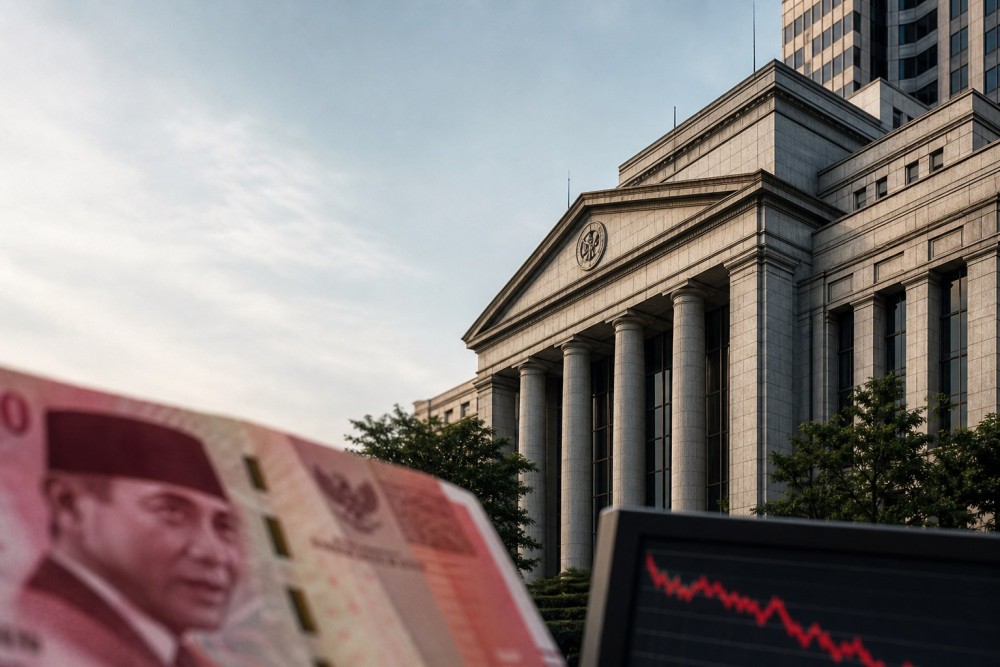
Indonesia Expands Bank Indonesia Mandate as Rupiah Hits Low
Rendy Andriyanto
Gotrade Team
Reviewed by Gotrade Internal Analyst
Share this article
Gotrade News - Indonesia's parliament passed a bill expanding Bank Indonesia's mandate on June 4, 2026. The measure passed by acclamation as the rupiah sank to a record low of 18,045 per US dollar.
The new mandate tasks the central bank with fostering real-sector growth and creating new jobs. The move immediately stirred central-bank independence concerns just as currency pressure intensified sharply this week.
Key Takeaways
Bank Indonesia is now mandated to foster real-sector growth and jobs alongside price stability.
The rupiah fell more than 7% this year to a record low of 18,045 per US dollar.
Moody's and Fitch cut Indonesia's outlook to negative over weakened policy credibility.
Deputy Speaker Sufmi Dasco Ahmad confirmed the bill passed unanimously without any dissent from lawmakers. According to Investing.com, the new mandate will be subject to a periodic performance review.
President Prabowo Subianto has set a national target of 8% annual economic growth. Finance Minister Purbaya Yudhi Sadewa testified in support of the broader central-bank role this week.
For many years Bank Indonesia focused narrowly on price stability and exchange-rate management alone. Adding an explicit growth objective now marks a fundamental shift in the country's monetary policy priorities.
The periodic performance review introduces a new oversight check on the independent central bank. Critics warn the review could pressure interest-rate decisions and erode credibility over time.
Investors worry the dual mandate opens the door to political interference in monetary policy. Prabowo's coalition controls more than 80% of parliament, which deepens that interference risk.
As reported by Bloomberg, the mandate expansion remains subject to a periodic performance review. Rating agencies cited reduced policymaking credibility and predictability behind their outlook cuts.
The weakening rupiah adds fresh pressure on Indonesian assets across this trading week. Foreign capital now risks rotating out toward developed markets that investors see as more stable.
A growth-focused central bank may keep policy rates lower for longer than markets expect. That stance can widen yield differentials and weaken the currency further against the US dollar.
The outlook cuts from Moody's and Fitch raise Indonesia's perceived country risk for lenders. Borrowing costs for both the government and corporates could climb in the months ahead.
US Investor Read-Through
US investors can gauge the broader impact through several US-listed Indonesia and emerging-market ETFs. The iShares MSCI Indonesia ETF (EIDO) offers the most direct exposure to Indonesian equities today.
Rotation risk also extends across the much broader emerging-market complex beyond Indonesia alone. The Vanguard Emerging Markets ETF (VWO) holds wide exposure spanning developing markets, including Indonesia.
Some global capital could shift toward safer US assets during periods of emerging-market stress. The SPDR S&P 500 ETF (SPY) often serves as the key benchmark for an EM-to-US rotation.
A weaker rupiah can erode ETF returns for dollar-based investors who hold Indonesian exposure. Currency pressure often deepens drawdowns across emerging-market focused funds during broad risk-off periods.
Gotrade is the trading name of Gotrade Securities Inc., which is registered with and supervised by the Labuan Financial Services Authority (LFSA). This content is for educational purposes only and does not constitute financial advice. Always do your own research (DYOR) before investing.