

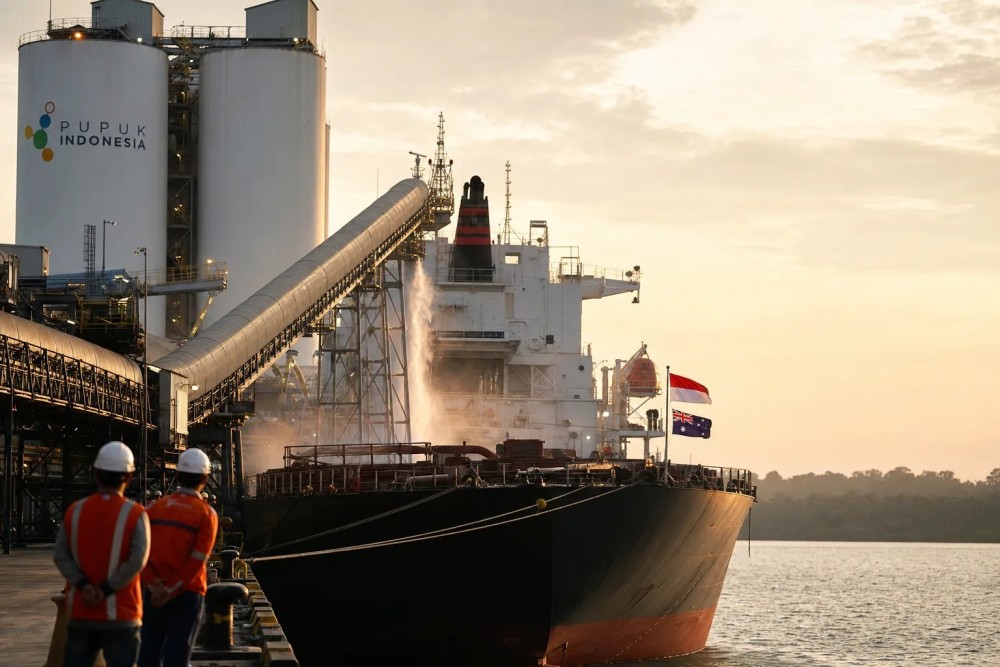
Gotrade News - Indonesia launched its first urea fertilizer export shipment to Australia on May 14, 2026, from Bontang Port. The initial cargo totals 47,250 tons valued at roughly Rp 600 billion, or about USD 38 million.
The deal signals shifting Asia-Pacific food security supply lines as Canberra diversifies fertilizer sourcing. Global agribusiness investors are watching nitrogen flows realign across emerging exporters and traditional Western producers.
Key Takeaways
- Indonesia shipped 47,250 tons of urea to Australia under a government-to-government framework.
- Jakarta targets 250,000 tons in phase one and 500,000 tons total, worth roughly USD 440 million.
- Pupuk Indonesia reports 1.1 million tons of domestic urea stock, easing supply concerns.
Why Indonesia Is Exporting Now
Indonesia is the world's fourth largest urea producer, with a 2026 output target of 7.8 million tons. Domestic demand sits near 6.3 million tons, leaving an export surplus of about 1.5 million tons.
According to Liputan6, daily production runs at 25,000 tons of urea and 15,000 tons of NPK fertilizer. Pupuk Indonesia Director General Rahmad Pribadi said current stock of 1.1 million tons demonstrates national supply resilience.
Subsidized fertilizer distribution reached 3.5 million tons through May 13, up 36% year on year. Domestic subsidized fertilizer prices have also been cut by 20% to support farmers.
As reported by Bloomberg Technoz, Agriculture Minister Andi Amran Sulaiman said the plan is to export 250,000 tons to Australia, then scale up to 500,000 tons. The full program could be worth around Rp 7 trillion, or roughly USD 440 million.
The shipment moved from BSL Dock at PT Pupuk Kalimantan Timur in Bontang, East Kalimantan. Australia's Deputy Ambassador Gita Kamath said Canberra values the partnership reflected in this cooperation.
Risks That Still Linger
Per Bloomberg Technoz, Australian Prime Minister Anthony Albanese called President Prabowo Subianto to thank him after the first cargo departed. The cooperation operates under a government-to-government framework rather than a private commercial tender.
New supply from Indonesia may pressure global nitrogen pricing, where CF Industries (CF) remains a leading North American urea producer. Margin sensitivity for nitrogen players will depend on how aggressively Asian exporters expand into Pacific markets.
Diversified peer Nutrien Ltd. (NTR), the world's largest fertilizer producer, is also exposed to shifting trade flows. Phosphate and potash specialist Mosaic Co (MOS) faces less direct urea overlap but watches the same agribusiness demand cycle.
Execution risk remains around scaling from 47,250 tons to the 500,000-ton target without straining domestic supply. Indonesia's 1.1 million ton buffer offers cushion, yet weather and subsidy policy could quickly alter the export math.
For global investors, the takeaway is a maturing Asia-Pacific fertilizer trade lane anchored by state-level diplomacy. Nitrogen pricing power may gradually shift as new G2G corridors complement traditional Gulf and North American supply.