

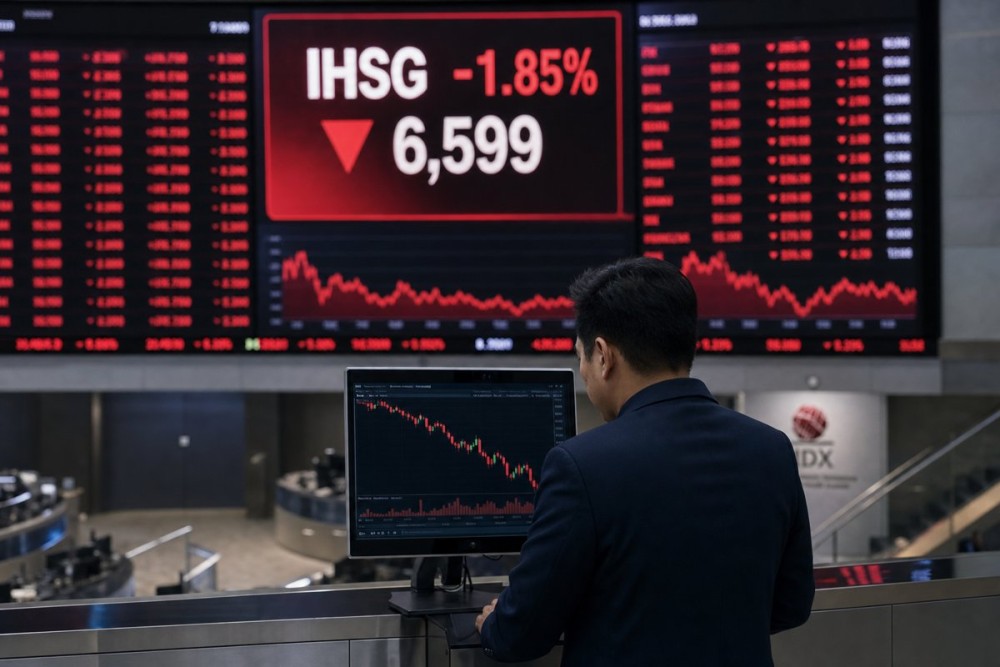
Gotrade News - The Jakarta Composite Index closed down 1.85% at 6,599 on Monday as 616 stocks declined. Conglomerate names DSSA, TPIA and CUAN led the selloff amid sustained foreign outflows.
The decline reflects persistent foreign selling tied to index rebalances and a record-low rupiah at 17,491 per dollar. US investors tracking Indonesia exposure saw the move ripple through proxies like the iShares MSCI Indonesia ETF (EIDO) during US hours.
Key Takeaways
- Jakarta Composite Index fell 1.85% to 6,599 with 616 decliners on Monday.
- Conglomerate stocks DSSA, TPIA and CUAN topped the losers list on rebalance-driven outflows.
- Rupiah hit a fresh record low at 17,491 per US dollar intraday.
Foreign Selling Leads the Decline
According to Katadata, Dian Swastatika Sentosa, Chandra Asri Petrochemical and Petrindo Jaya Kreasi led conglomerate losses. The three names are tied to looming FTSE and MSCI rebalance adjustments slated for May 2026.
Foreign investors continued unloading large-cap banks including BBRI, BMRI, BBNI and BBCA. As reported by Katadata, economists laid out two scenarios for Indonesia jumbo-bank stocks under continued outflow pressure.
The intraday low touched 6,400 before late-session buying trimmed losses. Per Bloomberg Technoz, select large-cap names cushioned the close and pulled the index off its session low.
Transportation stocks led the sector decline, followed by basic materials and consumer cyclicals. The Indonesia rupiah weakened to a fresh record of 17,491 per dollar, deepening risk-off pressure on equities.
Risks Still Looming
Indonesia Stock Exchange officials acknowledged that market uncertainty remains elevated heading into the next central-bank meeting. According to Kumparan, BEI urged retail investors to remain measured amid the volatility.
Finance Minister Purbaya Yudhi Sadewa said economic fundamentals remain solid and advised investors to accumulate quality names at lower prices. The minister framed the selloff as sentiment-driven rather than structural, a view echoed by domestic brokers.
For US investors, the spillover shows up in broad emerging-market proxies. The Vanguard FTSE Emerging Markets ETF (VWO) tracks the same FTSE rebalance that pressured Indonesia conglomerates over recent sessions.
Global banks with EM franchises also feel the spillover when local currencies weaken. Exposure to Indonesia and broader Asia loan books makes JPMorgan Chase (JPM) a useful gauge for assessing how US-listed banks digest emerging-market stress.
The market is now in wait-and-see mode ahead of the Bank Indonesia governors meeting next week. A dovish surprise could ease rupiah pressure, while a hold may extend the foreign-selling cycle into June.