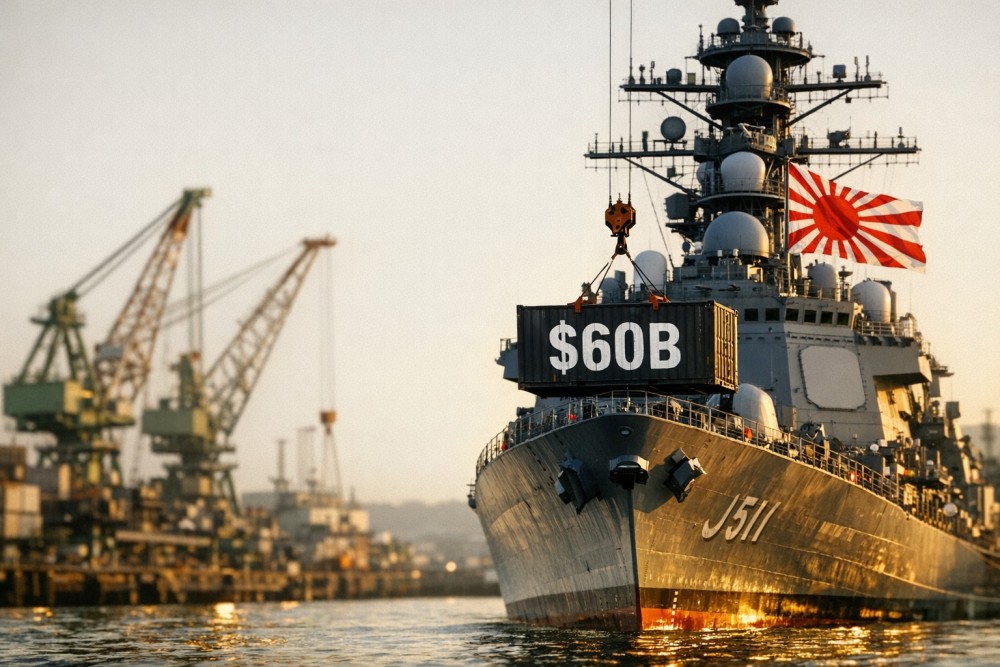
Gotrade News - Japan's ruling Liberal Democratic Party has approved sweeping changes to the country's arms export restrictions, marking the most significant defense trade opening since World War II. Prime Minister Sanae Takaichi's government plans to formally adopt the revised rules by late April 2026.
Key Takeaways
Japan will allow lethal weapons exports to countries with defense cooperation agreements, replacing decades-old limits on five nonlethal categories
Japanese defense firms Mitsubishi Electric and Toshiba are already hiring and expanding export departments in anticipation
Japan's $60 billion defense budget now ranks among the world's largest, with potential customers including the Philippines and Poland
The previous framework restricted military exports to five nonlethal categories including rescue, transport, and surveillance equipment. Under the new system, defense goods will be reclassified into just two groups: lethal arms such as warships and fighter jets, and nonlethal equipment like radars.
Growing security pressure from China and uncertainty around U.S. defense commitments have accelerated the policy change. Japan currently depends on the United States for 95 percent of its defense imports, a concentration the government views as unsustainable.
The overhaul strengthens Japan's position as a defense supplier for allied nations facing their own security challenges. The Philippines is expected to receive used frigates as the first approved lethal export, with missile defense systems potentially following.
Toshiba plans to hire roughly 500 workers over three years and establish new testing and manufacturing facilities dedicated to exports. Mitsubishi Electric expects defense sales to jump 50 percent to 600 billion yen, approximately $3.8 billion, by 2031.
Japan's defense industry ranks fourth globally, though it remains 25 times smaller than the American defense sector. Companies like Lockheed Martin, Northrop Grumman, and General Dynamics could face new competition but also new partnership opportunities.
The reform aligns with Japan's collaboration on next-generation fighter aircraft programs with the United States, Britain, and Italy. Reduced bottlenecks in allied weapons supply chains could benefit Raytheon Technologies and other contractors involved in joint development projects.
Under the revised rules, the National Security Council will approve exports with lawmakers notified only afterward. This grants the executive branch significantly more discretion over defense trade decisions.
A general ban on exports to countries engaged in active armed conflicts remains in place. However, exceptions can be made for sales deemed necessary for international or regional security, effectively opening a narrow path for exports to conflict-adjacent nations.
Investors tracking the global defense sector should watch for formal adoption of the rules, expected before the end of April. The scale of Japan's $60 billion military budget and its industrial base suggest meaningful long-term export revenue potential for Japanese manufacturers.
Gotrade is the trading name of Gotrade Securities Inc., which is registered with and supervised by the Labuan Financial Services Authority (LFSA). This content is for educational purposes only and does not constitute financial advice. Always do your own research (DYOR) before investing.