
Gotrade News - A wave of capital return announcements swept US markets this week as three major players unveiled large commitments. Netflix, Adobe, and Blackstone collectively put more than $50 billion in capital plans on the table.
Key Takeaways:
- Netflix and Adobe each authorized fresh $25 billion buybacks in late April 2026.
- Blackstone Life Sciences committed up to $400 million to fund Teva Pharmaceuticals and its duvakitug program.
- Big buybacks do not automatically lift share prices, as Adobe's muted reaction this week showed.
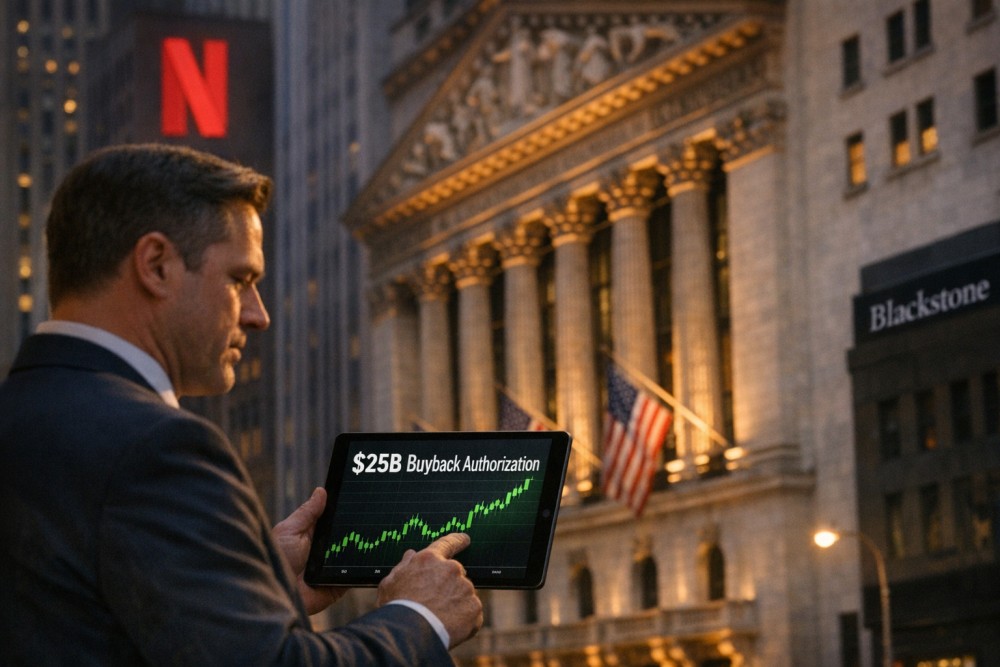
Netflix's board approved a fresh $25 billion share repurchase authorization on Wednesday (22/04). Insider Monkey reported the new program carries no expiration date and runs separately from the prior plan.
The earlier December 2024 authorization still had roughly $6.8 billion remaining as of 31 March 2026. Insider Monkey noted the move reflects Netflix's continued commitment to returning excess cash to shareholders.
Adobe Leans on Buyback Amid AI Pressure
Adobe's board approved a $25 billion stock buyback plan on Tuesday (21/04). The Motley Fool reported the program runs through 30 April 2030, covering roughly four years.
ADBE shares actually weakened to around $245 by the end of the week after the announcement. The Motley Fool noted Adobe's 52-week range sits between $224.13 and $422.95, well below recent highs.
Adobe's fundamentals remain strong with revenue growing from $21.5 billion in 2024 to $23.7 billion in 2025. Net income also rose from $5.5 billion to $7.1 billion over the same period according to The Motley Fool.
The first quarter of 2026 produced a record $6.4 billion in revenue with a forward P/E of just 10.4. The Motley Fool still urged caution given investor fears about AI disruption to software incumbents.
Adobe's longtime CEO is also in transition, leaving its AI integration strategy unclear. The Motley Fool concluded that buying ADBE solely on the buyback announcement is not a sound decision.
Blackstone Picks the Strategic Partnership Route With Teva
Unlike Netflix and Adobe, Blackstone Life Sciences chose to deploy capital into a third party. BioPharma Dive reported the firm committed up to $400 million over four years to fund Teva's duvakitug development program.
Duvakitug is a TL1A antibody targeting ulcerative colitis and Crohn's disease. BioPharma Dive noted Phase 3 trials will enroll over 3,000 patients followed for up to 40 weeks.
The deal includes milestone payments tied to FDA approval plus royalties on worldwide sales. Sanofi previously paid $500 million upfront in 2023 to co-develop and co-commercialize the asset according to BioPharma Dive.
Teva booked $17 billion in 2025 sales but has struggled with profitability since losing Copaxone exclusivity in 2018. Teva EVP Evan Lippman framed the deal as part of the company's Pivot to Growth strategy according to BioPharma Dive.
Competitors including Merck, Roche, and AbbVie are also developing similar TL1A inhibitors. Phase 3 data from Merck is expected later in 2026 based on BioPharma Dive's reporting.
The three announcements send mixed signals to the market about how large US firms are prioritizing capital. Retail investors should distinguish between Adobe's defensive buyback, Netflix's offensive buyback, and the Blackstone-Teva growth partnership.
Sources: