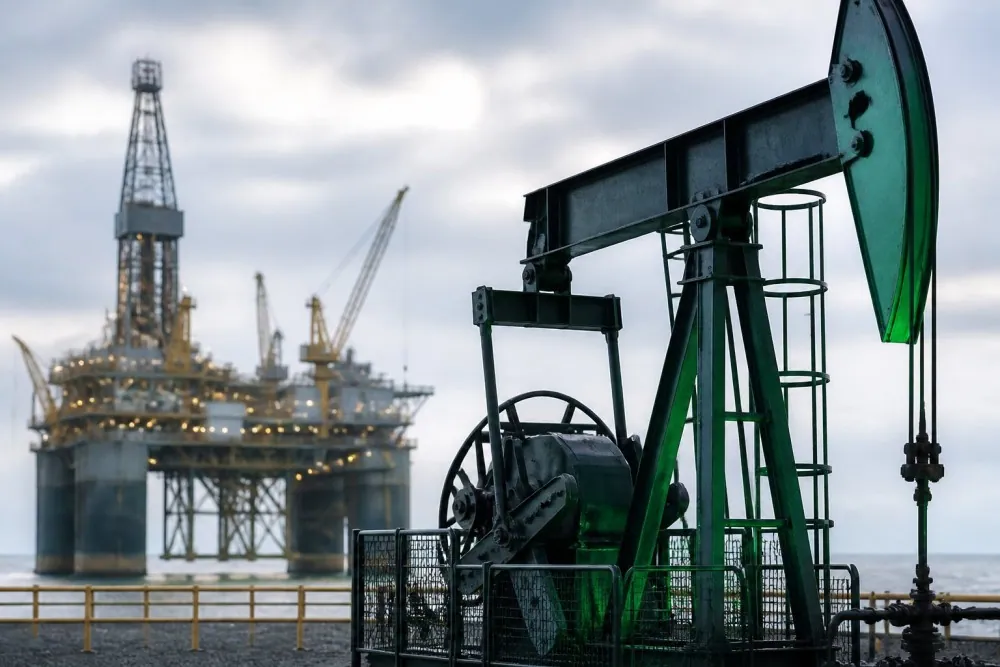
Gotrade News - The oil price briefly slipped below $90 a barrel on Tuesday, Nov. 10, for the first time since August, as hopes grew for an end to the U.S.-Iran war. According to CNBC, Brent settled down 1.17% at $91.49 a barrel after touching a session low of $89.16, while U.S. WTI crude fell 0.93% to settle at $86.04.
The same week brought two more energy headlines: Exxon Mobil (XOM) signed a preliminary agreement to evaluate seven oil areas in Venezuela, and October inflation data showed energy prices still rising, though far more slowly than in September.
Brent Falls Below $90 on Iran War Hopes
Oil fell after President Donald Trump said the Iran war could end "fairly soon," as reported by CNBC. The outlet added that crude flows through the Strait of Hormuz have largely recovered. Brent started 2026 around $60 a barrel before soaring as high as $130.
ING strategists said "the market has continued to unwind some of the geopolitical risk premium built into prices in recent weeks," per CNBC. Not everyone expects a quick settlement: Fereidun Fesharaki, chairman of energy consultancy FGE, was quoted as saying "the difference between the two sides is so wide, it cannot be bridged."
Exxon Signs Seven-Area Venezuela MoU
According to Reuters, a non-binding memorandum of understanding between ExxonMobil, the Venezuelan government and state oil company PDVSA lets the U.S. producer evaluate seven areas, including undeveloped fields, mature areas and an exploration block.
Reuters cited four people close to the matter and said the memorandum was signed on Monday in Caracas in the presence of interim President Delcy Rodriguez. Exxon has exclusive rights for one year to negotiate contract terms and view subsurface and other data for the fields.
Talks center mainly on heavy oil blocks in the Orinoco Belt. Exxon is evaluating a return to Petromonagas, previously called Cerro Negro, a project with an operational upgrader that turns extra-heavy crude into exportable grades, Reuters reported.
Exxon operated in one of the Orinoco blocks under discussion before its assets were expropriated in 2007, and Russia's 40% stake in Petromonagas, now held through Roszarubezhneft, remains an open question.
In its statement, Exxon called the memorandum "a meaningful first step" and said any future investment would require "stable policies, clear regulations, strong investment protections" and "competitive returns."
Reuters noted that CEO Darren Woods's tone has softened since January, when he called Venezuela "uninvestable" at a White House meeting, following an oil reform that opened the sector to newcomers. U.S. Energy Secretary Chris Wright said on social media the deal showed "tremendous progress in a remarkable short time."
October CPI: Energy Up 0.7% After September's 5.2% Jump
On the inflation side, the October consumer price index rose 0.4% on a seasonally adjusted basis after a 0.6% gain in September, according to the U.S. Bureau of Labor Statistics. The energy index rose 0.7% in October after rising 5.2% in September, while the gasoline index increased 1.0% after advancing 9.1% the previous month.
| CPI index (monthly change, seasonally adjusted) | September 2026 | October 2026 |
|---|
| All items | 0.6% | 0.4% |
| Energy | 5.2% | 0.7% |
| Gasoline | 9.1% | 1.0% |
| Shelter | 0.4% | 0.3% |
| Food | 0.0% | 0.5% |
| All items less food and energy | 0.3% | 0.3% |
Fuel pressure was smaller than the gasoline index suggests: before seasonal adjustment, gasoline prices fell 0.7% in October, the BLS said.
Shelter rose 0.3% and accounted for over thirty percent of the monthly all-items increase, while prices excluding food and energy rose 0.3%, matching the pace of September and August.
The BLS also said it cannot publish 12-month changes for October 2026 indexes where October 2025 data are unavailable.
Big Oil Q3: Refining Margins Lift Exxon and Chevron
Higher fuel prices have also shown up in Big Oil's results. In their third-quarter earnings reports, Exxon posted adjusted earnings of $4.23 per share and Chevron (CVX) $5.28 per share, both beating analyst forecasts as refining margins surged, as reported by BIC Magazine.
CNBC linked the jump in diesel, gasoline and jet fuel prices to a shortage of refining capacity, worsened by Houthi attacks on Saudi Arabia and the Russia-Ukraine war.
Both companies are prioritizing debt reduction over larger dividend increases or buybacks, BIC Magazine reported.
Exxon cut debt by $8 billion in the third quarter and plans $20 billion of buybacks in 2027, the same as in the prior two years, while Chevron's net debt is down nearly $14 billion since the end of 2025. Among European peers, Shell (SHEL) raised its buybacks to $5 billion over the next three months, up from $3 billion.
Chevron Vice Chairman Mark Nelson said refining margins "will stay a bit elevated, maybe into next year," while Exxon CFO Neil Hansen said higher fuel prices "put real pressure on families and businesses" and that the company would "pull every lever that's available to us to increase supply."
With Brent now well below its 2026 high, ING strategists said oil prices are likely to stay sensitive to developments in the Middle East, according to CNBC.
Sources