
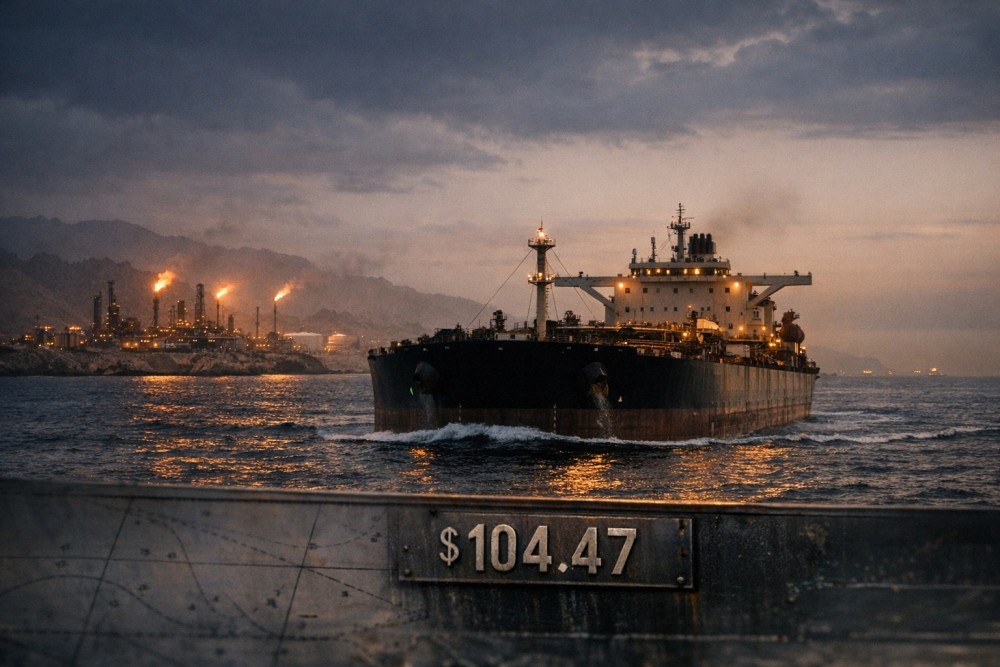
Gotrade News - Oil prices surged roughly 3% after President Donald Trump rejected Iran's latest nuclear peace proposal on Sunday. Brent crude climbed $3.18 to settle at $104.47 per barrel, while WTI rose 3.24% to $98.51.
The breakdown in diplomacy reignited supply fears tied to the largely blocked Strait of Hormuz. US energy stocks stand to benefit as tighter global crude supplies lift realized prices for domestic producers.
Key Takeaways:
- Brent climbed 3.14% to $104.47 per barrel, with WTI touching $98.51 after Trump's rejection.
- Strait of Hormuz remains largely blocked, removing roughly one billion barrels of supply over two months.
- Higher sustained crude prices typically boost upstream earnings for XOM, CVX, and oil-linked ETFs like USO.
According to Kompas, Brent briefly traded as high as $105.54 during intraday sessions. Trump labeled Iran's response "totally unacceptable" in a social media post that rattled global energy markets.
Iran reportedly offered to relocate enriched uranium to third countries under international supervision. However, Tehran refused to dismantle its nuclear facilities, a non-starter for the White House negotiating team.
Supply Shock Lifts US Energy Majors
The Strait of Hormuz, which handles about a fifth of global oil flows, has been largely closed since late February. As reported by Kumparan, two oil tankers recently disabled tracking systems while exiting the strait.
That disruption directly tightens seaborne crude supply, supporting higher realized prices for US majors. Shares of Exxon Mobil (XOM) and Chevron (CVX) typically track Brent closely on similar shocks.
Warren Patterson, head of commodities strategy at ING, said market optimism toward a swift deal is fading. "Market optimism toward a swift US-Iran deal is fading, driving oil prices higher," Patterson noted.
Saudi Aramco chief executive Amin Nasser warned the world has lost roughly one billion barrels over two months. He added that energy markets are unlikely to normalize before 2027 if shipping disruptions persist.
Refiners across Asia and Europe are already paying steep premiums to secure alternative non-Hormuz cargoes. That dynamic effectively widens crack spreads, an indirect tailwind for integrated majors with downstream refining exposure.
Investor Positioning and Near-Term Catalysts
Retail investors seeking direct crude exposure often use the United States Oil Fund (USO) as a tactical proxy. The fund closely tracks front-month WTI futures and amplifies short-term price swings in either direction.
Per Kompas, market focus has now shifted toward Trump's upcoming visit to Beijing. Tony Sycamore of IG noted attention has "shifted entirely to Trump's China visit this week."
The president is scheduled to meet Xi Jinping Wednesday and is expected to discuss Iran policy. Any coordinated China-US stance on Tehran could either escalate the standoff or open a new diplomatic channel.
For energy investors, the near-term setup favors sustained price strength if Hormuz remains constrained. Sustained Brent above $100 generally supports robust upstream cash flow for diversified majors throughout the second quarter.
However, traders should monitor potential demand-side weakness if higher fuel costs pressure global consumer spending. Crude's path from here likely hinges on Wednesday's Beijing meeting and tanker traffic through Hormuz.
Energy sector positioning has rotated meaningfully, with hedge funds reportedly adding net length on Brent and US oil majors. Continued geopolitical stress could extend the rally and lift sector laggards into the next earnings cycle.
Sources: