AI-powered contentSome parts of this article are powered by AI.
Share this article
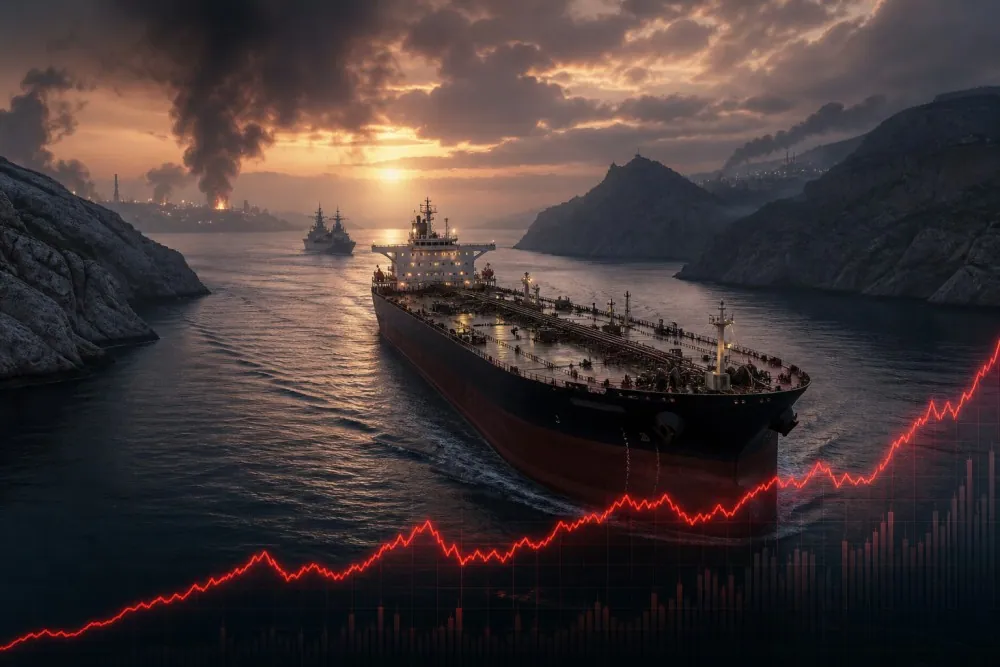
Gotrade News - U.S. forces launched a fresh round of strikes on Iranian targets in the Persian Gulf this week, reviving fears of a supply shock through the Strait of Hormuz and pushing crude prices higher. Brent traded near $94.87 a barrel and West Texas Intermediate around $90.30 as investors braced for disruption to the world's single most important oil transit chokepoint.
The escalation reignited an inflation scare just as the Federal Reserve weighs its next move. According to Investing.com, the market-implied probability of a 25-basis-point Fed rate hike at the September 16 meeting jumped to 67.9%, up from 34.7% a week earlier.
Key Takeaways
Brent traded near $94.87 and WTI near $90.30 as renewed U.S.-Iran strikes threatened Strait of Hormuz supply.
Odds of a September Fed rate hike surged to 67.9% from 34.7% a week earlier on the oil-driven inflation risk.
Vessel traffic through the Hormuz chokepoint ran at a small fraction of pre-war levels.
Asian equities sold off, with South Korea's KOSPI down 3% and Japan's Nikkei 225 off 2.2%.
Strait of Hormuz Chokepoint Back in Focus
Per Investing.com, this was a second round of U.S. military strikes against Islamic Revolutionary Guard Corps targets in the Persian Gulf, and President Donald Trump warned he could hit Iran's Kharg Island oil export facility if Tehran retaliates again. Maritime tracking cited in the same report showed vessel traffic through the strait operating at a small fraction of pre-war levels, even as Washington insisted the route remained open.
The Strait of Hormuz is the passage through which a large share of the world's seaborne crude moves, so any sustained disruption feeds quickly into global oil prices. That supply premium is what has kept Brent bid near a five-week high, as reported by Metrotvnews, which put Brent at $95.34 a barrel, up 0.7%.
Energy Majors and Refiners in the Spotlight
An oil-price spike is typically a tailwind for integrated energy producers whose revenue tracks crude. Investors often watch names such as Exxon Mobil (XOM) and Chevron (CVX), both of which have earnings leveraged to benchmark oil prices. Refiners like Valero Energy (VLO) can also see wider margins when fuel prices climb, though higher input costs cut the other way for energy-consuming sectors.
Risk-Off Tone Sweeps Global Markets
The energy shock rippled straight into equities and bonds. U.S. stock futures pointed lower, with S&P 500 futures off 0.19%, Nasdaq 100 futures down 0.4%, and Dow futures near flat, according to Investing.com. Treasury yields climbed as traders repriced inflation risk, with the 10-year at 4.780% and the 2-year at 4.354%, its highest since 2025, while the dollar index firmed to 99.78.
Across Asia the mood was firmly risk-off. Metrotvnews reported South Korea's KOSPI down 3% and Japan's Nikkei 225 off 2.2%, with the dollar near a two-week high at 99.67 and gold holding around $4,328.59 an ounce as investors sought shelter. A Westpac analyst quoted in the report said threats of further Hormuz disruption had reignited inflation concerns, driving the sell-off in stocks.
Conflict Shows No Sign of Cooling
The geopolitical backdrop offers little comfort. As reported by Bloomberg Technoz, Iran vowed to keep striking U.S. positions in the region. Colonel Ebrahim Zolfaghari, a spokesman for Iran's Khatam al-Anbiya headquarters, said on state television that the attacks would continue until the United States regretted the crimes it had committed.
For US-stock investors, the setup is two-sided: broad pressure on risk assets on one hand, and potential rotation into energy and defense on the other. All of the moves above are market context, not investment advice, and the near-term direction will hinge on whether the conflict escalates or cools and how long Hormuz supply stays at risk.
What to Watch From This News
The path from here depends on a handful of developments that will determine whether this stays a short-lived spike or turns into a longer supply and inflation story.
The September 16 Fed meeting. Rate-hike odds have swung sharply, to 67.9% from 34.7% in a week, so Federal Reserve communications and the inflation data that land before the decision are the key macro signals to follow.
Hormuz traffic and any tanker incidents. Vessel flows through the strait are the real-time gauge of actual disruption. A recovery toward normal levels would ease the supply premium, while fresh incidents or a formal closure would deepen it.
Escalation or de-escalation signals. Whether Washington acts on its threat to strike Iran's Kharg Island export facility, how Tehran responds, and any diplomatic movement will drive the geopolitical risk premium in oil.
Sustained versus fading price action. Whether Brent holds above recent levels or slips back distinguishes a genuine supply shock from a headline-driven move, and shapes any second-round inflation effect.
Cross-asset stress gauges. Treasury yields, with the 10-year near 4.78% and the 2-year at multi-year highs, alongside the dollar index and gold flows, show how markets are repricing inflation and risk beyond the oil price itself.
Sector divergence. Energy producers and refiners tend to move with crude, while energy-consuming sectors face the opposite pressure. How that split shows up in company guidance and earnings is worth following as the quarter progresses.
Gotrade is the trading name of Gotrade Securities Inc., which is registered with and supervised by the Labuan Financial Services Authority (LFSA). This content is for educational purposes only and does not constitute financial advice. Always do your own research (DYOR) before investing.
M. Alfathan Rahman is a content writer with over 3 years of experience developing digital content strategies across various industries, including fintech. He has experience producing content for tax-related websites and financial education platforms. His focus areas include data research, and crafting financial articles that are informative, accurate, and accessible to investors of all experience levels.