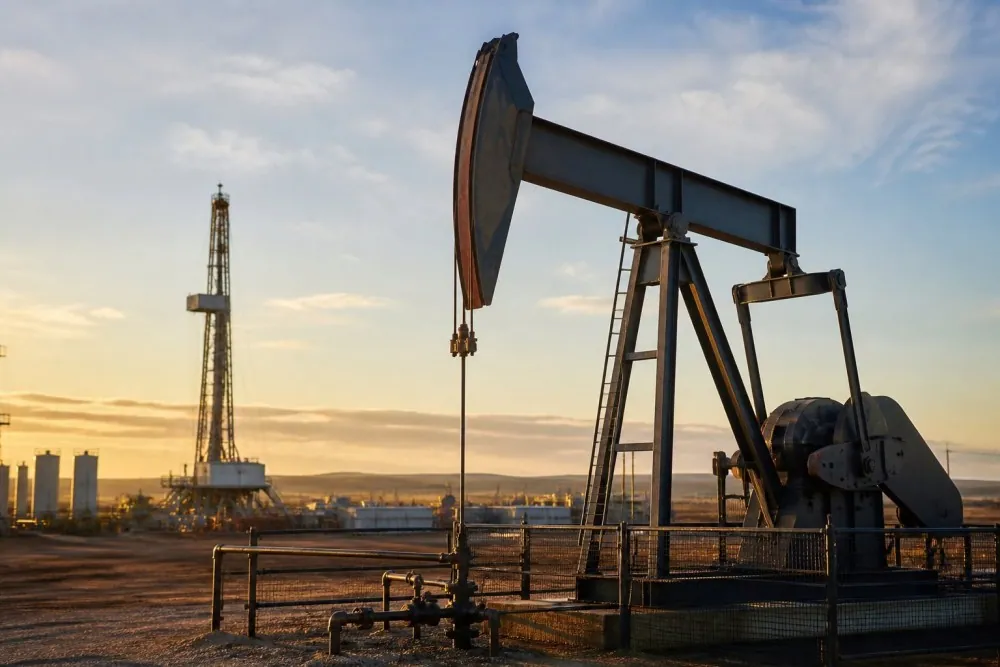
Gotrade News - Oil prices suffered a steep weekly slide, and US energy stocks fell with them. According to CNBC, Brent crude futures settled at $98.32 a barrel on Friday, November 6, after falling more than 16% for the week, while US West Texas Intermediate (WTI) crude settled at $90.83, down nearly 13% for the week.
Midterm Results and Iran Talks Push Oil Below $100
The sharpest move came on Wednesday, November 4. As reported by Fortune, the global oil benchmark fell 8% that day to below $100 a barrel, its first drop below that level in nearly a month, as optimism about Iran war peace talks and the Democratic "blue wave" in the US midterm elections weighed on crude and energy shares.
Refiners were hit as well. Fortune reported that Marathon Petroleum fell 9% and Valero Energy dropped 7% on Wednesday. "We had a referendum on inflation, high oil prices, and Trump in general," Dan Pickering, founder of Pickering Energy Partners, told Fortune.
By the end of the week, traders were weighing diplomacy against fresh supply risks. Per CNBC, Iran reportedly sent a nuclear proposal to Washington through Qatar, raising hopes for a diplomatic path, while Iran reported three more attacks on oil tankers in the Strait of Hormuz on Thursday. Both benchmarks edged higher on Friday, with Brent up 3 cents and WTI up 31 cents.
Diamondback, Exxon and Chevron Lose 10% to 16% in a Week
The table below sets out the weekly moves for the three producers, using closing prices from StockAnalysis.
Diamondback's slide began on Monday, November 2, the day the company published its quarterly earnings report, when the stock fell 5.8%. It dropped another 4.9% on Wednesday as crude tumbled, according to the same StockAnalysis data.
Diamondback Q3: 525,000 Barrels a Day and a 7.3% Dividend Increase
According to Diamondback's third-quarter release filed with the SEC, the company averaged 525,000 barrels of oil per day, or 1.034 million barrels of oil equivalent per day, in the third quarter of 2026. Adjusted earnings came in at $5.86 per diluted share. The company generated $2.6 billion of operating cash flow and $2.1 billion of free cash flow on $1.0 billion of capital spending. Its realized oil price was $87.30 a barrel, down from $96.82 in the second quarter but up from $64.60 a year earlier.
The board raised the quarterly base dividend 7.3% to $1.18 per share, or $4.72 annualized, which the company said equals an annualized dividend yield of about 2.2% based on its October 30 closing price. Diamondback also repurchased 1,348,209 shares for about $251 million in the quarter, bringing its total return of capital to $582 million.
The company raised its full-year 2026 guidance to about 524,000 barrels of oil per day, from 522,000 or more, and lifted its capital budget range to $3.95 billion to $4.00 billion. Even after the week's slide, WTI's Friday settlement of $90.83 sat above the $87.30 a barrel Diamondback realized in the third quarter.
In an analysis published on Seeking Alpha on November 8, contributor Elliott Gue argued that Diamondback's share price implies oil of about $67 a barrel, pointing to the company's low production costs, capital efficiency, low reinvestment rate and extended drilling inventory. That is the author's own valuation view, built on a discounted cash flow model that assumes conservative production growth and higher cash taxes.
Rapidan Sees 80% Odds of Renewed Iran Fighting
Not every analyst expects lower crude to last. Per CNBC, Rapidan Energy Group founder and president Bob McNally sees an 80% probability of military fighting resuming and expects both benchmarks could climb back above $100 a barrel.
Bob McNally, Rapidan Energy Group, told CNBC: "as long as that core difference in that deal space is absent, the escalation dynamic remains in place."
CNBC reported that investors are assessing whether the end of the midterm elections could lead to renewed US action against Iran, potentially threatening Middle East oil supplies.
Gotrade is the trading name of Gotrade Securities Inc., which is registered with and supervised by the Labuan Financial Services Authority (LFSA). This content is for educational purposes only and does not constitute financial advice. Always do your own research (DYOR) before investing.
M. Alfathan Rahman is a content writer with over 3 years of experience developing digital content strategies across various industries, including fintech. He has experience producing content for tax-related websites and financial education platforms. His focus areas include data research, and crafting financial articles that are informative, accurate, and accessible to investors of all experience levels.
Hendrie Saputra holds a Master of Business Administration (MBA) with a concentration in Business Risk & Finance, along with professional experience in finance, marketing, and project management. He is experienced in analyzing market data and developing research-driven business strategies.