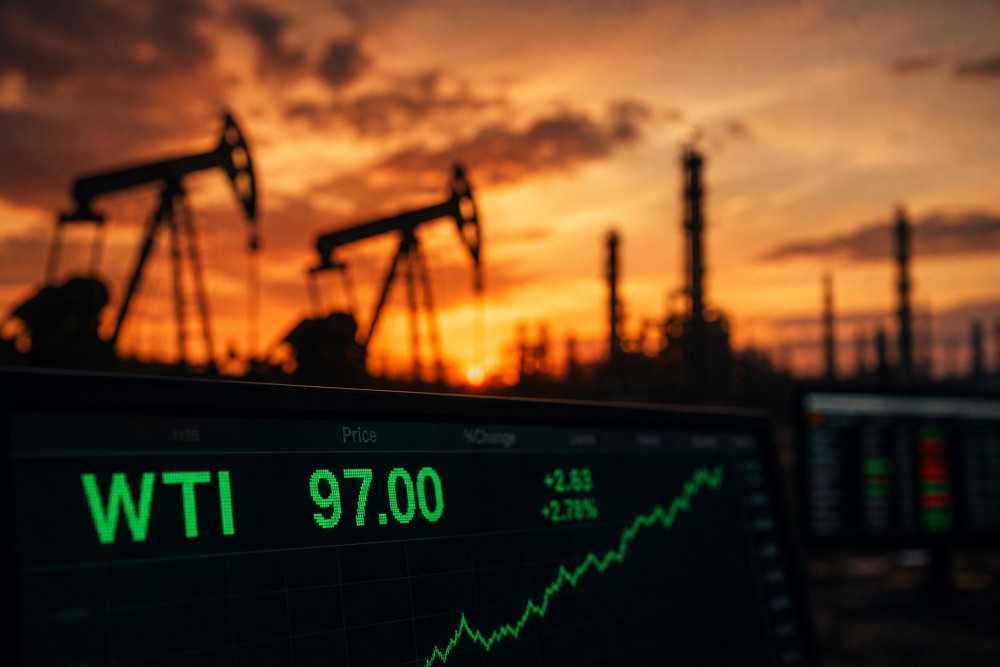
Gotrade News - Crude oil climbed more than 2% after fresh military exchanges between the United States and Iran in the Persian Gulf. The move followed US interception of Iranian ballistic missiles and drones in the region.
The escalation added to global inflation worries and weighed on equity sentiment. Higher energy prices also pushed US government bond yields upward in early trading.
Key Takeaways
- WTI crude oil rose more than 2% on the latest US-Iran clashes.
- The 10-year Treasury yield climbed four basis points to 4.49%.
- The OECD cut its 2026 global growth forecast to 2.8% from 3.4% in 2025.
According to Barchart, S&P 500 E-Mini futures slipped a slight 0.05% to 7,617.00. The softness reflected investors weighing geopolitical risk against still-resilient labor data.
The 10-year US Treasury yield rose four basis points to 4.49%. The increase was driven by concerns that surging oil prices could fuel renewed inflation pressure.
Energy and Defense in Focus
Higher oil prices typically benefit large energy producers such as Exxon Mobil (XOM) and Chevron (CVX). Refining and exploration margins tend to improve when crude prices strengthen.
Geopolitical tension often draws investor attention to defense names like Lockheed Martin (LMT). Demand for defense systems usually rises when regional conflicts intensify.
The latest clashes followed US interception of several Iranian ballistic missiles and drones in the Persian Gulf. The incident deepened concerns about energy supply moving through that strategic corridor.
The Persian Gulf is a vital shipping route for the world crude oil supply. Any disruption there can lift global energy prices quickly and sharply.
As reported by Barchart, US JOLTS job openings jumped to 7.618 million in April, beating the 6.860 million forecast. The reading signals a still-firm US labor market despite external pressure.
Saxo Bank analysts noted that market pessimism is again growing over the prospects of a US-Iran deal. Even so, the Trump administration maintains that a ceasefire remains possible.
OECD Trims Growth Outlook
Per InvestmentNews, the OECD cut its 2026 global growth forecast to 2.8% from 3.4% in 2025. In a prolonged-disruption scenario, growth could fall as low as 2.1% next year.
The OECD also expects G20 inflation to climb to 4.0% in 2026 from 3.4% in 2025. A worst-case scenario would add a further 0.4 percentage points of inflation in the same year.
The body warned that developing economies face the most severe consequences from the conflict. Limited energy reserves and constrained fiscal capacity leave them more exposed to price shocks.
The OECD added that central banks may need to raise rates by 50 to 75 basis points in 2026. Such moves would aim to contain inflation pressure under a prolonged-disruption scenario.
For retail investors, these dynamics underline the value of watching energy and defense sectors closely. Oil price swings and central bank policy will likely steer market direction in the weeks ahead.
Sources