
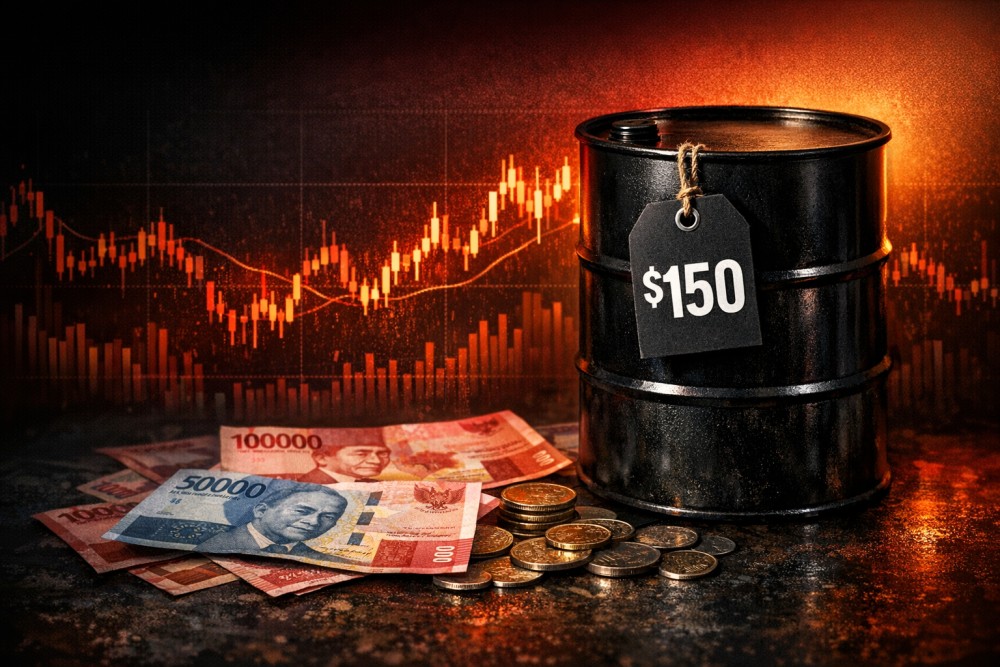
Gotrade News - Brent crude has surged past $103 per barrel following the formal enforcement of the Strait of Hormuz blockade, and several top analysts are warning prices could break through $150 if the situation does not ease. The 8% single-day spike is widely seen as not yet fully reflecting the actual supply disruption that is underway.
Jorge Montepeque, Managing Director of Onyx Capital Group, stated plainly that oil prices "should be $140, $150" based on global supply fundamentals. The blockade, which took effect Monday at 10 AM New York time, has cut off one of the world's busiest oil shipping lanes -- and markets have yet to fully price in the medium-term impact.
Key Takeaways:
- Brent is already at $103/barrel; Onyx Capital analysts project it could reach $140-$150 if the blockade continues
- Bank Indonesia identifies 3 major transmission channels: tightening global financial conditions, broad commodity price increases, and declining output and trade
- US energy stocks -- XOM, CVX, XLE, and USO -- offer instruments to play this volatility in both directions
Why Analysts Say $150 Is Not an Arbitrary Number
Brent crude above $103 per barrel looks dramatic on its own, but Montepeque of Onyx Capital Group argues that figure is still far from a "fair price" if the Hormuz blockade holds. The strait carries roughly 20% of global oil supply, and any disruption forces tankers to reroute thousands of nautical miles, adding significant cost and delivery time.
Wahyu Laksono, a commodity observer cited by Liputan6, adds another layer of risk: the "unpredictability of Trump's stance." Trump's comments frequently surface outside trading hours, creating additional psychological pressure on markets, and a geopolitical risk premium that had long been priced out is now being factored back in. WTI briefly fell to around $96 and Brent to $94, before both surged back above $100 in a single trading session -- a snapshot of volatility that shows no signs of settling anytime soon.
3 Major Risks to Indonesia, According to Bank Indonesia
Senior Deputy Governor of Bank Indonesia, Destry Damayanti, spoke directly at the 2026 Central Banking Forum in Bali, and her remarks should serve as a wake-up call for anyone monitoring the Indonesian economy. BI identified three primary transmission channels through which global oil price turbulence flows into the domestic economy.
First, tightening global financial conditions. Rising uncertainty pushes international investors toward safe-haven assets, meaning capital outflows from emerging markets like Indonesia flow toward developed economies, strengthening the dollar index and pressing the rupiah lower. Second, broad commodity price increases -- including energy and food -- which are felt immediately by consumers and businesses through higher production costs and the interplay between inflation, interest rates, and equities. Third, declining output and trade, as global supply chain disruptions hit exports, imports, and manufacturing activity that depends on imported inputs.
Rupiah and IDX Composite: Who Is Most Exposed?
Of the three risks BI identified, pressure on the rupiah exchange rate is the one felt most quickly. Capital outflows driven by global flight-to-safety strengthen the US dollar, and every dollar rally means the rupiah has to work harder to pay for imports -- including oil, which Indonesia largely purchases in dollars.
Indonesia is a net oil importer. That means rising global oil prices do not automatically benefit the trade balance the way they would for major oil-producing nations. Energy subsidies could balloon, inflationary pressure could build, and BI's room to cut interest rates narrows. This is the scenario investors need to understand before taking positions, because grasping investment risk is the foundation of any strategy built to last.
Opportunity in US Energy Stocks: Profit in Both Directions
Here is the angle that often gets missed: oil price turbulence is not just bad news for portfolios -- it can also be an opportunity if investors know where to position. US energy stocks are the most directly impacted instruments when global oil prices rise, and Gotrade gives Indonesian investors access to this market.
Exxon Mobil stock and Chevron stock are the two biggest names in US energy, with revenues that correlate directly to oil prices. When Brent is above $100, their profit margins widen -- and historically, both stocks have posted positive performance during sustained periods of elevated oil prices.
For those seeking broader diversification without picking a single stock, the XLE energy sector ETF holds roughly 23 of the largest US energy companies in a single instrument. The USO oil ETF, meanwhile, is designed to track WTI crude price movements more directly -- suited to investors who want an explicit bet on the direction of oil prices.
A Two-Way Strategy: Opportunity Whether Prices Rise or Fall
What separates skilled investors from the rest is the ability to read volatility as opportunity rather than just threat. Oil prices swinging between $94 and $103 in a single session signals that markets have not settled on a single narrative -- and that uncertainty itself creates entry points in both directions.
For investors who believe oil will continue climbing toward the $140-$150 projection cited by Montepeque, long positions in XOM, CVX, or XLE are a measured way to participate in that momentum. For those more cautious and watching for a possible geopolitical de-escalation that could bring prices back down, a different strategy applies. This kind of macro trading approach -- reading global events and mapping their impact to specific instruments -- is how institutional investors play moments like this. Retail investors in Indonesia can now do the same through Gotrade.