

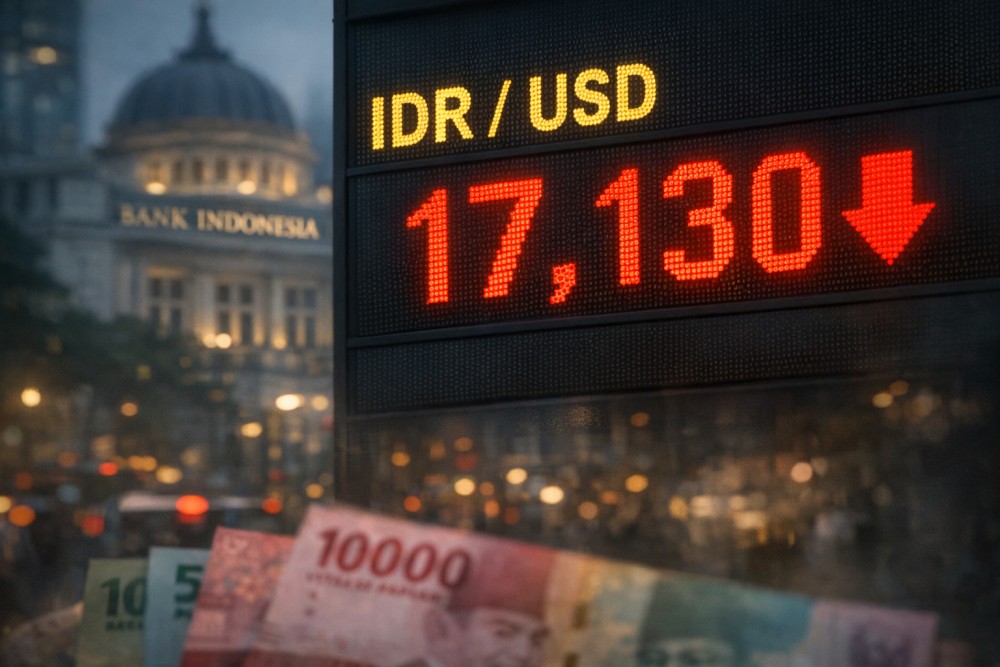
Gotrade News - The rupiah opened weaker at 17,130 per US dollar on Tuesday (14/4/2026), down 25 points or 0.15% from Monday's close of 17,105, according to Liputan6. Bank Indonesia set the JISDOR reference rate at 17,122, softening from 17,112 the previous day.
The depreciation came as geopolitical pressure from a planned Hormuz Strait blockade continued to weigh on the currency, with analyst Ibrahim Assuaibi citing the threat as the primary trigger for rupiah weakness.
Key Takeaways:
- Rupiah opened at 17,130/USD on April 14, 2026, falling 25 points from Monday's close of 17,105.
- CORE economist Mohammad Faisal says the 17,000 per dollar level could hold as a new psychological equilibrium through year-end 2026.
- Rupiah's fundamental fair value is estimated around 16,900/USD based on foreign reserves, interest rate differentials, and domestic economic fundamentals.
Mohammad Faisal, Executive Director of CORE (Center of Reform on Economics), believes the rupiah has entered a new phase. "17,000 per dollar can remain until year-end as a new psychological level," Faisal told Bloomberg Technoz.
He attributed the depreciation to two primary external forces: escalating conflict in the Middle East, and crude oil price volatility that has pushed prices above $100 per barrel in recent weeks.
Fair Value Still Around 16,900
Faisal emphasized that the rupiah's fundamental value remains at approximately 16,900 per US dollar. That estimate accounts for Indonesia's foreign reserves position, the interest rate differential between Indonesia and the US, and domestic economic fundamentals, according to Bloomberg Technoz.
This means there is a roughly 230-rupiah gap between fair value and current market pricing. That gap reflects the geopolitical risk premium investors are currently applying to emerging market assets, including Indonesia.
Asian Currencies Split in Two Directions
In the same trading session, the rupiah weakened alongside the South Korean won, Singapore dollar, and Hong Kong dollar, each down around 0.13%, based on Bloomberg Technoz data as of 09:31 WIB. Meanwhile, the Malaysian ringgit, Philippine peso, Taiwan dollar, Chinese yuan, and Japanese yen all strengthened as oil prices eased to $97.98 per barrel.
This split direction reflects differing sensitivity levels among Asian currencies to oil price dynamics and global capital flows at this stage.
Yuan Gaining Ground as Dollar Alternative
One emerging dynamic reshaping the global currency landscape is the yuan's growing role as an alternative to the US dollar. Iran has reportedly begun accepting yuan payments for energy transactions, boosting demand for CNY in international markets, according to Bloomberg Technoz.
This shift reinforces the yuan's position in regional energy trade and could gradually reduce the US dollar's dominance in global commodity transactions over time.
Indonesia's Growth Outlook Stays Firm
Despite currency pressure, the Asian Development Bank projects Indonesia's economic growth at 5.2% for 2026, according to data cited by Liputan6. This figure signals that rupiah weakness has not yet materially shifted Indonesia's medium-term growth trajectory.
The ADB projection supports the argument that the rupiah's move above 17,000 is conditional in nature, not a reflection of genuine deterioration in domestic economic fundamentals.
Oil Volatility and Energy Stocks
Crude oil prices sustained above $100 per barrel create a dual effect across global financial markets. Elevated oil prices benefit large energy producers like Exxon Mobil and Chevron, while simultaneously worsening imported inflation pressure for oil-dependent economies like Indonesia.
As long as Middle East tensions remain unresolved, oil price volatility will continue to act as a key variable driving rupiah movement and broader risk sentiment in emerging markets.
Waiting for a Reversal Catalyst
With fundamentals still stronger than current market pricing implies, a rupiah recovery toward 16,900 is not an implausible scenario. However, that recovery requires a concrete catalyst such as Hormuz conflict de-escalation or a broad pullback in US dollar strength.
Until that catalyst emerges, investors should monitor exchange rate dynamics as a meaningful variable in asset allocation decisions, particularly when weighing rupiah-denominated instruments against US dollar-denominated assets.
Sources:
- Rupiah Opens Weaker, Economist Says 17,000 Becomes New Equilibrium - Bloomberg Technoz, 14 Apr 2026
- Rupiah Today Weakens to 17,130, Hormuz Cited as Key Driver - Liputan6, 14 Apr 2026
- Rupiah Spot Falls 0.13% to 17,125, Yuan Strengthens as USD Alternative - Bloomberg Technoz, 14 Apr 2026