
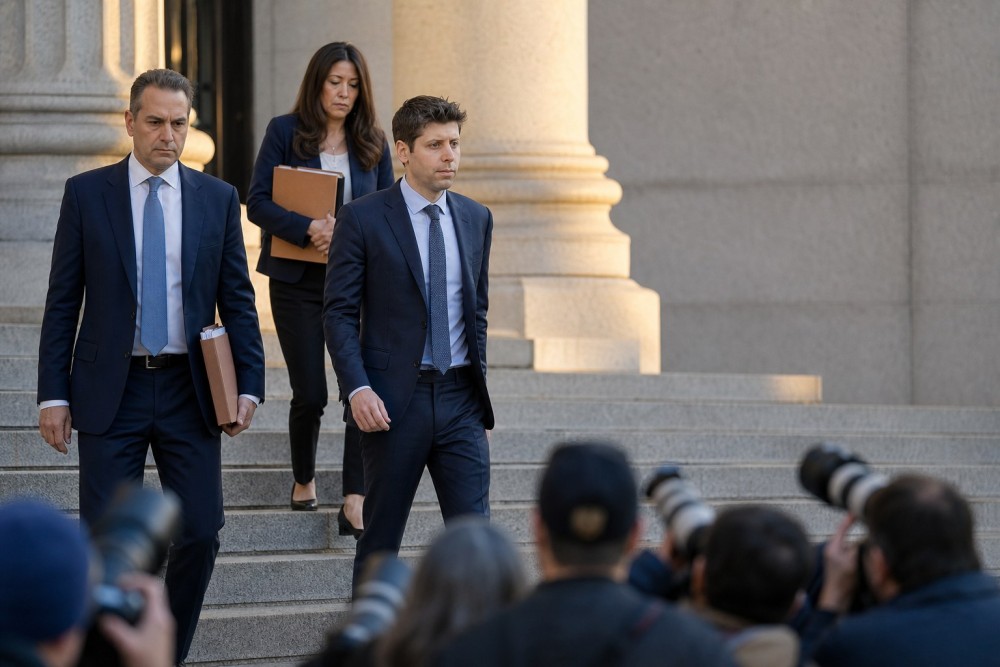
Gotrade News - OpenAI Chief Executive Sam Altman took the witness stand on Tuesday in the closely watched Elon Musk versus OpenAI trial. The case centers on OpenAI's planned for-profit conversion and Microsoft's role in shaping the artificial intelligence leader's governance.
Altman's testimony comes as investors weigh how a structural ruling could ripple across the broader AI ecosystem. The trial outcome is widely framed as a governance risk rather than a near-term operating threat to Microsoft or its peers.
Key Takeaways
- Sam Altman testified in the Musk vs OpenAI trial focused on OpenAI's for-profit conversion plan.
- Microsoft's roughly $13 billion OpenAI stake and Azure exclusivity face potential governance risk if control terms shift.
- AI capex incumbents including Nvidia, Alphabet, and Meta have indirect exposure to OpenAI's growth trajectory.
Inside the Courtroom Testimony
According to Axios, Altman defended OpenAI's restructuring as essential to fund frontier model development. He told the court that the for-profit conversion would not weaken the original mission of building safe artificial general intelligence.
Musk's legal team pressed Altman on early founding agreements and the company's shift from a nonprofit research lab. The plaintiff argues that the conversion breaches the original charter and unjustly benefits insiders.
As reported by TechBuzz, courtroom observers said Altman handled cross-examination with composure. However, analysts cautioned that strong testimony may not be enough to fully neutralize the governance questions in front of the judge.
Read-Throughs for US Investors
The most direct equity exposure runs through Microsoft (MSFT), OpenAI's largest commercial partner. Any ruling that restricts the conversion could complicate Azure exclusivity terms and the economic value of Microsoft's roughly $13 billion investment.
For Tesla (TSLA), the trial sharpens the spotlight on Musk's competing AI ambitions through xAI. Investors are parsing whether a favorable ruling could strengthen xAI's positioning against OpenAI in enterprise and consumer markets.
The wider AI capex thesis also depends on OpenAI's continued growth. Nvidia (NVDA) and Alphabet (GOOGL) both benefit indirectly from sustained model training demand and cloud infrastructure spending tied to OpenAI's roadmap.
Per Axios, the judge is not expected to rule immediately, and several days of additional testimony remain on the docket. Market reaction has so far been muted, with Microsoft shares trading in a tight range during the session.
Investors should treat the trial as a structural overhang rather than an imminent earnings catalyst. The governance outcome could reshape commercial terms over time but is unlikely to disrupt near-term Azure or AI revenue lines.