
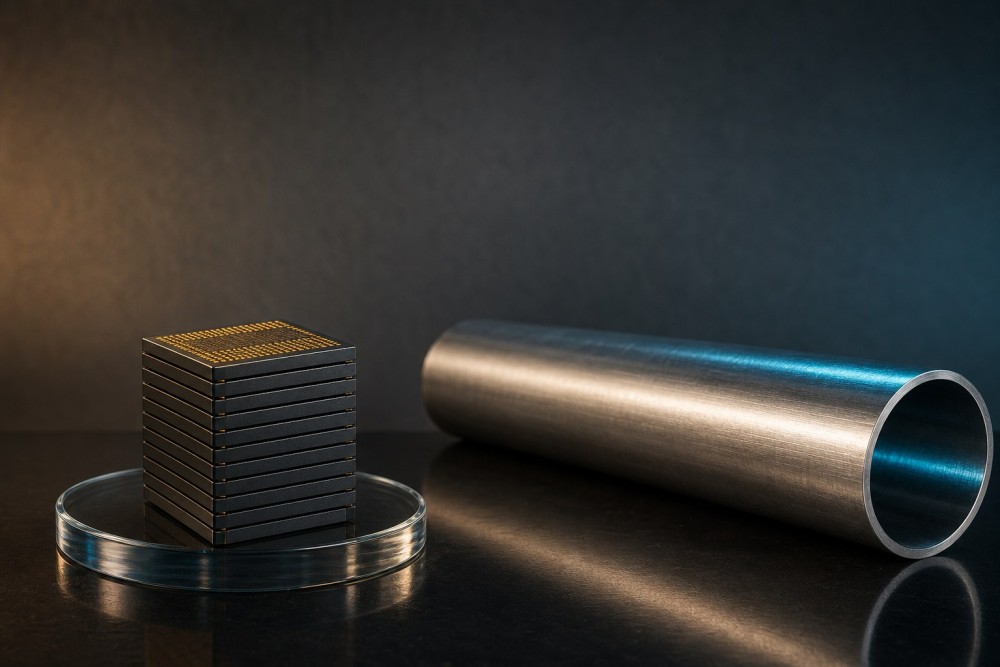
Gotrade News - Samsung Electronics has begun shipping 12-layer HBM4E memory samples to global customers, an industry first in AI memory. The chips deliver over 20% speed gains versus HBM4 and target AMD, Nvidia, and Google as priority buyers.
The acceleration reflects a wider AI supply strain, with Foxconn flagging hyperscaler capex on track toward $1 trillion next year. Tight high-bandwidth memory and server capacity remain the gating factor for AI revenue growth across US chip leaders.
Key Takeaways
- Samsung shipped first 12-layer HBM4E samples with 20% speed improvement over HBM4.
- Foxconn sees cloud capex potentially reaching $1 trillion in 2027 on AI demand.
- HBM supply and AI server capacity remain the key bottlenecks for chipmakers.
Samsung Accelerates HBM4E Rollout
According to Investing.com, Samsung pulled forward the HBM4E launch to the second quarter after shipping HBM4 samples in February. The new chips use Samsung's 1c DRAM process paired with a 4nm foundry logic base die.
The speed boost matters because high-bandwidth memory now sits at the center of AI accelerator performance. Customers including Nvidia (NVDA) and Advanced Micro Devices (AMD) rely on HBM stacks to feed their next-generation GPUs.
Samsung had ceded HBM3E share to SK Hynix during the first Nvidia Hopper cycle. The HBM4E sample milestone signals an attempt to reclaim primary-supplier status on Blackwell successor platforms now entering qualification.
The 20% speed improvement also pressures rival memory makers to respond quickly. Foundry partner Taiwan Semiconductor (TSM) produces the logic base die, deepening the cross-supply dependency at the leading edge.
Foxconn Flags Trillion-Dollar Capex Cycle
As reported by Investing.com, Foxconn Chairman Young Liu said cloud providers' capex has already reached $700 billion this year. He expects the figure to potentially reach $1 trillion next year as AI build-outs scale.
Foxconn assembles the bulk of Nvidia's AI servers and also leads iPhone production for Apple. The contract manufacturer plans to raise its own capex by 30% this year to expand AI server capacity globally.
Liu's confidence was anchored by a 19% first-quarter profit jump driven by AI server demand. The commentary reinforces that hyperscaler spending intentions remain firm despite recurring debates over AI return-on-investment timelines.
For investors, the capex trajectory directly underwrites order books at GPU vendors, foundry partners, and HBM suppliers. The supply strain narrative therefore reads as bullish for capacity-constrained names rather than as a demand risk.
However, execution risk concentrates around HBM yields and advanced packaging throughput. Any slip in Samsung's HBM4E qualification timeline could shift incremental orders back to SK Hynix and tighten margins across the chain.