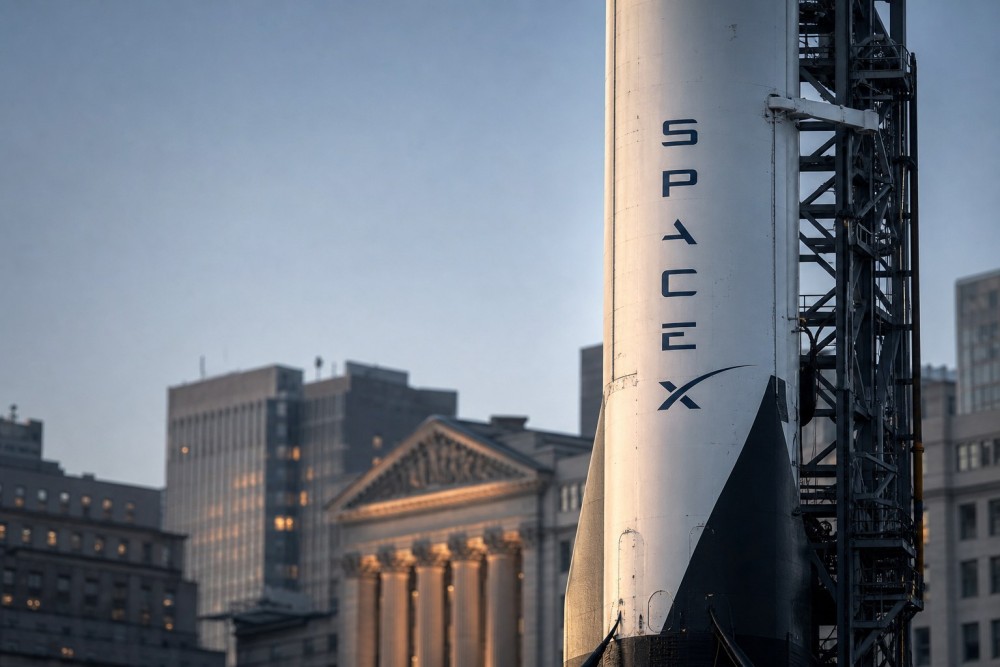
Gotrade News - S&P Dow Jones Indices refused to grant SpaceX a fast-entry path into the S&P 500. The decision arrived on June 4, 2026, just ahead of the rocket maker's blockbuster IPO.
The snub rests on strict profitability rules rather than sheer market capitalization. It leaves the Wall Street underwriting banks as the cleanest tradeable read-through for retail investors.
Key Takeaways
- S&P denied SpaceX fast entry because it failed GAAP profitability requirements.
- SpaceX posted a 2025 net loss of $4.94 billion on $18.67 billion in revenue.
- The IPO targets next week with a $1.75 trillion valuation and $75 billion raise.
According to Investing.com, S&P rules demand a GAAP profit in the most recent quarter and across the trailing four. SpaceX missed that bar after reporting a heavy loss last year.
SpaceX recorded a 2025 net loss of $4.94 billion despite revenue rising 33% to $18.67 billion. That loss is precisely what closed the door to the flagship index for now.
The index provider stressed that exceptions should not be granted solely on the basis of market capitalization. The stance keeps the entry rules consistent across every candidate company.
Index Rules and Market Impact
S&P will adjust only the broader S&P Total Market Index and the Dow Jones US Total Stock Market Index. The widely tracked S&P 500 stays shut to SpaceX in the meantime.
As reported by Investing.com, Nasdaq and FTSE Russell have already approved fast entry for SpaceX. Art Hogan of B. Riley Wealth praised S&P for staying rules-based and protecting its credibility.
For retail investors, the clearest play is the underwriting banks steering this offering. They stand to earn meaningful fees from a deal sized at roughly $75 billion.
Per Investing.com, JPMorgan (JPM) CEO Jamie Dimon hosted a Thursday event with roughly 3,500 clients. Morgan Stanley (MS) has its own event set for Monday to court investor demand.
Goldman Sachs even displayed SpaceX model rockets in two downtown Manhattan lobbies. The aggressive marketing underscores how much the banks have riding on this listing.
The investor roadshow drew President and COO Gwynne Shotwell alongside CFO Bret Johnsen. Their presence signals how seriously SpaceX is courting a broad capital base ahead of the listing.
Pure-play exposure to the space economy also runs through Rocket Lab (RKLB), a listed alternative to private SpaceX. Elon Musk said the company is entering a massive new growth phase and needs fresh capital.
The index snub does little to dent the commercial appeal of the SpaceX offering itself. Instead, investor attention shifts toward names that are already tradeable on US exchanges today.
The three lead banks effectively become a direct proxy for the momentum around this listing. Deal volume and advisory fees could rise as demand for the offering builds further.
The IPO is targeted for next week at a $1.75 trillion valuation. If it lands, SpaceX would rank among the ten most valuable US-listed companies.
Sources