SpaceX Targets $1.75T IPO With Musk Retaining Full Control
Erwanto Khusuma
Gotrade Team
Reviewed by Gotrade Internal Analyst
Share this article
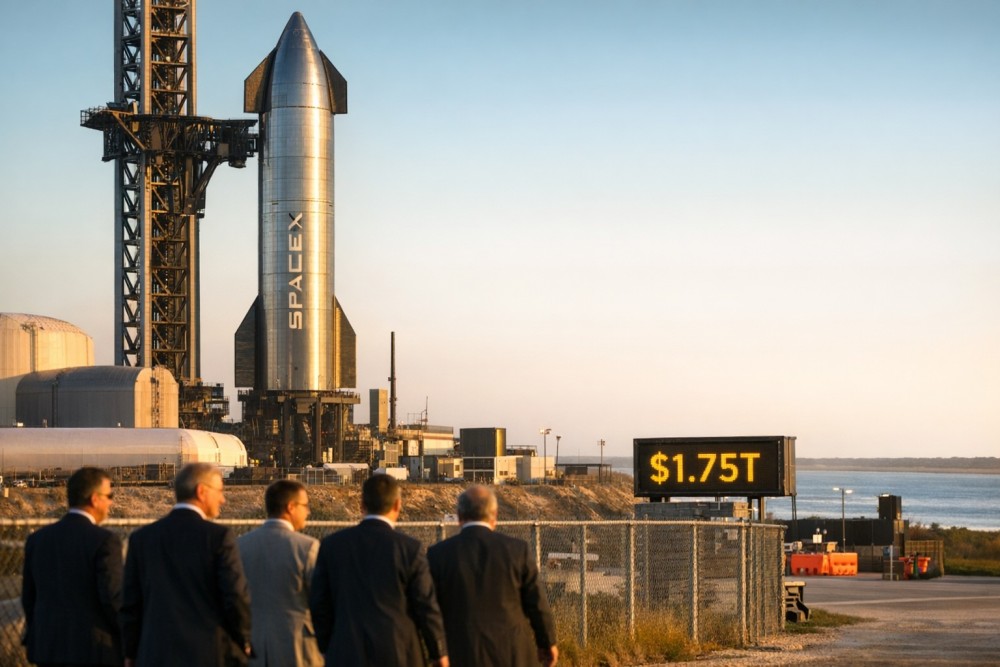
Gotrade News - SpaceX has confidentially filed for what would be the largest initial public offering in history, targeting a valuation of approximately $1.75 trillion with plans to raise $75 billion. Regulatory filings reviewed by Reuters reveal that Elon Musk and a small group of insiders will retain super-voting control through a dual-class share structure even after the company goes public.
Cathie Wood's ARK Invest (ARKK) has backed the ambitious valuation, calling it "grounded in a plausible trajectory" driven by Starlink, the xAI merger, and launch services. Three-day analyst meetings are set to begin at SpaceX's Starbase facility in Boca Chica, Texas this week.
SpaceX's $1.75 trillion IPO would be the largest ever, with Musk retaining super-voting control via Class B shares
ARK Invest supports the valuation, citing Starlink profitability and xAI integration as key drivers
Environmental and governance concerns are mounting as prediction markets see a 90%+ chance of timeline delays
The dual-class structure gives Musk and insiders Class B shares worth 10 votes each, while public investors receive Class A shares with just one vote. Musk will maintain three simultaneous roles as Chief Executive Officer, Chief Technical Officer, and Chairman of the nine-member board.
SpaceX's 2025 financials paint a complex picture behind the headline valuation. The company reported revenue of $18.67 billion against a consolidated loss of $4.94 billion, with $24.8 billion in cash, $92 billion in total assets, and $50.8 billion in liabilities.
Starlink Profits Fuel the Bull Case
Starlink, the satellite internet division, generated $4.42 billion in operating profit in 2025, providing the clearest path to profitability. ARK emphasized that "Musk's goals are ambitious by any historical standard, and SpaceX has repeatedly demonstrated the ability to compress the timelines that skeptics once assumed."
The xAI merger earlier in 2026 has added a significant AI dimension to SpaceX's business. Capital expenditures on AI infrastructure surged to $12.7 billion in 2025, more than doubling from $5.6 billion the prior year.
ARK's research identified three primary drivers supporting the valuation: Starlink operations, xAI integration, and launch services with "structural advantages." The firm stated that "the xAI merger has added a strategic dimension that no comparable public company has even attempted to replicate."
Headwinds and Skepticism
Not everyone is convinced the valuation holds up. Some analysts caution that much of the value may already be priced in, potentially limiting returns for IPO investors.
Environmental opposition is also intensifying ahead of the public offering. The South Texas Environmental Justice Network plans to protest outside Starbase as investors visit, with co-founder Bekah Hinojosa urging New York City's comptroller to avoid investing pension funds in SpaceX.
Hinojosa, a Brownsville resident near Starbase, pointed to a 2023 failed launch that sent concrete dust over a nearby town and ignited a 3.5-acre fire on state park land. The NAACP has also filed a federal lawsuit against xAI for air pollution at its Memphis data center.
Compensation disclosures in the filing revealed stark contrasts: Musk drew a salary of $54,080 in 2025, while President and COO Gwynne Shotwell earned $85.8 million. Prediction markets currently indicate a 90%+ probability that the IPO timeline will slip beyond both the June and September 2026 targets.
Despite the headwinds, the sheer scale of SpaceX's ambition and its demonstrated Starlink profitability make this the most closely watched IPO in a generation. Investors should expect significant volatility around the listing timeline and governance debates in the months ahead.
Gotrade is the trading name of Gotrade Securities Inc., which is registered with and supervised by the Labuan Financial Services Authority (LFSA). This content is for educational purposes only and does not constitute financial advice. Always do your own research (DYOR) before investing.