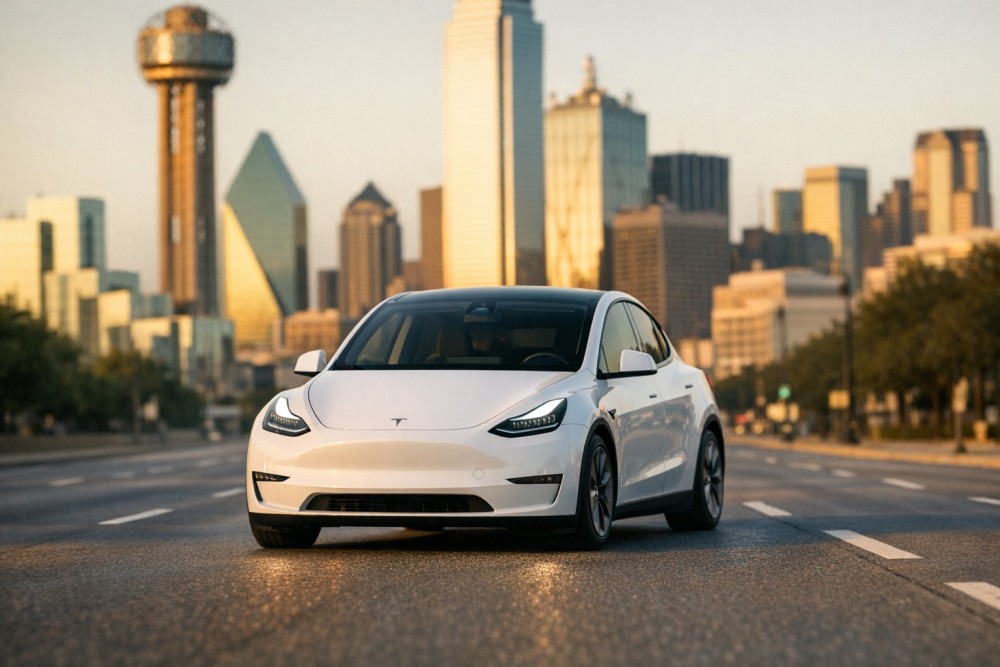
Gotrade News - Tesla (TSLA) expanded its robotaxi service to Dallas and Houston this week, building on its initial Austin launch at a time when investors were growing skeptical about the company's autonomous driving ambitions. The expansion comes just ahead of Tesla's Q1 earnings report, with the stock trading at $400.62 after gaining 3.01%.
Key Takeaways
1. Tesla's robotaxi expansion to Dallas and Houston signals a shift from supervised to unsupervised autonomous driving.
2. Morgan Stanley maintains a $415 price target, citing a potential ecosystem flywheel from successful FSD deployment.
3. Ford's CEO identifies BYD, not Tesla, as the primary competitive benchmark for the next wave of affordable EVs.
Robotaxi Momentum Meets Wall Street Debate
Morgan Stanley analyst Andrew Percoco called the rollout "tangible progress at a time when the market was growing increasingly skeptical." He described the move as a "material evolution" from Austin's deployment, which relied on human safety drivers, to a path toward unsupervised autonomous rides.
Percoco maintained his $415 price target for Tesla despite the company's projected $8.5 billion in capital expenditure. He argued that a successful robotaxi program could "create a powerful flywheel across Tesla's ecosystem," linking autonomous driving progress to revitalized auto sales and improved margins.
Not everyone on Wall Street shares that optimism. Ross Gerber of Gerber Kawasaki dismissed the robotaxi launch as a distraction, calling it a strategy to "kick the can down the road" and deflect attention from upcoming earnings.
According to Benzinga, Gerber had previously demanded $10,000 refunds if Full Self-Driving version 14.3 failed to achieve unsupervised capability. Tesla also faces more than 21 active lawsuits, including wrongful death claims and FSD-related litigation with potential billion-dollar settlement costs.
EV Competition Heats Up Globally
Ford (F) CEO Jim Farley offered a pointed assessment of Tesla's product lineup, noting that Tesla "really don't have an updated vehicle." Farley identified BYD, not Tesla, as Ford's primary competitive reference for the next generation of electric vehicles.
Farley believes the next wave of American EV buyers wants pickups and SUVs priced around $30,000, not the $50,000 range where Tesla currently competes. That price gap represents both a challenge and an opportunity for legacy automakers willing to go downmarket.
Despite the criticism, Tesla's sales numbers remain dominant in the US market. According to Benzinga, Tesla sold 117,300 EVs in the United States during Q1 2026, more than all other EV brands combined.
The Model Y led Chinese sales in March 2026 with 39,827 retail registrations. CEO Elon Musk noted that the "limiting factor is production output in Shanghai" ahead of supervised FSD approval in China.
Globally, Tesla delivered 358,023 units in Q1 while BYD posted 310,389 battery-electric sales in the same period. The narrowing gap between the two companies underscores BYD's rapid ascent in the pure electric segment.
Tesla's Q1 earnings report will provide clarity on whether the robotaxi expansion and FSD progress translate into improved margins. Investors will be watching closely for commentary on autonomous driving timelines, litigation exposure, and competitive positioning against both legacy automakers and Chinese rivals.
Sources
Benzinga, Tesla Robotaxi Launch in Dallas, Houston Represents 'Tangible Progress,' Morgan Stanley Says, 2026.
Benzinga, Jim Farley Says Tesla Lacks 'An Updated Vehicle' To Compete With Chinese EVs, 2026.