
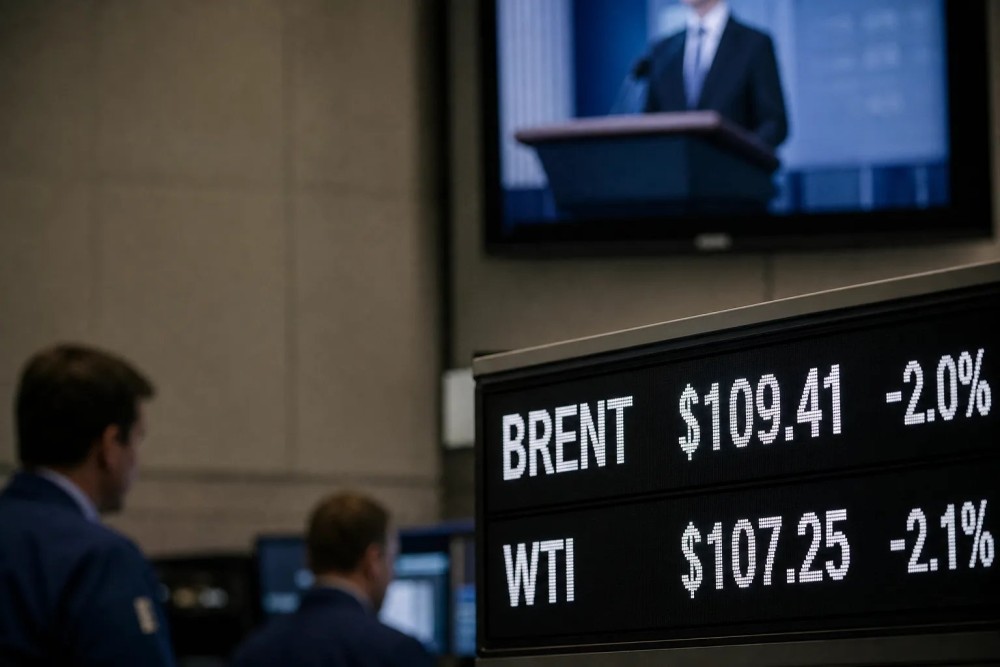
Gotrade News - President Donald Trump postponed a planned military strike on Iran after Gulf states requested a delay of two to three days. Oil prices retreated sharply on the news, with Brent crude futures falling more than 2% to $109.41 per barrel.
The pause eased immediate supply-shock fears that had rattled energy markets and lifted safe-haven assets last week. Asian equities traded mixed Tuesday as investors weighed geopolitical relief against lingering uncertainty over Middle East tensions.
Key Takeaways
- Trump suspended a planned Iran strike after appeals from Qatar, Saudi Arabia, and the UAE to delay action.
- Brent crude fell over 2% to $109.41 while U.S. crude declined 1.3% to $107.25 on the news.
- Asian markets traded mixed, with Japan's Nikkei up 1% and South Korea's Kospi down 2%.
According to Axios, Trump announced Monday he was postponing a strike that had been scheduled for the following day. He cited requests from the Emir of Qatar, the Saudi Crown Prince, and the UAE President to hold off on military action.
Trump instructed Defense Secretary Pete Hegseth and Joint Chiefs Chairman Gen. Dan Caine to suspend attack plans. The Gulf leaders reportedly asked for a window of two or three days to pursue diplomatic alternatives.
Oil Markets React to Diplomatic Pause
Energy traders unwound risk premiums that had built up on fears of a wider Middle East conflict. Producers including Exxon Mobil (XOM) and Chevron (CVX) face direct exposure to swings in global crude benchmarks.
As reported by Investing.com, the United States Oil Fund (USO) tracks WTI movements closely. The fund had rallied alongside crude before Tuesday's pullback on the diplomatic pause.
IG analyst Fabien Yip said markets remain cautious despite the easing. "Until we actually see real action happening in the Strait of Hormuz, whereby ships are passing through safely, I think the market in general is shrugging off the commentary," Yip told Investing.com.
Treasury yields edged lower as bond markets recovered from last week's risk-off positioning. The 10-year U.S. Treasury yield eased to 4.5974%, reflecting calmer flight-to-safety demand among global investors.
Asian Equities Diverge as US Futures Hold Steady
Regional benchmarks showed no clear direction Tuesday morning across Asia-Pacific trading desks. The MSCI Asia-Pacific ex-Japan index fell 0.22% while Japan's Nikkei 225 climbed 1% on a weaker yen tailwind.
South Korea's Kospi dropped 2% as exporters faced pressure from regional growth concerns. U.S. futures showed muted moves with Nasdaq down 0.07% and S&P 500 futures off 0.03% ahead of the New York open.
Investor focus now shifts to Nvidia's earnings report scheduled Wednesday after the close. The print serves as a critical test for the AI-driven rally that has propelled the S&P 500 ETF (SPY) through recent volatility.
Traders will watch whether geopolitical risk reasserts itself if the diplomatic window closes without a deal. Oil markets remain vulnerable to headline shocks given the proximity of major shipping routes to the conflict zone.