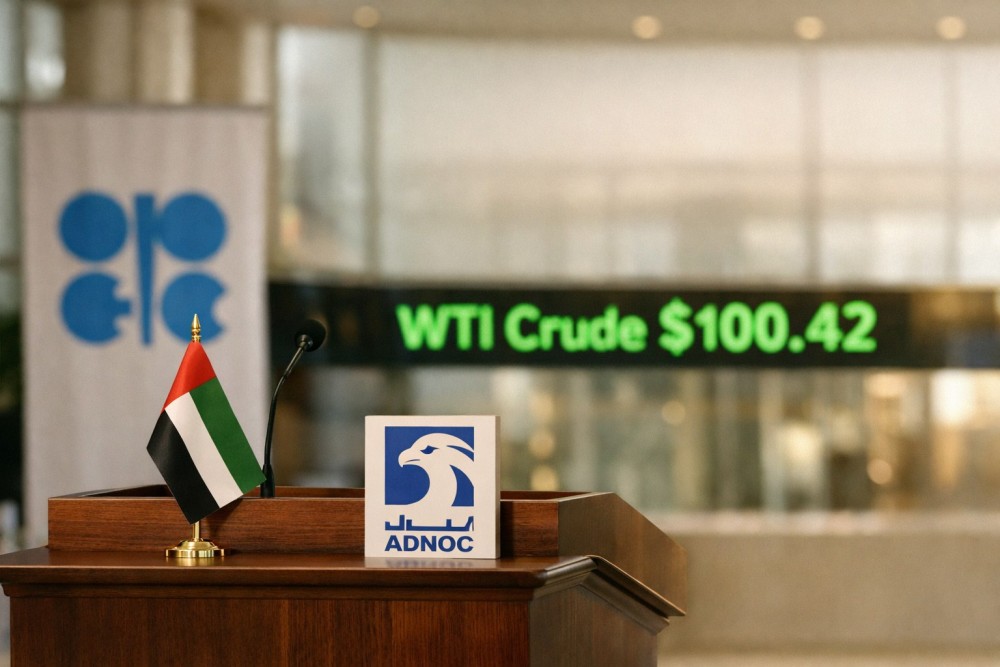
Gotrade News - The United Arab Emirates announced it will exit OPEC and the broader OPEC+ supergroup effective May 1, 2026, a move that immediately rattled global energy markets in the midst of the ongoing war with Iran.
The announcement came as WTI crude was already trading above $100 per barrel for the first time since April 10, reflecting a combination of supply disruption and unresolved geopolitical tension, according to Bloomberg and Al Jazeera.
Key Takeaways
- UAE oil production fell 44% from 3.4 million bpd before the Iran war to 1.9 million bpd in March amid the Strait of Hormuz closure.
- Goldman Sachs estimates 14.5 million bpd of Persian Gulf oil production has been disrupted by the war with Iran.
- UAE targets 5 million bpd capacity by 2027, the primary motivation for breaking free of OPEC quota constraints.
The UAE has long been one of OPEC's largest producers, contributing significantly to global supply. Its departure marks a fundamental shift in the world's oil alliance structure.
The country has been the target of missile and drone attacks for weeks by fellow OPEC member Iran. Tehran's strikes on shipping in the Strait of Hormuz have also constrained the UAE's ability to export oil.
UAE production fell from 3.4 million barrels per day before the Iran war to 1.9 million barrels per day in March. The 44% decline reflects the impact of the Hormuz closure on the country's export infrastructure.
Goldman Sachs commodities analysts said 14.5 million barrels per day of Persian Gulf crude oil production has been cut off by the war with Iran. The estimate captures disruption across multiple regional producers.
WTI crude topped $100 per barrel for the first time since April 10 after Iran talks stumbled and the UAE confirmed its OPEC departure. The combination of two catalysts triggered a sharp price move.
The UAE has the ambition to reach 5 million barrels per day of capacity by 2027 and wants more freedom to pursue that goal. OPEC's quota system has historically constrained the production expansion Abu Dhabi has been seeking.
Major US oil producers like Exxon Mobil and Chevron stand to benefit from a higher oil price regime. The realignment of Gulf alliances opens new volatility windows in energy markets.
For global retail investors, the supply-tight narrative dominates near-term energy positioning. Beyond major producers, energy sector ETFs like XLE serve as primary monitoring instruments in diversified portfolios.
Markets will also watch how OPEC+ responds to UAE's departure. Saudi Arabia, the de facto group leader, may revise production strategy to either compensate or maintain supply discipline.
The move is described by some analysts as President Trump's biggest OPEC win to date. The geopolitical implications extend beyond oil markets into broader Middle East alliance dynamics.
Central banks worldwide, including the Federal Reserve and ECB, were already navigating energy-driven inflation pressure. The new spike adds complexity to upcoming rate decisions across major economies.
Equity markets are processing the news through a sector rotation lens. Energy names are seeing tactical inflows while transportation, airlines, and energy-intensive consumer staples face renewed margin scrutiny.
LNG markets are equally affected with Asian benchmarks already up roughly a third since the war began. The interconnected nature of global energy markets means the UAE move ripples beyond crude oil futures.
For now, the supply-tight narrative dominates energy markets. Investors holding US oil producer exposure are aligned with the trend, though risk of reversal remains high if Iran diplomacy yields a breakthrough.