
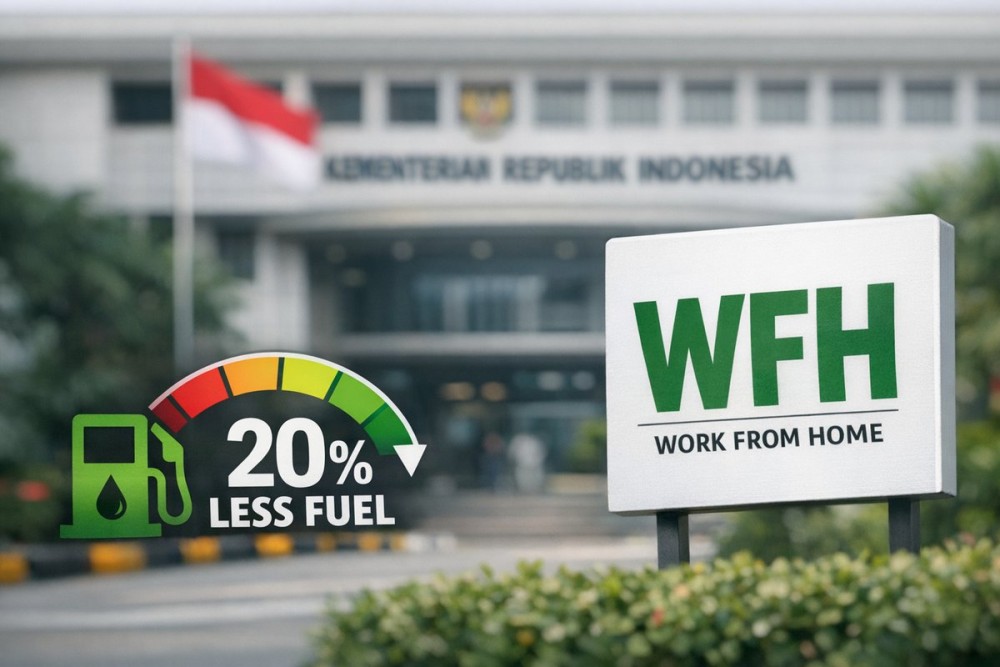
Gotrade News - The Indonesian government is set to announce a one-day-a-week work-from-home (WFH) policy tomorrow as a measure to reduce fuel consumption. This step addresses uncertainties in the global energy supply. According to Hadi Ismoyo, an oil and gas industry expert, this policy will indeed cut down national fuel use, yet its impact may not be substantial.
Although major fuel absorption comes from industry and the state electricity company, this policy needs support. It's seen as an efficiency effort in response to the energy crisis and escalating global conflicts. Especially now, governance and industry operations can also function digitally. However, certain field operations still require physical presence.
Coordinating Economic Minister Airlangga Hartarto stressed that the government is reviewing flexible work policies with a one-day WFH scheme out of a five-day workweek to anticipate spikes in global energy prices. Airlangga noted a fifth of the usual gasoline consumption could be saved.
Finance Minister Purbaya Yudhi Sadewa echoed this, suggesting that WFH won't impede economic productivity and that energy efficiency could be achieved if applied selectively. For civil servants, WFH will be mandatory, while it remains an advisory for the private sector.
Strategic sectors like manufacturing and public services will continue operations as usual, as not all jobs can be performed remotely. On the other hand, fuel savings from reduced public mobility heavily hinge on oil prices.
Interior Minister Tito Karnavian also assured that the WFH policy's confirmation would be made official on Tuesday. Tito emphasized WFH as an energy-saving measure amid global dynamics. More specific directives to regional governments will be provided by the Ministry of Home Affairs.
The government is currently committed to strengthening national fiscal resilience amid global changes. Through WFH, efficiency within various ministries/agencies is hoped to be achieved, thus keeping the fiscal deficit under 3%.
The challenge lies in ensuring effective WFH implementation without disrupting key operations. Jobs that demand physical presence, like in oil field operations, need strict regulation. However, efficiency potential remains, especially if the policy is implemented correctly and flexibly.
The effectiveness of the WFH policy will be continuously monitored, considering the ever-changing energy prices. The government is confident that this policy provides a preventive measure to tackle the global energy crisis without compromising national productivity.
Reference:
- Liputan6, WFH 1 Hari Diumumkan Besok, Hemat Konsumsi BBM Berapa?. Accessed on March 31, 2026
- Liputan6, Kebijakan WFH Diumumkan Selasa 31 Maret 2026 Besok. Accessed on March 31, 2026
- Bloomberg Technoz, Besok, Pemerintah akan Umumkan Kebijakan Baru: WFH hingga B50. Accessed on March 31, 2026
Featured Image: GPT Image 1.5