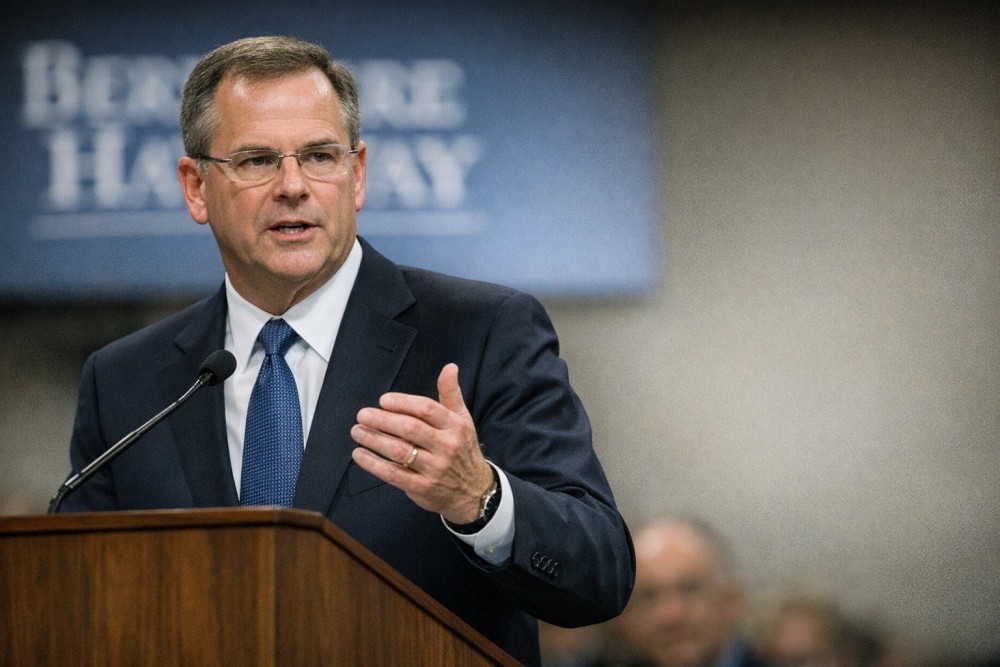
The berkshire cash pile 2026 has swelled to roughly $397 billion, the largest war chest in company history and a loud signal that new CEO Greg Abel sees few bargains here. For BRK.B holders, this is a direct input into your brk.b decision and how you size US equity exposure for the next twelve months.
Quick Context: $400B Cash Position Under Greg Abel
Berkshire reported $58 billion in cash and $339 billion in Treasury bills at the end of Q1 2026, for a combined $397 billion in liquid assets, according to Fortune. That is up from the prior $381.6 billion peak set last year. Greg Abel formally took over as CEO on January 1, 2026, with Warren Buffett moving to chairman emeritus and presiding over the May 3 annual meeting in a reduced role.
What Abel actually said
Abel told shareholders Berkshire will not deploy into subpar opportunities and called patience a core strength. He also ruled out a break-up. Translation: the cash stays parked, earning roughly 5% in T-bills, until prices come to him.
What this means for your portfolio
If the most disciplined capital allocator in modern markets is hoarding cash at this scale, assume broad US equities are not cheap. Use that as a check against urges to add aggressively at index highs.
Why Cash Hoarding Signals Caution About Valuation
The buffett cash signal has historically been a leading indicator. Berkshire built cash heading into 2000 and 2007, then deployed massively into the dislocations that followed. Buffett rarely says markets are expensive on television. He says it through the cash column on the balance sheet.
The opportunity cost is real
$397 billion at 5% generates close to $20 billion in annual interest, which is real income. But it caps compounding because equities have historically returned more over long horizons. Abel is choosing certainty over expected return, which only makes sense if equity returns from here are below average.
What you should do about it
Stress test your book the way Berkshire is stress testing its. If a 20% drawdown forces you to sell, you are too long. Trim the speculative tail and keep your highest conviction core. The margin of safety framework matters most when the most respected investor in the country is publicly avoiding new buys.
Trade smarter, not harder. Open a Gotrade account to access fractional BRK.B shares and build a Berkshire-style core position from any size starting capital.
Historical Analog: 2007-2008 vs Today
The 2007-2008 analog is the cleanest comparison. Berkshire let cash build through 2007 while declining to chase the late cycle. When markets cracked in late 2008 and 2009, Buffett deployed into Goldman Sachs preferreds, Bank of America, and a string of bolt-on industrial buys at depressed prices. Coattail investors who tracked those deployments and bought alongside Berkshire compounded heavily over the following decade.
Where today differs
Today is not a credit crisis. It is a valuation and concentration concern, with a handful of mega caps driving index returns. Abel may need to wait longer than Buffett did in 2008 because the trigger event is less obvious.
Where today rhymes
Both periods feature record cash, public caution from Omaha, and an index priced for perfection. The base case for BRK.B holders is that Berkshire's cash becomes a strategic asset within 24 months, not a permanent feature.
BRK.B Holders: Hold, Add, or Rotate to Index
The brk.b decision splits three ways. Hold is the most reasonable default. Abel built Berkshire Hathaway Energy into a multi-billion dollar earner and inherited an operating business that grew earnings 18% year over year in Q1, per CNBC. The continuity case is intact.
When adding makes sense
Add only on a clear deployment catalyst. That means an announced large acquisition, a meaningful equity buy disclosed in a 13F or 13G, or a market dislocation where BRK.B trades at a discount to its sum-of-parts. Adding because the headlines say record cash is the wrong signal.
When rotating makes sense
If you cannot stomach the optionality of waiting for Abel to deploy, rotate part of your BRK.B position into a low cost S&P 500 index fund. You give up the Berkshire premium but reclaim full equity exposure if the market keeps grinding higher.
Action Plan: Coattail Bolt-On Buys Once Deployed
Once Abel deploys, the coattail strategy is to buy alongside Berkshire in the names where it adds. Track 13F filings each quarter for new positions and adds. Watch the sectors Buffett historically loves: energy via OXY, financials, consumer staples like KO, and the long held core in AAPL.
Conclusion
The buffett cash signal is doing the talking even as Buffett himself steps back. Near $400 billion in cash at Berkshire is a clear message that valuations matter and that patience pays. Your brk.b decision should reflect that, with hold as the default, adds gated on real deployment catalysts, and rotation only when the Berkshire premium no longer fits your risk profile.
Investors who win the next cycle prepare during the patient phase, not the deployment phase. Build your watchlist of Berkshire-style quality names now.
Open a Gotrade account today to access fractional shares of BRK.B, AAPL, KO, and OXY, and build a Berkshire-style core that compounds patiently with you.
FAQ
What is the berkshire cash pile 2026 figure?
Berkshire reported roughly $397 billion in cash and Treasury bills at the end of Q1 2026, a record level under new CEO Greg Abel.
Is the buffett cash signal a sell signal for stocks?
It is a caution signal, not a sell signal, suggesting investors should stress test allocations rather than exit equities entirely.
Should I add to BRK.B at current levels?
Hold is the cleanest brk.b decision, with adds gated on a clear cash deployment catalyst from Abel.
How do I coattail Berkshire's deployments?
Track quarterly 13F filings for new positions and adds, then evaluate those names on your own merits before buying.