
AI infrastructure stocks rarely trade on their own news this week. The real read-through comes from Mag 7 capex commentary landing April 29-30, when Microsoft, Alphabet, Meta, and Amazon disclose how much they will spend on data centers, custom silicon, and accelerator buildouts.
That commentary directly moves five infrastructure names. A capex guide-up tightens GPU and foundry supply assumptions for the back half of 2026. A guide-down forces multiple compression across the stack. Either way, the listening matters more than the print.
Why Mag 7 Earnings Move These Names
Hyperscaler capex is now the demand curve for AI silicon. According to Bloomberg, the four largest cloud spenders are projected to put more than $300 billion into AI infrastructure in 2026, and any incremental change in that envelope reprices the supply chain instantly.
Custom silicon commentary matters just as much as raw dollar guides. When a hyperscaler talks up TPU, Trainium, or MAIA volumes, it shifts share assumptions for merchant accelerator vendors. When they emphasize off-the-shelf GPUs, the merchant names rip.
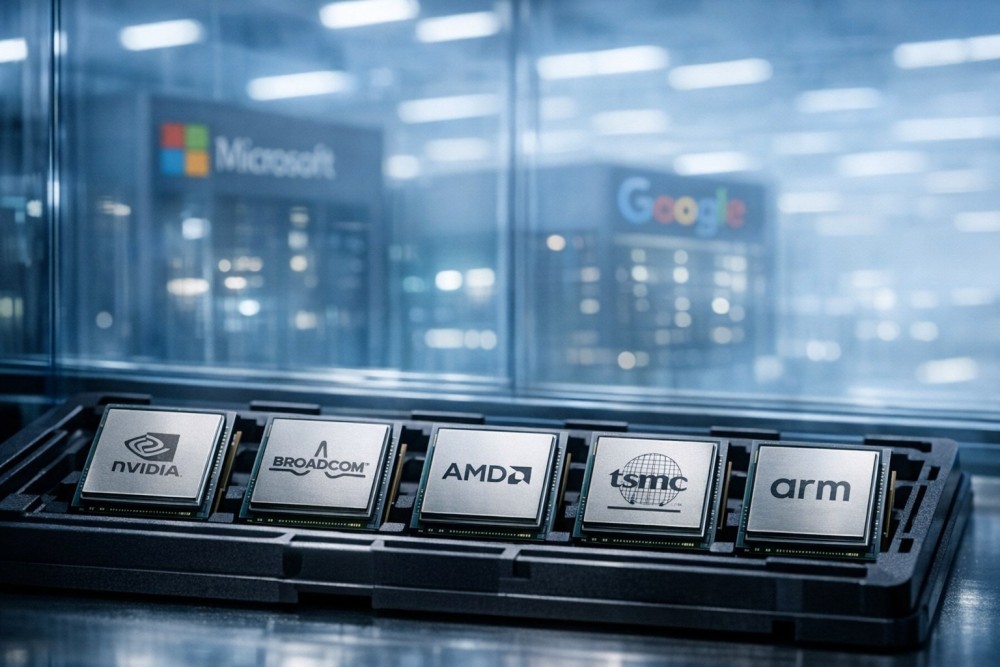
The 5 AI Infrastructure Names to Watch
1. Nvidia (NVDA)
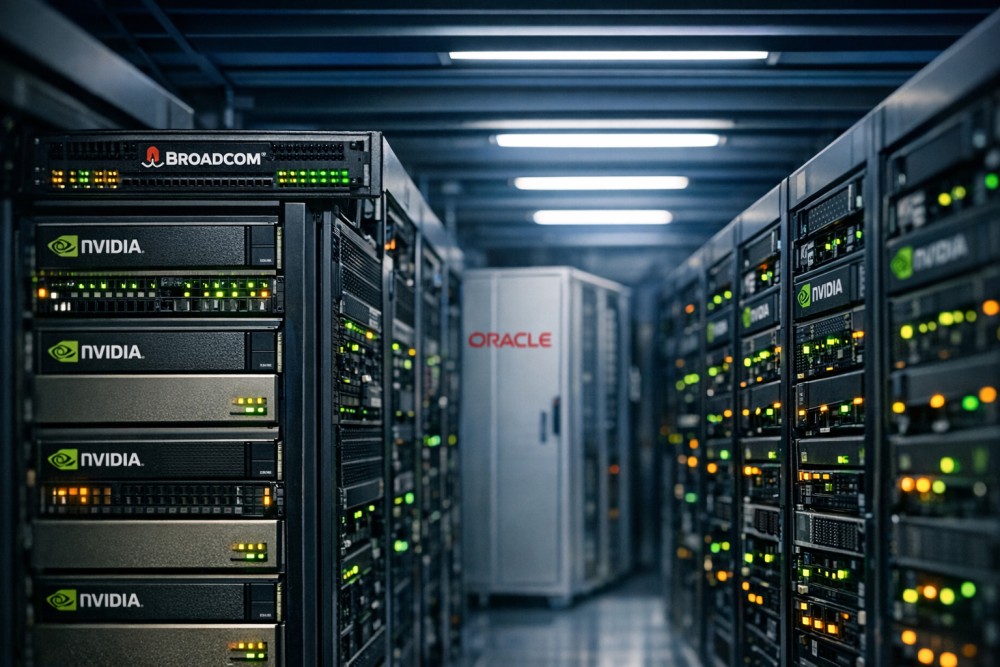
The cleanest read-through name. Nvidia rises when Microsoft, Alphabet, or Meta guide capex higher and reaffirm GPU prioritization for frontier model training.
Listen for two things tonight: any explicit dollar capex guide-up for fiscal 2026, and language around accelerator mix. If hyperscalers tilt commentary toward in-house ASICs over merchant GPUs, NVDA gets pressured even on a beat.
The asymmetric move is on Microsoft. Azure capex commentary has been the single biggest NVDA repricer over the last four quarters, more than Nvidia's own guidance.
2. Broadcom (AVGO)
The custom silicon proxy. Broadcom co-designs Google's TPU and is reportedly involved in Meta's MTIA program, so any positive TPU or custom accelerator commentary from Alphabet or Meta is a direct AVGO read-through.
The bear case is subtle. If Amazon emphasizes Trainium scaling without naming partners, or if Microsoft de-emphasizes MAIA timeline, AVGO loses one of its three custom-silicon legs. Watch the named-customer disclosures closely.
The bull setup is unit-volume language on TPU v6 or successor designs. Any Alphabet commentary that points to internal TPU growth outpacing GPU growth flows directly into AVGO's networking and ASIC segments.
3. AMD (AMD)
The data-center share story. AMD trades on whether Microsoft and Amazon name MI300X or MI350 deployments in their cloud commentary, and whether they frame AMD as a second source or a strategic accelerator partner.
A negative read shows up when hyperscalers talk capex up but mention only Nvidia and in-house silicon. That is the tell that AMD is losing share at the margin, regardless of what AMD itself reports later in the quarter.
The bull case is any specific MI350 deployment commentary from Microsoft or Amazon, particularly tied to inference workloads where AMD's price-performance pitch lands hardest.
4. TSMC (TSM)
The foundry flow-through. TSMC benefits from any Mag 7 capex guide-up because every accelerator in the stack, NVDA, AVGO, AMD, and most custom silicon, is fabbed at TSMC's leading nodes.
The specific tell is CoWoS advanced packaging language. If hyperscalers signal sustained 2026 demand for HBM-equipped accelerators, TSM's packaging capacity story tightens further. According to CNBC, CoWoS capacity remains the single biggest bottleneck across the AI silicon supply chain.
5. ARM Holdings (ARM)
The Neoverse and custom CPU read. ARM moves when Amazon discusses Graviton deployment scale, when Microsoft mentions Cobalt CPU rollout, or when Apple-related commentary surfaces around in-house silicon roadmaps.
ARM's royalty model means commentary itself moves the stock more than near-term shipment math. A single sentence about Graviton penetration in AWS workloads can reprice the name overnight.
The data-center CPU narrative is the most underpriced thread in this earnings cycle. Watch for any quantification of ARM-based instance share inside hyperscaler fleets.
Mag 7 prints land tonight and tomorrow. If you already use Gotrade, add NVDA, AVGO, AMD, TSM, and ARM to your Watchlist now so you can react to capex commentary the moment it crosses, not 30 minutes later.
Conclusion
The Mag 7 print itself is rarely the trade. The read-through is. Hyperscaler capex envelopes, custom silicon language, and accelerator mix commentary will reprice these five names within minutes of the earnings call, often before the headline numbers fully digest.
The discipline this week is listening with a checklist. Capex dollar guides move TSMC and the merchant accelerator names. Custom silicon language moves Broadcom and pressures AMD. CPU commentary moves ARM. Each stock has a different sensitivity to a different sentence on the call.
Gotrade gives you fractional access to all five names with no minimums, so you can size positions around your conviction in each read-through rather than around share price.
Open the app, add the watchlist, and be ready before the first Mag 7 call kicks off tonight.
FAQ
Which Mag 7 print matters most for AI infrastructure stocks?
Microsoft and Alphabet typically set the tone because their capex guides anchor the full-year hyperscaler envelope.
Why does custom silicon commentary matter for Broadcom and AMD?
Custom ASIC growth at hyperscalers can displace merchant GPU demand, so the language reprices accelerator vendors instantly.
Is TSMC a safe way to play AI infrastructure regardless of share shifts?
TSMC captures the foundry flow-through across nearly every accelerator, making it less sensitive to vendor-level share moves.
How fast do these stocks move on Mag 7 commentary?
Reactions usually occur during the earnings call itself, often before the official transcript hits the wire.