The orcl vs crm 2026 debate is back on the table. Both names just printed earnings, and they tell very different stories on growth and margin.
Oracle (ORCL) is the cloud backlog story. Salesforce (CRM) is the software margin story.
If you already hold US cloud stocks, this is a good moment to update your watchlist and decide which lane you want more of.
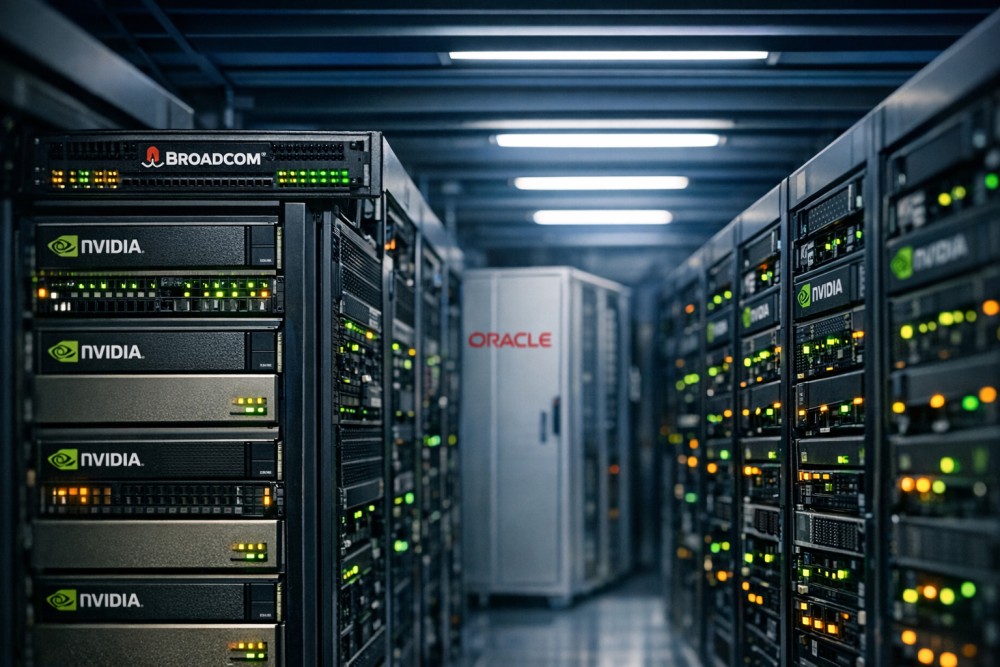
ORCL Earnings Highlights: Cloud Backlog and AI Capex
Oracle's most recent quarter put the cloud backlog front and center. Remaining performance obligations (RPO) hit roughly $553 billion, with a fresh leg added on top of last quarter's headline jump.
Cloud infrastructure (OCI) grew in the high double digits year over year. AI infrastructure revenue is now a meaningful contributor.
Backlog and revenue mix
According to Investing.com, Oracle added about $68 billion of net-new RPO in a single quarter, roughly five times the year-ago pace.
That backlog converts into revenue over multiple years. Management has flagged about $4 billion of incremental revenue feeding into FY2027 alone.
Capex and the cash question
Oracle raised FY2026 capex guidance to roughly $50 billion, up from $35 billion. That is the cost of locking in AI compute capacity.
A meaningful share of the new capacity is funded by partners or customer prepayments. That softens the cash impact, but does not erase it.
The bull case: the backlog more than covers the spend. The bear case: any slip in conversion timing pressures free cash flow before revenue catches up.
CRM Earnings Highlights: Agentforce and Software Margins
Salesforce delivered a different shape of result. Revenue grew about 12% year over year to $11.2 billion in Q4 FY2026.
The story now is operating leverage plus an early AI product line called Agentforce.
Margin expansion
According to CapyFin, non-GAAP operating margin expanded to 34.2%, up from 33.1% a year earlier.
FY2027 guidance points to 34.3% non-GAAP operating margin. That is a software business compounding profit, not chasing top-line at all costs.
Agentforce traction
Agentforce annual recurring revenue reached $800 million, up 169% year over year.
It is still small inside an $11 billion quarterly base. But cumulative deal count and quarter over quarter growth show it is sticking, not stalling.
Quick check: pull up your watchlist now. Do you have ORCL, CRM, or both? If only one, ask yourself whether you are missing the other side of the cloud trade.
Valuation Compare: Forward P/E and Revenue Growth
This is where the two stocks diverge most clearly. The market is pricing them for very different things.
The forward multiples
Oracle's forward P/E sits near the low 20s. Salesforce trades closer to the mid teens on most consensus models.
Oracle gets the higher multiple for backlog growth. Salesforce gets the lower multiple for slower top-line.
The forward multiple gap shows up clearly when you put both names side by side.
Growth versus margin
| Metric | ORCL | CRM |
|---|---|---|
| Revenue growth (latest qtr, YoY) | ~22% | ~12% |
| Forward P/E (approx) | ~22 | ~15 |
| Headline AI metric | $553B RPO | $800M Agentforce ARR |
| Capex intensity | High and rising | Low and stable |
You are paying for two different cash flow profiles. One trades the multiple for visible backlog. The other trades the multiple for proven margin.
How to Pick: ORCL for Backlog or CRM for Margin
This is not a binary choice for most portfolios. Most readers should think in terms of weight, not picking one over the other.
When ORCL fits your slot
You already hold software margin compounders. You want more direct exposure to AI infrastructure spend.
You are willing to live with capex risk and watch RPO conversion every quarter.
When CRM fits your slot
You already hold an AI infra basket. You want a lower multiple, higher margin software name to balance it.
You want optionality on Agentforce without paying a premium price for it. The downside is that revenue growth is in the low double digits, not the 20s.
Your homework is simple. Track Agentforce ARR each quarter as the proof point, and watch operating margin for any sign of erosion.
For broader cloud context, the framework in AWS vs Google Cloud vs Azure applies here too. You can also pressure test these earnings against the four metrics in the cloud growth signal playbook.
Conclusion
Post earnings, ORCL and CRM are not direct substitutes. They are complements.
ORCL gives you the AI infrastructure backlog. CRM gives you software margin and an early agentic AI product line. Owning both is reasonable for most cloud watchlists.
If you already trade US stocks on Gotrade, you can act on this without rebalancing your whole book. Buy from US$1 with fractional shares, set your target weights for ORCL and CRM, and scale in over a few sessions. Open the Gotrade app and check your current cloud exposure today.
FAQ
Q: Is ORCL or CRM the better cloud stock for 2026?
Neither is strictly better. ORCL leans growth and backlog, CRM leans margin and quality, and they cover different parts of the cloud trade.
Q: What is the biggest risk in ORCL right now?
Capex risk. If RPO conversion slips, free cash flow gets pressured before the backlog hits the income statement.
Q: Does Agentforce justify owning CRM?
Agentforce ARR of $800 million is small versus total revenue. But 169% growth and rising deal count make it the metric to track each quarter.
Q: Can I hold both ORCL and CRM in my watchlist?
Yes. They are complements, not substitutes. Most cloud-focused watchlists can carry both with different position weights.