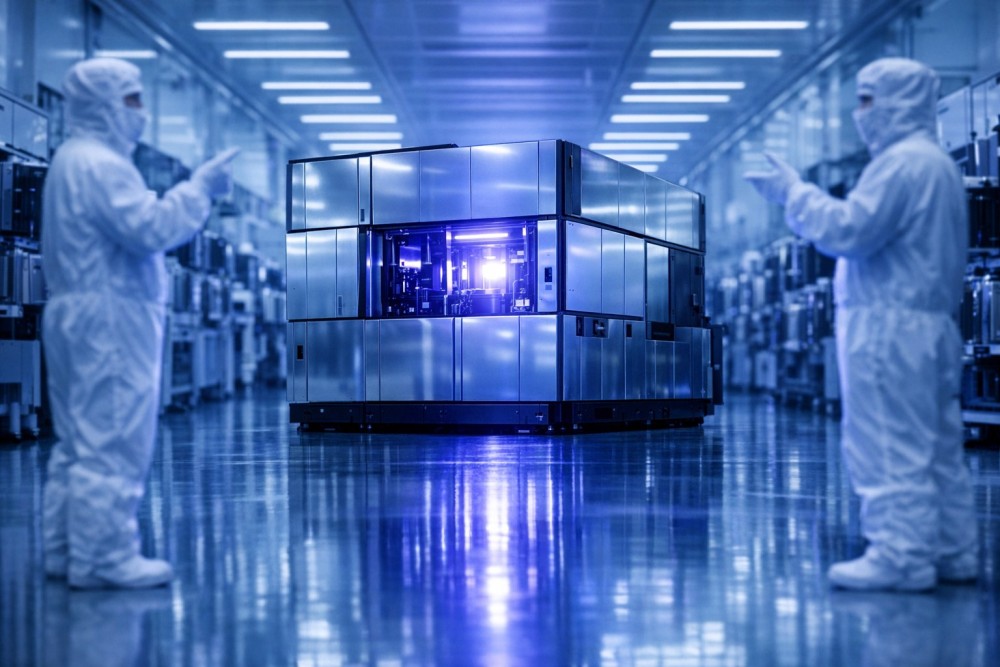
ASML Holding (ASML) sits at a strange intersection of cyclical and structural. It is the only company in the world that builds extreme ultraviolet lithography systems, the machines required to print every leading-edge AI chip.
That monopoly turns ASML into the picks-and-shovels play on global semiconductors. Whether Nvidia (NVDA) or AMD wins the next AI cycle, the wafers run through ASML tools.
The setup matters now because Q1 2026 confirmed both the demand pull and the China headwind in one print. Here is how to think about the long-term thesis.
Why ASML Has a Literal Monopoly on EUV Lithography
EUV is not a competitive market. It is a single-vendor market, and that vendor is ASML.
The technology requires a 13.5-nanometer light source, mirrors polished to atomic flatness, and a supply chain ASML spent two decades and over $9 billion building with Zeiss and Cymer. Nikon and Canon publicly walked away from EUV development years ago.
The result is structural pricing power. Each Low-NA EUV system sells for roughly €180 million, and the new High-NA tools clear €380 million each. Customers pay because there is no substitute below the 7nm node.
Customer Concentration: TSMC, Samsung, and Intel Dependency
ASML's order book leans heavily on three buyers. Taiwan Semiconductor (TSM), Samsung Foundry, and Intel collectively absorb the majority of EUV capacity, with TSMC alone accounting for an estimated 40 percent of EUV deliveries.
This concentration cuts both ways. Losing a single customer would dent revenue, but each of these three is in an AI-driven capex sprint and cannot scale without ASML.
The dependency is mutual. TSMC's 2nm ramp, Samsung's Pyeongtaek P5 fab, and Intel's 18A node all require dozens of additional EUV scanners through 2027. That is the bookings tailwind sitting in the backlog.
Semi Capex Cycle: How ASML Benefits Across Memory and Logic
Semiconductor capex is cyclical, but ASML smooths the cycle better than most equipment names.
When logic capex peaks, EUV demand from foundries drives the order book. When memory capex turns, SK Hynix and Micron lift DRAM-related EUV orders for HBM, the high-bandwidth memory feeding AI accelerators. Our overview of the chip industry in semiconductor stocks and the chip industry walks through how these cycles overlap.
SK Hynix recently placed a multi-year EUV order north of $7 billion to support HBM expansion. That is the memory leg of the cycle now firing alongside logic, a setup ASML rarely enjoys.
Want to add picks-and-shovels names to your AI exposure? Review your portfolio and access ASML on Gotrade to see whether semiconductor equipment fits your thesis.
China Export Controls: Headline Risk vs Long-Term Demand
China is the most quoted ASML risk and arguably the most overstated one. EUV systems have never shipped to China, so the export controls hit only the older DUV product line.
The Q1 2026 print made the impact concrete. China fell to 19 percent of system sales, down from 36 percent in Q4 2025, yet ASML still raised full-year guidance to a €36 to €40 billion range.
The reason is mix. Lost DUV revenue to China is being replaced by higher-margin EUV demand from AI customers in Taiwan, Korea, and the US. Headline risk persists, but the unit economics improve as the mix shifts.
Valuation: P/E Premium Justified by Order Backlog
ASML trades at roughly 30 times forward earnings, a clear premium to the broader semiconductor equipment group at 22 to 25 times.
The premium is anchored by visibility. Year-end 2025 backlog stood at €38.8 billion, with Q4 net bookings of €13.2 billion including €7.4 billion of EUV. According to ASML's Q1 2026 financial results, Q1 net sales reached €8.8 billion at a 53 percent gross margin.
According to Tom's Hardware, ASML now guides to €44 to €60 billion in 2030 revenue, implying a high single-digit topline CAGR with margin expansion as High-NA EUV ramps. That backlog and roadmap explain why investors tolerate the multiple.
For a broader view of the AI semiconductor stack, our note on NVIDIA vs TSMC vs Broadcom is a useful companion read.
Conclusion: ASML as the Pickaxe Play on Global Semis
ASML offers something rare: monopoly economics inside a cyclical industry, with a multi-year backlog providing visibility most chip names lack.
The risks are real. China revenue keeps shrinking, customer concentration is high, and any AI capex pause would slow new orders. But the structural pull from EUV demand and the High-NA roadmap looks intact.
Review your semiconductor exposure and check whether your portfolio holds enough picks-and-shovels names. Open ASML on Gotrade to size the position alongside your existing chip exposure.
FAQ
Does ASML really have a monopoly on EUV lithography?
Yes, ASML is the only company that produces EUV scanners, after Nikon and Canon exited the technology over a decade ago.
How exposed is ASML to China export controls?
EUV has never shipped to China; controls affect older DUV systems, and China dropped to 19 percent of Q1 2026 system sales.
Why does ASML trade at a premium to other semi equipment names?
A €38.8 billion order backlog and structural EUV monopoly give ASML earnings visibility peers cannot match.
What drives ASML's long-term revenue growth?
AI-driven logic capex at TSMC, Samsung, and Intel plus HBM memory expansion at SK Hynix and Micron.
What is the biggest risk to the ASML thesis?
A sharp pause in global AI capex would slow new EUV bookings, even though existing backlog still ships.