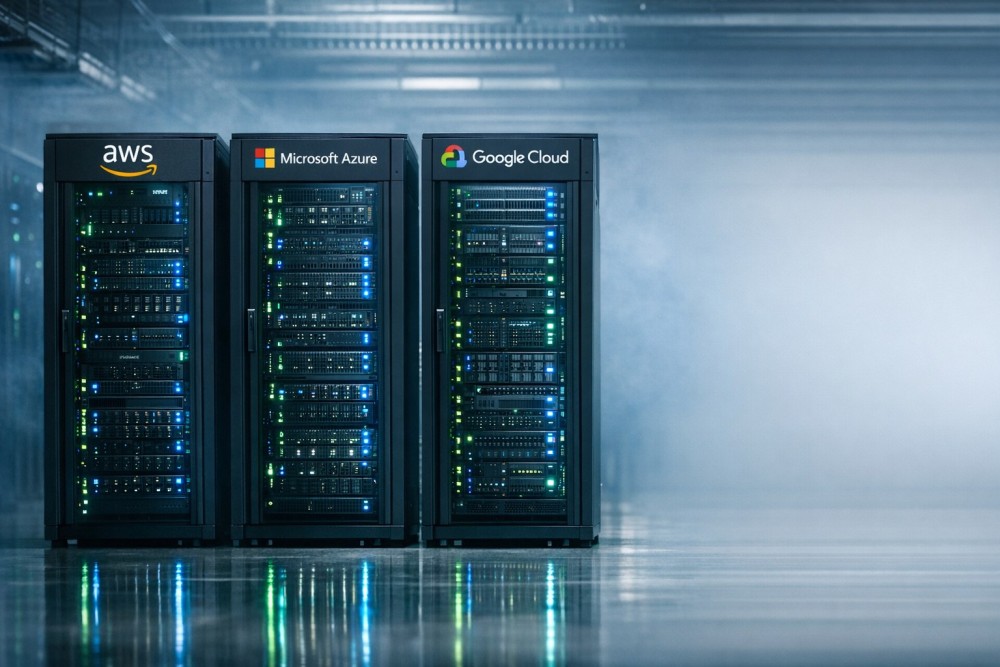
The AWS vs Azure vs Google Cloud race is no longer a fight for cloud share. It is a fight for AI workloads, capex efficiency, and the next decade of compute revenue. For investors, picking the right hyperscaler exposure (or the picks-and-shovels around them) is one of the most consequential calls in US tech.
Below is a Q1 2026 read on where each cloud stands, how to value the AI ramp, and the cleanest ways to invest through Gotrade.
Cloud Market Share in Q1 2026
Hyperscaler share has stayed remarkably stable at the top, but growth rates have re-ranked the leaderboard.
AWS still leads, but margins are the story
According to Synergy Research Group, AWS held roughly 30% of global cloud infrastructure spend in Q1 2026, with Azure at 25% and Google Cloud at 13%. AWS revenue grew 19% year over year, helped by AI capacity coming online faster than modeled.
The bull case for AMZN is operating margin: AWS now contributes the majority of Amazon's operating income on a minority of revenue.
Azure is closing the gap on AI workloads
Azure grew 31% year over year in the latest quarter, with management attributing roughly 12 points of that growth to AI services. That makes MSFT the fastest-growing of the three majors at scale.
The OpenAI partnership remains a structural advantage, but Microsoft has also broadened its AI customer base to include Anthropic workloads and large enterprise fine-tuning contracts.
Google Cloud finally turns profitable at scale
Google Cloud posted operating margins above 17% in Q1, a sharp turn from the loss-making years. Revenue growth of 28% pushed run-rate revenue past $50 billion. That re-rating is now reflected in GOOGL and the non-voting GOOG shares.
AI Revenue Run Rates and Backlogs
The cleanest way to compare AI traction is run-rate revenue and remaining performance obligations (RPO), the contracted backlog of cloud spending.
AWS crosses $15B in AI run rate
Amazon disclosed an AI services run rate above $15 billion on its Q1 2026 call, growing triple digits year over year. Bedrock, Trainium chips, and capacity sales to Anthropic are the main contributors.
The read-through: AWS is monetizing AI without ceding as much margin to Nvidia, because Trainium offsets some GPU spend.
Google Cloud's $70B+ backlog
According to Sotatek, Alphabet's cloud RPO climbed past $70 billion at quarter end, with management citing multi-year AI commitments from financial services and pharma customers. That is roughly 1.4x annualized cloud revenue, an unusually large coverage ratio.
Azure does not break out an AI run rate but disclosed a $315 billion total commercial RPO, the largest of the three.
Capex and ROI Across the Supply Chain
The three hyperscalers plus Meta are on track for combined 2026 capex above $400 billion, most of it AI infrastructure. That spend cascades through the supply chain in predictable ways.
The chip and accelerator layer
Roughly 40% of hyperscaler AI capex flows to silicon. NVDA remains the dominant beneficiary as Blackwell shipments ramp. Custom silicon (Trainium, TPU, Maia) is gaining share but still relies on TSM for fabrication.
Networking tied to AI clusters has lifted AVGO, whose AI revenue more than doubled year over year.
The ROI question investors should be asking
Hyperscaler capex intensity (capex as a percent of revenue) has climbed above 30% for the first time. The bear case is that AI ROI lags the spend, compressing free cash flow for several years.
The bull case is that AI workloads are sticky, multi-year, and command higher gross margins than commodity compute once depreciation cycles normalize.
Already invested in cloud? Open your Gotrade portfolio and check your combined AMZN, MSFT, and GOOGL weighting against your overall tech exposure. Rebalance fractionally if any single hyperscaler exceeds your target.
Direct vs Indirect Ways to Invest
There is no pure-play cloud stock among the big three, every hyperscaler is bundled inside a larger business. That changes how investors size positions.
Direct hyperscaler exposure
Buying AMZN, MSFT, or GOOGL gives cloud upside diluted by retail, productivity software, or advertising respectively. Cloud is roughly 17% of Amazon revenue, 25% of Microsoft, and 13% of Alphabet, but a much larger share of incremental operating profit.
Indirect picks and shovels
For undiluted AI infrastructure beta, investors typically combine NVDA (accelerators), TSM (fabrication), and AVGO (networking and custom silicon). ORCL has emerged as a fourth-place hyperscaler with notable AI training contracts, and trades at a lower multiple than the big three.
Conclusion
The hyperscaler race in 2026 is not about who wins infrastructure share, it is about who converts AI capex into durable margin. AWS leads on profit dollars, Azure on growth at scale, and Google Cloud on backlog visibility.
For most investors, owning a basket across AMZN, MSFT, and GOOGL plus a chip-layer name like NVDA captures the trend without single-stock concentration risk.
You can build that basket fractionally on Gotrade, sized to your conviction, without needing to time any single hyperscaler's AI inflection.
FAQ
Which hyperscaler has the highest AI growth rate in 2026?
Microsoft Azure leads on year-over-year growth at 31%, with roughly 12 points attributable to AI services.
Is Google Cloud profitable yet?
Yes, Google Cloud posted operating margins above 17% in Q1 2026, a structural turn from prior loss-making years.
How can I invest in cloud growth without buying mega-cap tech?
Indirect plays like NVDA, AVGO, and TSM offer AI infrastructure exposure without the diluted business mix of the hyperscalers themselves.
What is the biggest risk to hyperscaler stocks in 2026?
Capex intensity above 30% of revenue could compress free cash flow if AI workloads monetize slower than depreciation schedules assume.