Boeing's Q1 2026 print on April 22 did something the last three years of earnings could not deliver. It confirmed the recovery is real, not a promise based on future guidance.
Revenue came in at $22.22B, up 14% year over year. The 143 commercial deliveries, the record $695B backlog, and the smaller-than-expected loss all point the same direction for the business.
That changes the question for BA holders today. The decision is no longer whether to wait, but whether to add, hold, or take profit before the H2 free cash flow inflection lands.
What the Q1 Print Actually Confirmed
Q1 2026 was the cleanest quarter Boeing has reported in years. Revenue grew 14% YoY to $22.22B, with 143 commercial deliveries up 10% YoY across the program portfolio.
The non-GAAP loss of $0.20 per share was meaningfully smaller than analyst estimates feared. Backlog hit a record near $695B, which is roughly eight years of commercial production at current monthly delivery rates.
Per CNBC's Boeing Q1 2026 coverage, the print also showed margin progress across both commercial and defense segments. That breadth is what made the quarter feel different from prior false starts.
737 MAX: production ramp confirmed
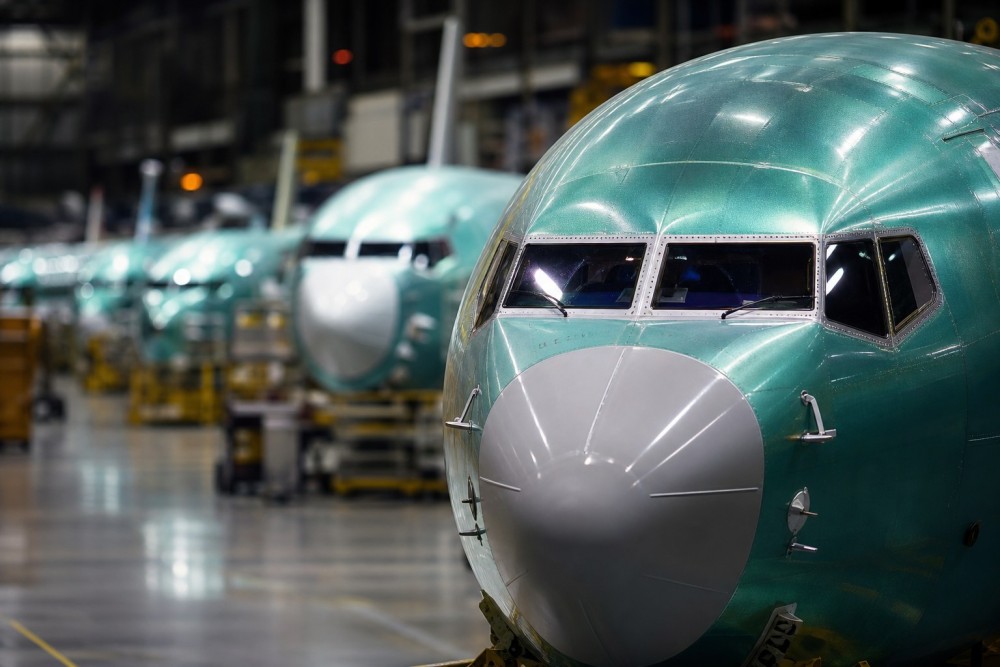
737 MAX production is moving from 42 per month to 47 per month this summer. That is the FAA-approved cap rising, not just internal targets pushed by management.
MAX 7 and MAX 10 certification is expected later in 2026, with first deliveries starting in 2027. The FAA has signaled no current roadblocks to that timeline, which removes a major overhang.
787 Dreamliner: stabilizing
The 787 program delivered 15 jets in Q1 and is on track for 90 to 100 deliveries in FY 2026. Production is stabilizing at 8 per month, prepping for 10 per month later this year.
The FAA also approved the 787-9 and 787-10 maximum takeoff weight raise this quarter. That unlocks more payload and range flexibility for airline customers placing fresh orders.
The FCF Inflection Coming in H2 2026
CEO Kelly Ortberg and CFO Jay Malave guided free cash flow positive in H2 2026. The FY 2026 FCF guide is $1B to $3B, per the Boeing IR Q1 release.
That matters because BA has burned cash for most of the past five years running. The transition from cash burn to cash generation is what re-rates a recovery stock in equity markets.
The H2 print is where the market marks this story to model. If FCF lands inside the guide, the multiple typically expands ahead of FY 2027 consensus.
It also unlocks capital return optionality. Buybacks and dividend reinstatement are not on the table yet, but they are back in the conversation.
Three Ways to Position Around BA Now
The Q1 print does not say buy more at any price level. It says the binary risk of "will the recovery actually happen" is now mostly resolved.
What is left is a positioning question, not a thesis question. Below are three paths, each with a different risk and conviction profile.
Add into the H2 FCF print
For investors underweight aerospace, adding before the H2 FCF inflection is the higher-conviction path forward. The catalyst is dated and quantified, which is rare in this space.
Sizing matters more than timing, similar to the mega-cap reposition framework. A staged add across the next two earnings prints reduces the risk of buying a bad headline at peak enthusiasm.
Hold and watch the MAX 7/10 cert
For existing BA holders, the simplest path is to hold and let the MAX 7 and MAX 10 certification news compound the position. Each FAA milestone tightens the 2027 delivery story.
Take partial profit only if BA has become an outsized share of your portfolio. The recovery still has multiple legs left to play out across 2026 and 2027.
Risks That Could Slow the Recovery
Supply chain remains the biggest swing factor for the recovery cadence. Engine and fuselage suppliers have to ramp in lockstep, and any single bottleneck pushes deliveries to the right.
FAA delays on MAX 7 or MAX 10 certification would push first deliveries past 2027. That would not break the recovery thesis, but it would compress the FCF curve materially.
A macro demand soft patch is the other watch item, similar to repositioning ahead of the June FOMC. Airlines order long-cycle equipment, but cancellations or deferrals would slow backlog conversion into revenue.
Defense execution is a smaller but real risk. Fixed-price programs have caused charges before, and any new charge would distort an otherwise clean recovery narrative.
Conclusion
The Q1 2026 print confirmed what BA bulls have been pricing in for the last two quarters. Revenue is growing, deliveries are scaling, and the backlog is at record levels.
The decision now is about position sizing, not directional conviction. Add into the H2 FCF inflection, hold through MAX 7/10 certification, or take partial profit if BA is oversized in your book.
If you want to act on this view, you can trade BA through Gotrade. Trade US stocks from $1 with fractional shares, so you can size exposure to your conviction without overcommitting capital.
FAQ
Did Boeing beat Q1 2026 estimates? Boeing posted $22.22B revenue, +14% YoY, and a smaller-than-expected non-GAAP loss of $0.20 per share.
When does Boeing's free cash flow turn positive? Management guided FCF positive in H2 2026, with FY 2026 FCF in the $1B to $3B range.
What is the status of MAX 7 and MAX 10 certification? Certification is expected later in 2026, with first deliveries starting in 2027 and no current FAA roadblocks.
Should I add, hold, or take profit on BA? The cleanest framework is add into the H2 FCF print, hold through MAX 7/10 certification, or take partial profit only if BA is oversized in your portfolio.